
Selecting the right thermal camera for a drone depends on three primary variables: sensor resolution (lower-cost 160×120 for basic surveys versus 640×512 for detailed industrial inspections), thermal sensitivity (NETD — lower is more sensitive, target below 50mK for professional work), and integration with your specific drone platform. In India, certified professional-grade drone thermal cameras range from ₹2 lakh for entry-level radiometric cameras to ₹18+ lakh for high-resolution FLIR systems.
A Bengaluru-based inspection firm recently faced a costly lesson: purchasing a 160×120 pixel thermal camera at ₹1.8 lakh for solar panel inspection work, then discovering minimum resolution requirements of 320×256 per IEC 62446-3 for bankable solar inspection reports. The replacement cost was ₹6.5 lakh, plus ₹3 lakh in lost contracts. Matching camera specifications to application requirements from the outset prevents expensive re-purchasing.
In India, import duties and GST on professional thermal cameras add 28–38% to international pricing, making total landed cost a critical budget consideration. FLIR Systems, DJI (Zenmuse XT2/H20T), and Autel Robotics dominate the professional drone thermal camera market in India, with growing availability of locally-supported products through authorised distributors in Bengaluru, Mumbai, and Delhi.
For building/roof surveys: 320×256 resolution, NETD <80mK is sufficient. For electrical inspections: 640×512, NETD <50mK required. For solar farm surveys: 640×512 with radiometric capability (per IEC 62446-3). Industrial process monitoring: 640×512 minimum with temperature range to 550°C or higher. Budget ₹4–15 lakh for professional-grade equipment.
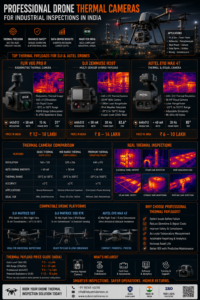
FLIR Vue Pro R 640 thermal camera integrated with DJI Matrice 300 RTK drone — a common professional configuration for Indian industrial thermography surveys, priced approximately ₹14–18 lakh combined.
Key Takeaways
- Thermal cameras come in different types, including uncooled, cooled, and microbolometer cameras, each with its own advantages and limitations.
- When considering drone compatibility, it’s important to ensure that the thermal camera is lightweight and has the necessary mounting options for the specific drone model.
- Thermal resolution and accuracy are crucial factors to consider when evaluating the quality of thermal imaging, as they determine the level of detail and precision in the captured images.
- Assessing the range and field of view of a thermal camera is essential for determining its suitability for different applications, such as search and rescue or surveillance.
- When examining image and video capture capabilities, it’s important to consider factors such as frame rate, image enhancement features, and the ability to record and stream footage in real-time.
- Budget and cost considerations should be factored in when choosing a thermal camera, as different types and models vary widely in price.
- Researching additional features and accessories, such as image analysis software, lens options, and mounting hardware, can help enhance the functionality and versatility of a thermal camera system.
Considerations for Drone Compatibility
Compatibility with Your Drone Model
Not all thermal cameras are compatible with all drones, so it’s crucial to ensure that the camera you choose is compatible with your drone’s mounting system and payload capacity. Some drones may require a specific mounting bracket or adapter to attach a thermal camera, so it’s important to check the compatibility requirements before making a purchase.
Weight and Size Considerations
The weight and size of the thermal camera are also important considerations. Drones have payload limitations, so it’s essential to select a thermal camera that is lightweight and compact enough to be carried by your drone without affecting its performance or flight time. Additionally, some drones may have specific power requirements for attaching a thermal camera, so it’s important to ensure that the camera’s power consumption is compatible with your drone’s power system.
Communication Interface Compatibility
The communication interface of the thermal camera is another critical factor to consider. Some drones may require a specific communication protocol or interface to integrate a thermal camera with their onboard systems. Understanding the compatibility requirements for your drone can help you select a thermal camera that seamlessly integrates with your drone’s existing hardware and software.
Evaluating Thermal Resolution and Accuracy
Thermal resolution and accuracy are crucial factors to consider when choosing a thermal camera for your drone. The resolution of a thermal camera refers to the number of pixels it can capture, which directly impacts the level of detail and clarity in the thermal images. Higher resolution cameras can capture more detailed thermal images, making them ideal for applications that require precise temperature measurements and analysis.
In addition to resolution, it is important to evaluate the accuracy of the thermal camera. The accuracy of a thermal camera refers to its ability to measure temperature with precision. Higher accuracy cameras provide more reliable temperature measurements, which is essential for applications such as building inspections, electrical maintenance, and industrial monitoring.
It is also important to consider the thermal sensitivity of the camera, which determines its ability to detect small temperature differences. Cameras with higher sensitivity can detect subtle temperature variations, making them suitable for applications that require precise temperature measurement and analysis. Evaluating the thermal resolution, accuracy, and sensitivity of a thermal camera can help you select a camera that meets your specific requirements for drone-based thermal imaging.
According to IEC 62446-3 (the international standard adopted by Indian solar developers for PV inspection), thermal cameras for bankable solar plant inspection reports must have minimum 320×256 pixel resolution and NETD below 80mK. Equipment not meeting these specifications cannot produce reports accepted by project financiers — relevant for India’s 73GW+ installed solar capacity requiring periodic inspection.
What IEC 62446-3 Requires for Solar Inspection
- Thermal resolution: minimum 320×240 pixels for Level 1. Level 2 (which Elion provides) requires 640×512 pixels
- NETD: below 80mK for Level 1, below 50mK for Level 2. Lower NETD means smaller temperature differences are detectable — critical for early-stage PID and mild soiling
- Pixel pitch: 17 microns standard on professional inspection cameras
- Calibration: camera must be calibrated within 12 months of use. Calibration certificates must be available on request
- Radiometric recording: camera must save radiometric data — actual temperature values, not just visual images — for post-processing and report generation
What Changes for Transmission Line Inspection
- Focal length: a standard 9mm to 13mm lens suits solar inspection. For transmission lines, a 25mm to 35mm telephoto lens is needed to achieve sufficient spatial resolution on conductor components at safe standoff distance from live conductors
- Spatial resolution on target: you need at least 3×3 pixels on the smallest target component to detect thermal anomalies reliably
- EMIF protection: for 765kV corridor inspections, camera electronics should be shielded from electromagnetic interference from the line field
Elion’s Equipment Specification
| Parameter | Elion Standard Solar | Elion Standard Transmission |
| Thermal resolution | 640×512 pixels | 640×512 pixels |
| NETD | Below 50mK | Below 50mK |
| Lens (thermal) | 13mm standard field of view | 25 to 35mm telephoto |
| Radiometric format | RJPEG radiometric JPEG | RJPEG |
| RGB camera | Simultaneous 12MP minimum | Simultaneous 20MP minimum |
| Calibration | Annual, certificate available on request | Annual, certificate available on request |
| Drone platform | Multi-rotor, 35 min flight time minimum | Fixed-wing or multi-rotor per corridor length |
Assessing the Range and Field of View
The range and field of view of a thermal camera are important considerations when selecting a camera for drone-based thermal imaging. The range of a thermal camera refers to the maximum distance at which it can detect and capture thermal images. Cameras with longer range capabilities are ideal for applications such as search and rescue, surveillance, and wildlife monitoring, where long-distance thermal imaging is required.
The field of view of a thermal camera refers to the area that the camera can capture in a single frame. Cameras with wider field of view are suitable for applications that require capturing large areas or conducting panoramic thermal surveys. Understanding the range and field of view capabilities of a thermal camera can help you select a camera that meets your specific requirements for drone-based thermal imaging.
It is also important to consider the zoom capabilities of the thermal camera. Some cameras offer digital zoom, while others offer optical zoom or a combination of both. Cameras with zoom capabilities provide greater flexibility in capturing thermal images at different distances and magnifications, making them suitable for various applications such as inspection, surveillance, and monitoring.
Furthermore, it is important to consider the refresh rate of the thermal camera, which determines how quickly it can capture and display thermal images. Cameras with higher refresh rates provide smoother and more responsive thermal imaging, making them ideal for applications that require real-time monitoring and analysis. Assessing the range, field of view, zoom capabilities, and refresh rate of a thermal camera can help you select a camera that meets your specific requirements for drone-based thermal imaging.
know more about – From Drones to AI: How Emerging Technologies are Transforming Energy Audits
Examining Image and Video Capture Capabilities
When selecting a thermal camera for your drone, it is important to examine its image and video capture capabilities. The ability to capture high-quality thermal images and videos is essential for conducting effective aerial inspections, surveys, and monitoring tasks. It is important to consider the resolution and format of the captured images and videos, as well as the storage options available for saving and transferring the data.
Some thermal cameras offer built-in storage options such as onboard memory or removable storage media such as SD cards. Others may offer wireless connectivity options for streaming live thermal video feed to a ground station or mobile device. Understanding the image and video capture capabilities of a thermal camera can help you select a camera that meets your specific requirements for capturing and recording thermal data during drone flights.
In addition to image and video capture capabilities, it is important to consider the integration options for the captured data with other software or systems. Some thermal cameras offer compatibility with third-party software for processing and analyzing captured thermal data, while others may offer proprietary software solutions for data management and analysis. Examining the integration options for captured data can help you select a thermal camera that seamlessly integrates with your existing workflow and data analysis tools.
Furthermore, it is important to consider any additional features such as image enhancement modes, image stabilization, or automatic target tracking that may enhance the image and video capture capabilities of the thermal camera. Examining these features can help you select a camera that offers advanced capabilities for capturing high-quality thermal images and videos during drone flights.
Factoring in Budget and Cost
Establishing a Budget and Identifying Key Features
To make an informed decision, establish a budget for your thermal imaging needs and identify the essential features and capabilities required for your specific applications.
Additional Costs and Ongoing Expenses
In addition to the initial purchase cost, consider any additional expenses such as accessories, mounting hardware, software licenses, or training required for integrating the camera with your drone and workflow. Ongoing maintenance or support costs, like calibration services or warranty coverage, should also be factored in.
Evaluating Value and Financing Options
A higher-priced thermal camera with advanced features may offer greater value in terms of improved efficiency, accuracy, and reliability. Evaluate the return on investment (ROI) potential of the thermal camera based on its capabilities and performance in meeting your specific requirements. Additionally, consider financing options or leasing programs that may be available to acquire a thermal camera within your budget constraints.
Researching Additional Features and Accessories
In addition to the core features and capabilities of a thermal camera, it is important to research any additional features and accessories that may enhance its performance and usability for drone-based thermal imaging. Some thermal cameras offer advanced features such as radiometric measurement capabilities, temperature alarms, or image fusion modes that can provide greater flexibility in capturing and analyzing thermal data during drone flights. It is also important to consider any accessories such as lens options, filters, or protective enclosures that may be available for customizing the thermal camera to meet specific application requirements.
Some accessories may enhance the durability, versatility, or functionality of the thermal camera for conducting aerial inspections, surveys, or monitoring tasks in challenging environments or conditions. Furthermore, it is important to research any software options or firmware updates that may be available for enhancing the performance or expanding the capabilities of the thermal camera. Some manufacturers offer regular updates or support services for their thermal cameras to ensure compatibility with new drone models or software platforms.
It is also important to consider any training or certification programs that may be available for learning how to effectively operate and utilize the features of the thermal camera for conducting aerial inspections or surveys. Researching additional features and accessories can help you select a thermal camera that offers comprehensive capabilities for meeting your specific requirements for drone-based thermal imaging. In conclusion, selecting a thermal camera for drone-based imaging requires careful consideration of various factors such as the type of camera, compatibility with your drone model, resolution and accuracy capabilities, range and field of view specifications, image and video capture capabilities, budget constraints, as well as additional features and accessories that may enhance its performance.
By understanding these factors and conducting thorough research on available options, you can make an informed decision when selecting a thermal camera that meets your specific requirements for conducting effective aerial inspections, surveys, or monitoring tasks with your drone.
If you are interested in learning more about the importance of energy audits and how they can benefit your business, check out The Ultimate Guide to Energy Audits: Why They Matter.
FAQs
What is a thermal camera for a drone?
A thermal camera for a drone is a specialized camera that captures infrared radiation to create images based on the temperature differences of objects and surfaces. These cameras are commonly used for applications such as search and rescue, building inspections, agriculture, and wildlife monitoring.
What are the key factors to consider when selecting a thermal camera for a drone?
When selecting a thermal camera for a drone, key factors to consider include the camera’s thermal resolution, frame rate, weight, size, compatibility with the drone, and the specific application or use case.
What is thermal resolution and why is it important in a thermal camera for a drone?
Thermal resolution refers to the ability of a thermal camera to detect and display small temperature differences. It is important in a thermal camera for a drone as higher thermal resolution allows for more detailed and accurate thermal imaging, which is crucial for many applications such as building inspections and search and rescue operations.
What are some common applications for thermal cameras on drones?
Common applications for thermal cameras on drones include search and rescue operations, building inspections, agricultural monitoring, wildlife surveys, and infrastructure inspections. Thermal cameras on drones are also used for firefighting, law enforcement, and environmental monitoring.
What are some popular brands of thermal cameras for drones?
Some popular brands of thermal cameras for drones include FLIR Systems, DJI, TeAx Technology, Workswell, and Xenics. These brands offer a range of thermal cameras designed specifically for drone use, with various features and capabilities to suit different applications.