
Training Coordinator, Industrial Paint Manufacturer
“The safety induction for new hires was handled smoothly. Elion brought their own AV equipment and kept the session engaging. We’re thinking of repeating this monthly.”

And Consulting Private Limited

And Consulting Private Limited
ETAP Studies involve using ETAP (Electrical Transient Analyzer Program) software to simulate and analyze your facility’s electrical power system for safety, reliability, and regulatory compliance.
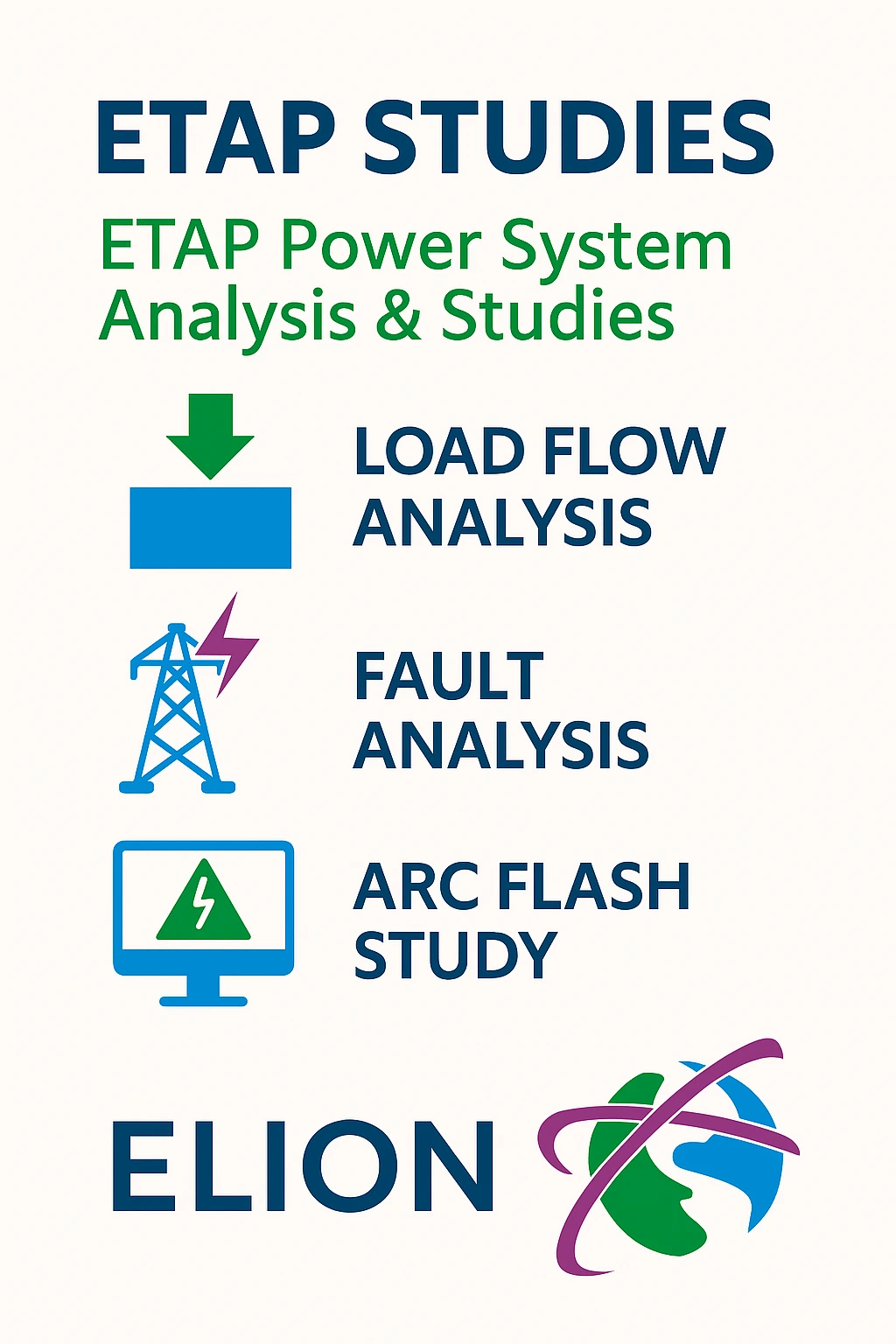
ETAP allows comprehensive power system analysis covering load flow, short circuit, relay coordination, arc flash hazard analysis, motor starting studies, harmonic analysis, and transient stability studies to optimize your electrical network.
Elion offers professional ETAP Studies across India, helping industries improve system performance while ensuring safety and compliance with IS, IEC, IEEE, and CEA regulations.
ETAP Studies are detailed electrical power system analysis services performed using ETAP (Electrical Transient Analyzer Program) software to simulate, evaluate, and optimise the performance of an electrical network.
In simple terms, ETAP creates a digital model of your entire electrical system — including transformers, generators, panels, cables, motors, and protection devices — to analyse how the system behaves under normal and fault conditions. These studies help improve safety, reliability, system stability, and regulatory compliance while preventing costly electrical failures.
Optimize your facility’s electrical safety and reliability with Elion’s ETAP Studies and power system analysis services.
.Request a Quote or contact us at [email protected].
“The safety induction for new hires was handled smoothly. Elion brought their own AV equipment and kept the session engaging. We’re thinking of repeating this monthly.”
“Good response from our team for the chemical spill drill and awareness session. We had a minor leak last year and this training was timely. They even explained the MSDS sheet details clearly.”
“Elion conducted ergonomics training for our office support staff. They gave tips that don’t need any budget—just posture, breaks, and seating angles. Everyone found it useful.”
“Warehouse safety training was organized at our distribution center. The module covered stacking, material flow, and emergency handling. One or two team leads found the content basic, but the newcomers appreciated it.”
“The hot work and gas cutting safety training helped us address some recent near-misses. Our fabrication contractors said it was the first time anyone explained why permits matter, not just how to fill them.”
“We held a training on ergonomics and workstation safety. Elion’s speaker had a practical approach—suggested small furniture changes and posture tips that didn’t cost much but helped our office staff.”
“Elion covered cold storage safety and ammonia handling well. Some of our technicians said it was the first time they understood how to respond to leaks. We may request them for a follow-up drill.”
“Our garment unit required machine safety awareness for new joiners. Elion kept it interactive and used visuals from our own plant, which the workers related to.”
“The crane and material handling training helped reduce near misses in our yard. The trainer also gave tips that were not in the slides, based on their field experience. That made a difference.”
“We requested a training module on emergency evacuation procedures. Elion included site-specific examples which helped. The mock drill later was well-coordinated too. Our fire wardens felt more confident after the session.”
Simulation and analysis of electrical systems using ETAP software.
Load flow, short circuit, relay coordination, arc flash, and harmonic analysis.
They enhance safety, reliability, and compliance of electrical systems.
Yes, to identify voltage drops and optimize loading.
Yes, for fault level calculation.
Calculation of relay settings to ensure selective protection.
Yes, including incident energy calculation and PPE labeling.
SLDs, equipment ratings, relay data, and operational data.
They support compliance with CEA and safety regulations.
Every 3-5 years or after major system changes.
ETAP studies help identify potential electrical risks such as overloads, short circuits, improper protection coordination, and arc flash hazards before they cause real damage or downtime.
In many industrial projects, ETAP studies are required for regulatory compliance, electrical safety audits, insurance approvals, and major project commissioning.
Typical studies include:
Each study addresses specific operational and safety concerns.
ETAP studies are recommended:
During new plant design or expansion
Before commissioning
After major load additions
When frequent electrical faults occur
For safety compliance updates
You will receive a comprehensive technical report including system modeling results, fault calculations, risk assessment, protection recommendations, and compliance references.
An electrical audit identifies visible issues and inefficiencies, while ETAP provides detailed simulation-based analysis of system performance and fault behavior.
Fields marked with an asterisk (*) are required
Industrial safety audits are an essential part of maintaining a safe and healthy work environment for employees. These audits involve a comprehensive review of the workplace to identify potential hazards and ensure that all safety protocols and regulations are being followed. The goal of an industrial safety audit is to…
ISO 45001 is an international standard for occupational health and safety management systems. It provides a framework for organizations to improve employee safety, reduce workplace accidents, and ensure compliance with legal and regulatory requirements. ISO 45001 safety training is essential for organizations looking to implement and maintain an effective occupational…
Safety training for engineers is of utmost importance in ensuring the well-being of both the workers and the community at large. Engineers are responsible for designing, constructing, and maintaining various structures and systems that have the potential to impact public safety. Without proper safety training, engineers may overlook critical safety…
Gender-driven safety audits are a crucial tool in empowering women in the workplace. These audits are designed to specifically address the unique safety concerns and challenges that women face in their work environments. By conducting gender-driven safety audits, organizations can identify and address potential hazards and risks that may disproportionately…
Safety training in the workplace is a critical component of organizational success and employee well-being. It serves as a proactive measure to prevent accidents, injuries, and fatalities, which can have devastating effects not only on individuals but also on the overall productivity and morale of a company. By equipping employees…
Safety policy implementation is crucial for any organization, regardless of its size or industry. A comprehensive safety policy helps to create a safe and healthy work environment for employees, reduces the risk of accidents and injuries, and ensures compliance with legal and regulatory requirements. By implementing a safety policy, organizations…
Cement factories are critical components of the construction industry, providing the essential material for building infrastructure, homes, and commercial properties. However, the production of cement involves complex processes that can pose significant risks to workers if not managed properly. Therefore, training in cement factories is not merely a regulatory requirement;…
In today’s dynamic work environment, the significance of customized safety training cannot be overstated. Traditional, one-size-fits-all training programs often fail to address the specific risks and challenges faced by individual teams. Customized safety training is designed to meet the unique needs of a workforce, ensuring that employees are not only…
Road safety training is an essential aspect of ensuring the safety of all road users, including pedestrians, cyclists, and motorists. It is crucial to educate individuals on the importance of following traffic rules and regulations, understanding road signs, and practicing safe driving behaviors. By providing comprehensive road safety training, individuals…
Fire safety training is a critical component in the textile manufacturing industry, where the combination of flammable materials, machinery, and human activity creates a heightened risk for fire incidents. The textile sector is characterized by its use of various combustible materials, such as cotton, polyester, and other synthetic fibers, which…