
Home › Fire Audit > Fire Pump Testing
Fire Pump Testing · NFPA 25 · NFPA 20 · IS 12469 · OISD · NBC 2016
Fire Pump Testing Service
Fire pump testing verifies that your fire protection system’s pump can deliver the required flow and pressure when needed — tested per NFPA 20 (pump installation) and NFPA 25 (inspection, testing, and maintenance). Elion performs churn, rated flow, and overload tests and delivers a compliance report — trusted since 2010 across 30,000+ audits.
NABL-Calibrated Flow & Pressure Instruments
NFPA 25 ITM Methodology
IS 12469 Curve Benchmarking
Certified Fire Engineers
Diesel & Electric Pump Testing
Residential Complexes
Pan-India Execution
Four-Tier ITM Schedule · NFPA 25 Chapter 8
Fire Pump Testing Regime
A fire pump that is installed correctly is not guaranteed to perform when called. After handover, only a structured inspection, testing and maintenance (ITM) programme keeps the pump in a ready state. NFPA 25 prescribes four testing intervals, each verifying a different aspect of readiness. Elion executes any single tier or the complete annual programme, and reconciles findings against the duty point recorded at acceptance.
Weekly / Monthly
No-Flow (Churn) Test
The pump is started automatically by simulating a pressure drop on the sensing line and run at shut-off — electric pumps for a minimum of 10 minutes, diesel for 30 minutes. We verify automatic start, circulation relief valve discharge, packing gland leakage, bearing condition and suction/discharge pressures. Weekly frequency applies to vertical turbine pumps, limited-service controllers and pumps drawing from non-pressurised sources.
Monthly
Condition & Controller Checks
Visual and operational inspection of the pump room environment, suction and system pressures, controller status and selector position, valve alignment, diesel fuel level, battery condition and jacket water heater operation. Deficiencies that would prevent automatic start are flagged before they cause a silent failure.
Annual
Full-Flow Performance Test
The defining test: flow and pressure are measured at three operating points — churn (zero flow), 100% of rated capacity and 150% of rated capacity — and plotted against the manufacturer’s certified pump curve and acceptance baseline. This is the only test that proves the pump can still deliver rated head at peak demand and exposes degraded impellers, suction obstructions or closed valves.
Every 3 Years
Comprehensive Flow Verification
Where a closed-loop flow meter is used for the annual test, NFPA 25 requires the pump to be flow-tested through actual discharge devices (hose streams or test header) at least every three years to confirm the meter’s accuracy and the integrity of the suction supply under genuine draw-down conditions.
What's Include
What Does Fire Pump Testing Include?
– Churn test (no-flow condition) — confirms pump starts and runs correctly
– Rated flow test — confirms pump delivers rated capacity at rated pressure
– Peak/overload test — confirms performance at 150% of rated flow
– Visual inspection of pump, controller, and associated components
– Weekly/monthly/annual test schedule review against NFPA 25 requirements
Costing
Factors That Decide Fire Pump Testing Cost in India
Cost depends on: number of fire pumps on site, pump capacity and type (electric vs. diesel-driven), and whether testing is a one-time assessment or an ongoing annual programme. Request a fixed-fee quote with your facility details.
Annual Performance Test · Execution Protocol
Annual Fire Pump Test Procedure
Every annual performance test follows a defined eight-phase protocol with specific inputs, instrument readings and outputs at each stage. The protocol is applied consistently across electric and diesel pump sets so that results are repeatable, defensible and directly comparable year-on-year.
1
Pre-Test Review & Isolation Planning
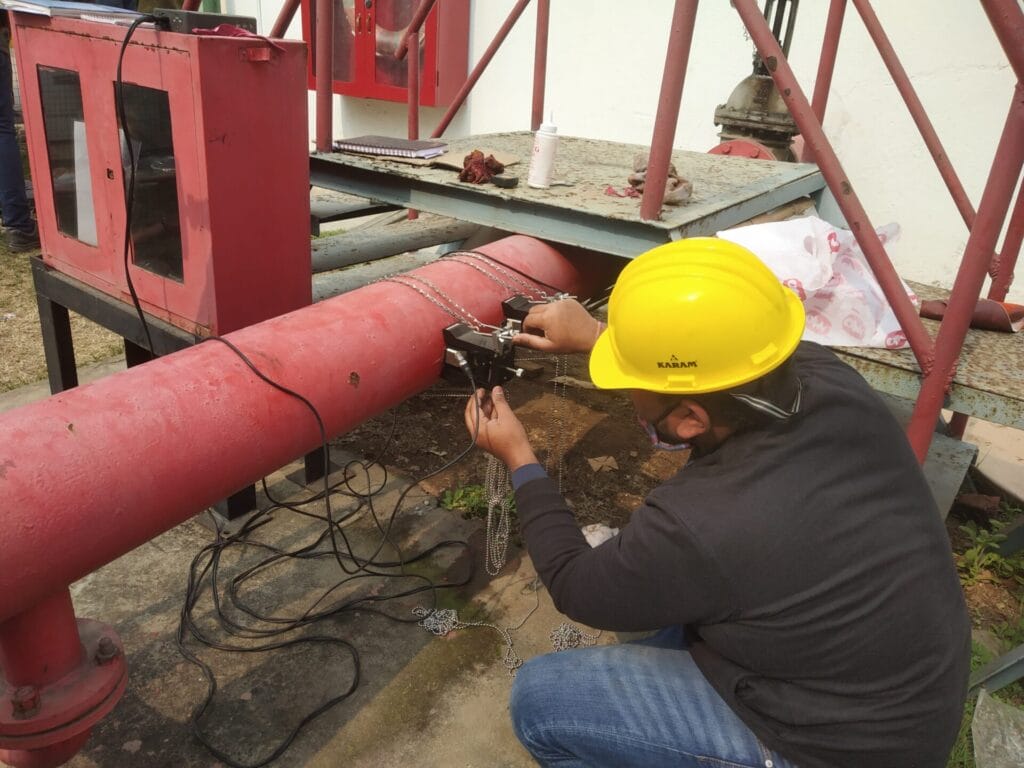
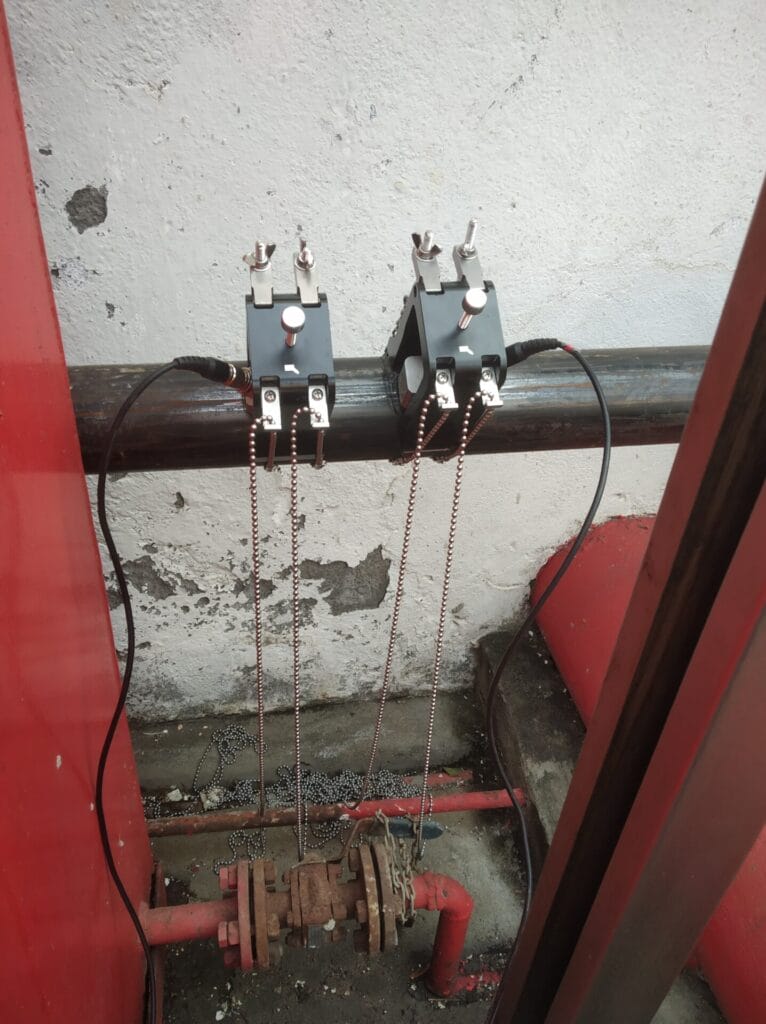
We review the pump nameplate, manufacturer pump curve, acceptance test report, prior annual results and the system schematic. An isolation and coverage plan is agreed with the facility so fire protection is maintained — standby pump on auto, test bypass confirmed, and the discharge path (test header, closed-loop meter, clamp-on ultrasonic on the discharge pipeline, or hydrant outlets) selected.
2
No-Flow (Churn) Reading
With no water flowing, the pump is auto-started via a sensing-line pressure drop. We record shut-off (churn) pressure, confirm it is within design limit, observe the circulation relief valve discharging to prevent overheating, and set the packing gland to a light drip. Suction pressure and time-to-start are logged.
3
100% Rated Capacity Point
Flow is progressively opened to the pump's rated discharge. Suction pressure, discharge pressure, net pressure, flow rate and pump speed (rpm) are recorded simultaneously. Net pressure at rated flow is compared against 95% of the certified curve value — the primary acceptance check.
4
150% Peak Capacity Point
Flow is increased to 150% of rated capacity to load the pump to its design extreme. Per NFPA 20 and IS 12469 the net head at this point must be at least 65% of rated head. Suction behaviour is watched closely here — a collapsing suction pressure reveals an inadequate water supply or obstruction that is invisible at lower flows.
5
Diesel Engine Parameter Run
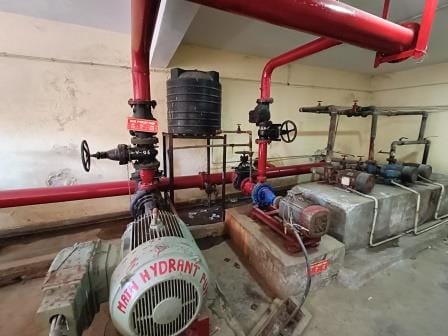
For diesel-driven pumps we log oil pressure, rated speed, coolant and exhaust temperatures, exhaust back-pressure, fuel consumption and governor response across the run, and verify the battery crank on each bank independently. The overspeed shutdown device is function-tested annually and reset.
6
Controller, Transfer & Alarm Verification
We record cut-in and cut-out pressure switch settings, confirm the minimum-run timer and weekly auto-test, function-test the automatic transfer switch between normal and alternate supply (where provided), and verify each alarm signal — pump running, loss of phase, phase reversal, engine fail-to-start, low oil and high temperature.
7
Curve Plotting & Degradation Analysis
The three measured points are plotted and overlaid on the manufacturer's certified curve and the previous annual test. Performance is classified against the 95% acceptance band, and any drop exceeding 5% from acceptance or prior results is identified as a degradation trend requiring investigation — long before the pump fails outright.
8
Reporting & Compliance Register
The lead engineer prepares the report, reviewed by a senior engineer before issue. Each deficiency is clause-referenced and risk-classified, and a standalone compliance action register lists every item with recommended corrective action and a closure-tracking field — formatted for Fire NOC renewal and insurance surveyor review.
Pass / Fail Benchmarks · NFPA 20 · NFPA 25 · IS 12469
Fire Pump Performance Acceptance Criteria
A fire pump test is only meaningful against defined acceptance limits. A pump that starts and makes pressure at the gauge can still be non-compliant. Elion classifies every result against the following benchmarks, each tied to a specific standard clause rather than opinion.
≥ 95%
Of certified curve at rated & peak flow
NFPA 25 — measured net pressure must be within 95% of the manufacturer’s pump curve / nameplate value to be acceptable.
≥ 65%
Of rated head at 150% flow
NFPA 20 & IS 12469 — centrifugal fire pump design requirement at peak (150%) capacity.
≤ 140% / 120%
Churn (shut-off) pressure limit
≤ 140% of rated head for horizontal split-case pumps (NFPA 20); ≤ 120% under IS 12469 — verifying the pump is correctly matched and not over-pressurising the system at no flow.
< 5%
Allowable degradation
A drop greater than 5% from the acceptance test or previous annual test triggers mandatory investigation — the early warning of impeller wear or suction loss.
Total Head / Pressure
Flow Rate (% of rated capacity)
Annual test points plotted against the certified pump curve and the 95% acceptance band — the analysis Elion delivers in every report.
Codes · Standards · Regulations
Standards & Compliance Framework
Every finding in an Elion fire pump report is referenced to a specific clause. The applicable set is determined by pump type, building occupancy, water source and regulatory jurisdiction — combining international ITM standards with Indian statutory and insurance requirements.
NFPA 25
ITM of Water-Based Systems
Chapter 8 — inspection, testing and maintenance frequencies, the four test tiers, and the 95% performance acceptance criterion.
NFPA 20
Stationary Fire Pump Design
Design and acceptance basis — rated/150% head relationship, churn limit, and the certified pump curve the annual test is measured against.
NFPA 70 · Art. 695
Electric Pump Power Supply
National Electrical Code Article 695 — dedicated power supply, transfer switch and circuit requirements for electric motor driven fire pumps, verified during controller and ATS testing.
NFPA 72
Pump Status Signalling
Fire alarm and signalling code — supervision of pump running, loss of phase and trouble signals reported from the controller to the fire alarm system.
IS 12469
Centrifugal Fire Pumps
Indian specification for fire pump duty, the 65% head at 150% flow requirement, and the 120% shut-off head limit.
IS 15301 / 3844 / 13039
Installation & Hydrant Codes
Layout, internal hydrant/hose reel, and external hydrant maintenance codes governing the wider fire-water network the pump serves.
NBC 2016 — Part 4
Fire & Life Safety
Occupancy- and height-specific pump capacity and pressure benchmarks — main, standby diesel, jockey and terrace pump duties.
OISD
Oil & Gas Sector
OISD-STD-116 and OISD-STD-117 (fire-water system and pump capacity for refineries, depots, terminals and pipeline installations) and OISD-STD-142 (inspection and testing of fire fighting equipment) — applied for petroleum and hydrocarbon facilities.
TAC / IRDAI
Fire Protection Manual
Insurance documentation expectations — pump test records required by surveyors for property fire-policy compliance and renewal.
State Fire NOC
Statutory Compliance
Delhi Fire Service Act, Maharashtra Fire Prevention & Life Safety Measures Act and equivalent State rules requiring periodic certified testing.
ISO 9001:2015
Quality-Governed Output
Elion’s report review and corrective-action procedures are governed by an ISO 9001:2015 quality management system.
NABL
Instrument Traceability
All flow, pressure and speed instruments are calibrated against NABL-accredited reference standards with certificates available for review.
NABL-Calibrated · Traceable Evidence
Instrumentation & Measurement
Instrument-based measurement is what separates a genuine performance test from a visual check. Qualitative observations are supported by quantified data benchmarked against standard limits, producing evidence that withstands regulatory and insurance scrutiny.
Flow
Flow Metering — Method per Site
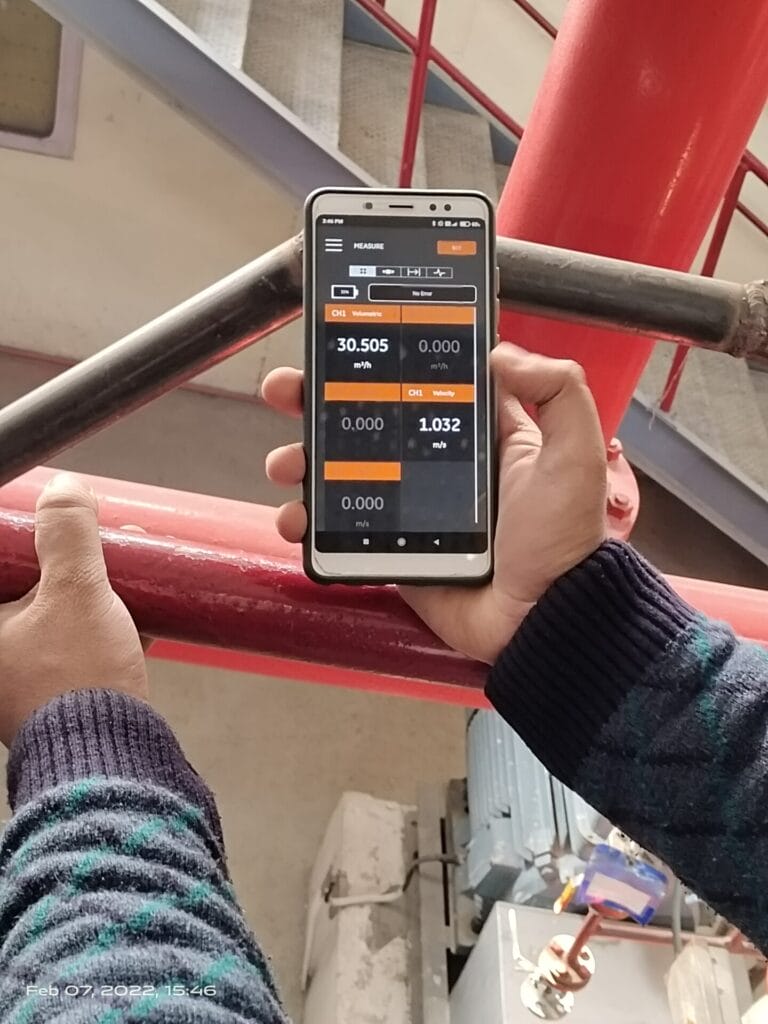
Where an in-line flow meter or test header exists, it is used directly. Where the installation has neither — or pipe configuration prevents it — a non-intrusive clamp-on ultrasonic meter on the discharge pipeline measures flow at churn, 100% and 150%. Pitot readings at hydrant outlets (Q = 29.83 × Cd × d² × √P) provide an independent cross-check.
Pressure
Calibrated Gauges
NABL-calibrated suction and discharge pressure gauges and transducers capture churn, rated and peak readings with serial numbers and calibration dates recorded.
Speed
Tachometer
Optical / contact tachometer verifies actual pump speed against rated rpm — essential for correctly interpreting head readings on diesel sets.
Diesel
Engine Analyser
Oil pressure, coolant and exhaust temperature, back-pressure and battery condition instruments log diesel engine health across the run.
Thermal
Infrared Imaging
Level II/III thermography of motor windings, bearings, couplings and panel terminations identifies thermal anomalies by ΔT per ISO 18434 criteria.
Electrical
Power & Insulation
Clamp meters, insulation resistance and leakage testers assess motor and supply integrity on electric pump sets against IS 732 and IE Rules limits.
Report Structure · Evidence · Compliance
What Elion Delivers
The deliverable package serves facility engineers, management, Fire Service authorities and insurance underwriters simultaneously. Each item is self-contained, evidence-backed and actionable.
1
Plotted Pump Performance Curve
Measured churn / 100% / 150% points overlaid on the certified manufacturer curve and previous annual test, with the 95% acceptance band shown.
2
Flow & Pressure Data Annex
Suction, discharge and net pressure with flow and rpm at every point, each tagged with instrument model and NABL calibration reference.
3
Deficiency Register (Critical / Major / Minor)
Every non-conformance risk-classified by a structured matrix, with Critical items summarised separately for management visibility.
4
Diesel Engine Parameter Log
Oil pressure, speed, temperatures, overspeed trip result and dual-battery crank verification recorded over the full run.
5
Photographic Evidence Register
Site and thermographic images cross-referenced to specific findings, allowing independent verification without a site visit.
6
Clause-Referenced Corrective Action Matrix
Technically specific remediation for each deficiency, citing the breached clause — no generic "repair as required" entries.
7
Executive Summary
Management-level compliance status with Critical/Major/Minor counts, suitable for board and audit-committee reporting.
8
Compliance Statement for NOC & Insurance
Structured to meet State Fire Service and insurance surveyor documentation requirements, with reaudit / closure verification available.
Complete Pump Set Coverage
Fire Pumps We Test
Elion tests the full Indian fire pump set across horizontal split-case and end-suction configurations — as an independent body that supplies, installs and repairs nothing it audits.
Related Compliance Services
Related Case Study
Frequently Asked Questions
1. Which standards govern fire pump testing in India?
Testing is benchmarked against NFPA 25 (inspection, testing and maintenance), NFPA 20 (design and acceptance), IS 12469 (centrifugal fire pump specification), IS 15301 / IS 3844 / IS 13039 (installation and hydrant codes) and NBC 2016 Part 4 for occupancy-specific flow and pressure. Records are also required by the TAC Fire Protection Manual for insurance review and by State Fire Service NOC compliance such as the Delhi Fire Service Act and the Maharashtra Fire Prevention and Life Safety Measures Act.
2. How often must a fire pump be tested?
NFPA 25 prescribes four intervals — a weekly or monthly no-flow (churn) test depending on pump type, monthly condition checks, an annual full-flow performance test, and a three-year verification of flow where a closed-loop meter is used annually. Diesel engine pumps are run weekly for at least 30 minutes; electric pumps for at least 10 minutes.
3. What is the annual fire pump flow test?
It is a full assessment of pump capability. Flow and pressure are measured at three points — no-flow/churn, 100% of rated capacity and 150% of rated capacity — and plotted against the manufacturer’s certified pump curve and the acceptance baseline to reveal degradation, suction problems or closed valves.
4. What are the pass / fail criteria for a fire pump performance test?
The pump is acceptable when net pressures are within 95% of the manufacturer’s curve at rated and peak flow. By design it must deliver at least 65% of rated head at 150% flow, and shut-off (churn) pressure must not exceed the design limit — 140% of rated head for horizontal split-case pumps, or 120% under IS 12469. A drop of more than 5% from acceptance or the previous annual test requires investigation.
5. How is flow measured during a fire pump test?
Either by a closed-loop flow meter on a test line returning to the suction tank, or by pitot gauge readings at a test header or hydrant outlets using the discharge relationship Q = 29.83 × Cd × d² × √P. Suction and discharge pressures are read on NABL-calibrated gauges and speed is verified with a calibrated tachometer.
6. What is a churn (no-flow) test and why does it matter?
A no-flow test confirming the pump starts and operates correctly without water actually being discharged through the system. It confirms automatic start, verifies the circulation relief valve discharges to prevent overheating, checks packing gland leakage, and records suction and discharge pressures and bearing condition.
7. What is checked on a diesel engine fire pump?
Battery condition and crank test on each bank, fuel level and quality, jacket water heater and coolant, lube oil level and pressure, verified rated speed, coolant and exhaust temperatures, exhaust back-pressure, governor response, and the annual overspeed shutdown verification — all logged over a minimum 30-minute run.
8. Will testing disrupt building operations?
The pump is offline only for the duration of the test. Testing is scheduled with the facility team, with standby pumps and isolation arranged to maintain fire protection throughout. Most tests finish within a few hours depending on system size.
9. What does Elion's fire pump test report contain?
The plotted pump curve against the manufacturer baseline, suction and discharge readings at each flow point, a deficiency register with Critical / Major / Minor risk classification, the diesel engine parameter log, a photographic evidence register, a clause-referenced corrective action matrix, an executive summary, and a compliance statement for Fire NOC and insurance submission.
10. Is the report accepted for Fire NOC and insurance?
Yes. Findings are referenced to specific NFPA 25, IS 12469 and NBC clauses, and the report is structured to meet the documentation expected by State Fire Service authorities and insurance surveyors under the TAC Fire Protection Manual.
11. What is fire pump testing?
It’s a set of tests confirming your fire protection system’s pump delivers the required flow and pressure — churn, rated flow, and overload conditions — per NFPA 20 and NFPA 25.
12. How often should fire pump testing be conducted?
NFPA 25 recommends weekly churn (no-flow) tests and an annual full flow test; Elion can align this to your facility’s specific programme.
13. What is a rated flow test?
A test confirming the pump delivers its rated capacity (GPM/LPM) at its rated pressure under real flow conditions.
14. Does fire pump testing disrupt building operations?
Testing is typically scheduled to minimize disruption; flow tests may require brief coordination with building operations depending on discharge arrangement.
15. What happens if a pump fails testing?
Elion identifies the likely cause and recommends corrective action — from maintenance to controller or pump replacement, depending on findings.
16. Is fire pump testing mandatory in India?
Fire protection systems, including pumps, are typically subject to inspection and testing requirements under applicable fire safety regulations and NBC guidance; Elion can confirm what applies to your specific facility.
17. What do I receive after testing?
A report with test results (churn, rated flow, overload as applicable), pass/fail status, and recommendations.
18. What does fire pump testing cost in India?
Cost depends on number of pumps, pump type/capacity, and whether it’s one-time or an ongoing annual programme — request a fixed-fee quote with your details.
Book a Fire Pump Performance Test
Share your facility details, pump type and the standard or NOC requirement you need to meet. Elion’s fire engineering team will review the scope and provide a structured technical proposal. Available for industrial, commercial, healthcare, hospitality and institutional facilities across India.