Training Coordinator, Industrial Paint Manufacturer
“The safety induction for new hires was handled smoothly. Elion brought their own AV equipment and kept the session engaging. We’re thinking of repeating this monthly.”

And Consulting Private Limited
And Consulting Private Limited
PAT testing (Portable Appliance Testing) checks that mains-powered equipment — from office chargers to industrial power tools — is electrically safe to use. Elion combines visual inspection with earth continuity, insulation resistance, and functional testing, then labels each appliance Pass/Fail with a detailed report — trusted since 2010 across 30,000+ audits.
PAT Testing (Portable Appliance Testing) involves the examination and electrical testing of portable appliances to ensure they are safe to use. It is a critical preventive maintenance and safety practice to prevent electrical hazards and ensure compliance with workplace safety standards.
Elion offers professional PAT Testing services across India, using calibrated testing instruments and trained engineers to ensure your appliances meet safety compliance, reduce workplace hazards, and extend appliance life.
Any equipment connected to the mains supply via a plug is generally considered for PAT Testing.
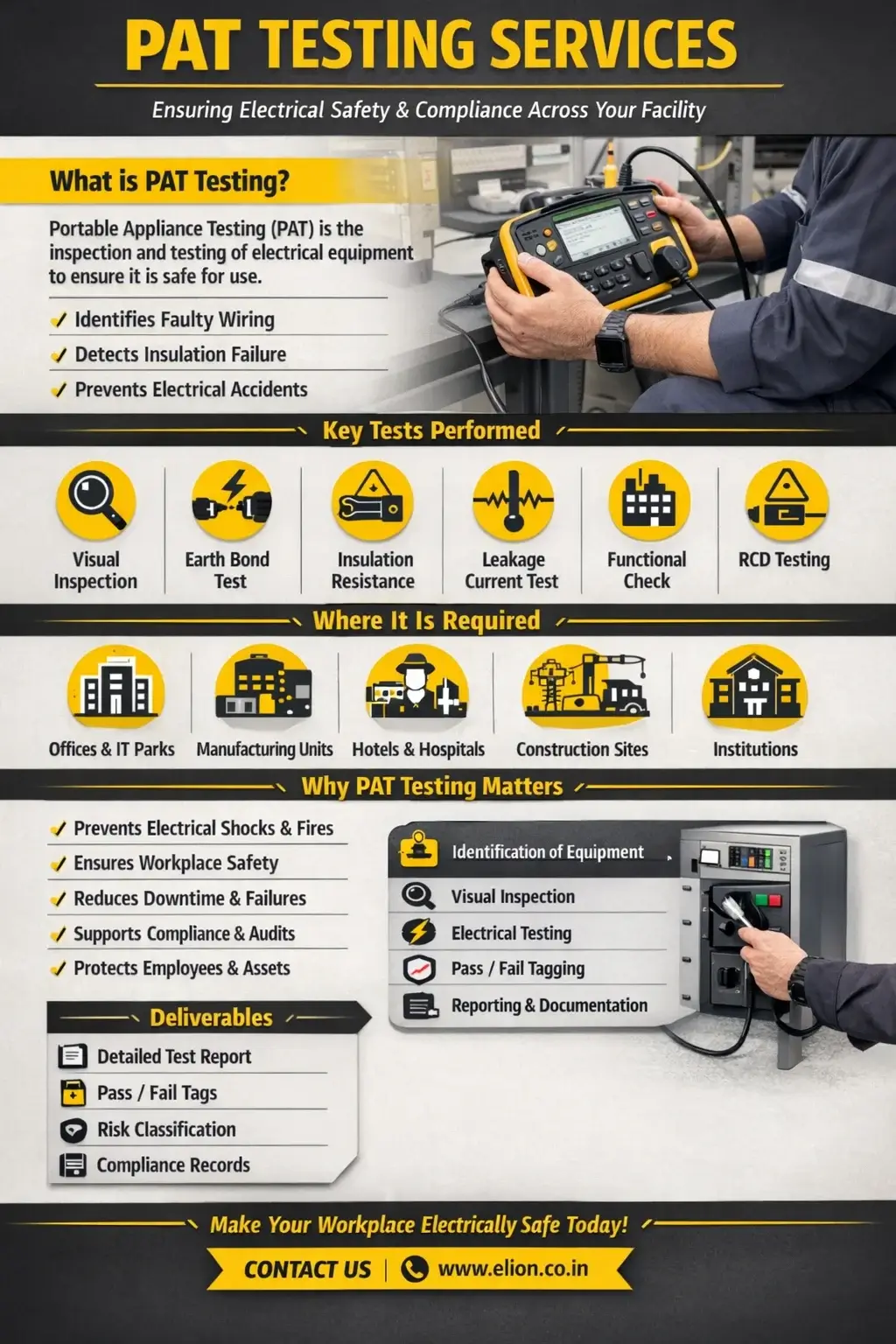
While PAT testing is not governed by a single mandatory Indian standard, it is widely recognised as workplace safety best practice and is often required by insurers, facility certifications, and internal EHS policies. Elion’s testing methodology follows internationally recognised PAT testing practice, adapted for Indian workplace requirements.
Cost depends on: number of appliances to be tested, appliance type/class (Class I vs. Class II equipment test differently), site location, and testing frequency required. Since testing typically takes only 1–2 minutes per appliance, larger inventories are usually priced per-appliance with volume pricing. Request a fixed-fee quote with your appliance count.
Ensure the safety and compliance of your workplace electrical appliances with Elion’s expert PAT Testing services.
Request a Quote or contact us at [email protected].
“The safety induction for new hires was handled smoothly. Elion brought their own AV equipment and kept the session engaging. We’re thinking of repeating this monthly.”
“Good response from our team for the chemical spill drill and awareness session. We had a minor leak last year and this training was timely. They even explained the MSDS sheet details clearly.”
“Elion conducted ergonomics training for our office support staff. They gave tips that don’t need any budget—just posture, breaks, and seating angles. Everyone found it useful.”
“Warehouse safety training was organized at our distribution center. The module covered stacking, material flow, and emergency handling. One or two team leads found the content basic, but the newcomers appreciated it.”
“The hot work and gas cutting safety training helped us address some recent near-misses. Our fabrication contractors said it was the first time anyone explained why permits matter, not just how to fill them.”
“We held a training on ergonomics and workstation safety. Elion’s speaker had a practical approach—suggested small furniture changes and posture tips that didn’t cost much but helped our office staff.”
“Elion covered cold storage safety and ammonia handling well. Some of our technicians said it was the first time they understood how to respond to leaks. We may request them for a follow-up drill.”
“Our garment unit required machine safety awareness for new joiners. Elion kept it interactive and used visuals from our own plant, which the workers related to.”
“The crane and material handling training helped reduce near misses in our yard. The trainer also gave tips that were not in the slides, based on their field experience. That made a difference.”
“We requested a training module on emergency evacuation procedures. Elion included site-specific examples which helped. The mock drill later was well-coordinated too. Our fire wardens felt more confident after the session.”
PAT (Portable Appliance Testing) is a combination of visual inspection and electrical testing to confirm mains-powered equipment is safe to use.
There’s no single mandatory Indian standard, but it’s widely adopted as workplace safety best practice and is often required by insurers or internal EHS policy.
Portable Appliance Testing.
To prevent electrical hazards and ensure compliance.
Annually or based on risk assessments.
Trained professionals with calibrated testing instruments.
Any appliance with a plug connected to the mains.
Yes, including chargers.
Depends on the number of appliances; typically 1–2 minutes per appliance.
Yes, Pass/Fail labels are affixed.
Visual inspection (damage, correct fuses, wiring), earth continuity, insulation resistance, and functional operation.
Typically 1–2 minutes per appliance, depending on equipment type.
Annually is common, though frequency can be adjusted based on a risk assessment of appliance type and usage environment.
Each appliance receives a clear Pass/Fail label along with the next due test date.
Any equipment connected to the mains supply via a plug — from office equipment to industrial power tools.
Yes, any mains-connected charger or portable device falls within PAT testing scope.
A detailed report for each appliance tested, with pass/fail summary and remedial advice for any failed items.
Cost depends on appliance count, type, and location — request a fixed-fee quote with your appliance inventory.
Fields marked with an asterisk (*) are required
Mohali, Punjab has emerged as a hub for call center operations in recent years, with a growing workforce dedicated to providing customer support and sales services to clients around the world. The call center industry in Mohali has seen significant growth due to the availability of a skilled workforce, cost-effective…
Risk assessment is a crucial process for any organization, as it helps to identify potential risks and hazards that could impact the business operations. By conducting a thorough risk assessment, businesses can proactively identify and mitigate potential threats, thereby reducing the likelihood of costly disruptions and ensuring the safety of…
Construction sites are inherently hazardous environments, where the risk of accidents and injuries is significantly higher than in many other industries. The importance of safety training in this context cannot be overstated. Effective safety training equips workers with the knowledge and skills necessary to identify potential hazards, understand safety protocols,…
Gender-driven safety audits are a crucial tool in empowering women in the workplace. These audits are designed to specifically address the unique safety concerns and challenges that women face in their work environments. By conducting gender-driven safety audits, organizations can identify and address potential hazards and risks that may disproportionately…
Elion, a leader in chemical processing, prioritizes safety and preparedness throughout its operations. Recognizing the inherent risks in the industry, the company has implemented comprehensive mock drill training as a fundamental component of its safety protocols. These simulations recreate emergency scenarios under controlled conditions, enabling employees to practice appropriate response…
An on-site emergency plan is a crucial component of any organization’s overall safety and risk management strategy. It is designed to ensure the safety and well-being of employees, visitors, and the public in the event of an emergency or disaster. By having a well-thought-out emergency plan in place, organizations can…
Defensive driver training is a program designed to teach drivers how to anticipate and react to potential hazards on the road. The goal of this training is to reduce the risk of accidents and promote safe driving practices. Defensive driving techniques include maintaining a safe following distance, scanning the road…
Industrial safety audits are an essential part of maintaining a safe and healthy work environment for employees. These audits involve a comprehensive review of the workplace to identify potential hazards and ensure that all safety protocols and regulations are being followed. The goal of an industrial safety audit is to…
The Occupational Safety and Health Administration (OSHA) has established regulations to protect workers from the harmful effects of noise exposure in the workplace. These regulations are designed to prevent hearing loss and other health issues that can result from prolonged exposure to high levels of noise. OSHA’s noise exposure regulations…
Disaster preparedness is crucial for families to ensure their safety and well-being in the event of a natural or man-made disaster. It is essential for families to have a plan in place to protect themselves and their loved ones in case of an emergency. By being prepared, families can minimize…