Training Coordinator, Industrial Paint Manufacturer
“The safety induction for new hires was handled smoothly. Elion brought their own AV equipment and kept the session engaging. We’re thinking of repeating this monthly.”

And Consulting Private Limited
And Consulting Private Limited
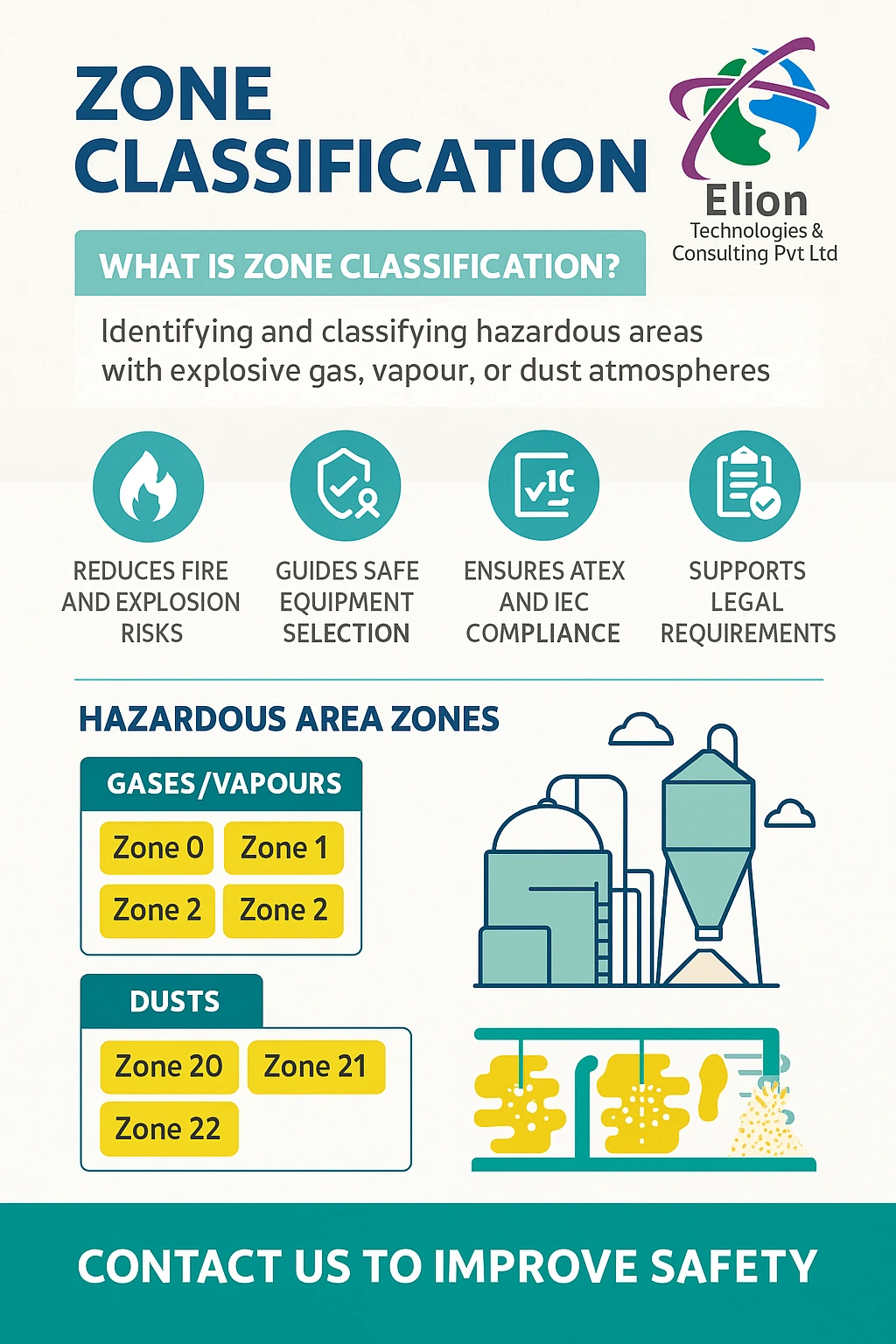
Zone classification identifies and categorizes areas where flammable gases, vapours, or combustible dust may create an explosion risk, so the right electrical and mechanical equipment can be selected. Elion classifies hazardous areas per IS/IEC 60079 and PESO guidelines, delivering classified-area drawings and a compliance report — trusted since 2010 across 30,000+ audits.
Zone Classification involves identifying and classifying areas where flammable gases, vapors, or dust may be present to prevent explosions and ensure operational safety. It is critical for industries like oil & gas, pharmaceuticals, chemical processing, and paint manufacturing.
Elion’s Zone Classification services help you comply with IS/IEC 60079 standards, ATEX directives, and Indian regulatory requirements, ensuring your facility’s safety and regulatory adherence.
| Gas/Vapour Zone | Dust Zone | Description |
|---|---|---|
| Zone 0 | Zone 20 | Explosive atmosphere is present continuously, frequently, or for long periods. |
| Zone 1 | Zone 21 | Explosive atmosphere is likely to occur during normal operation. |
| Zone 2 | Zone 22 | Explosive atmosphere is not likely to occur during normal operation, but if it does occur, it will exist only for a short period under abnormal conditions. |
Step 1: Process Understanding
We study the processes, materials handled, and plant layout to identify potential hazards.
Step 2: Data Collection
Material safety data, ventilation data, and operational parameters are collected.
Step 3: Hazard Analysis
Evaluation of flammable material sources, leakage likelihood, and dilution.
Step 4: Classification of Zones
Zones are classified based on IEC/ATEX guidelines:
Step 5: Documentation & Drawings
We provide classified area drawings, detailed zone classification reports, and recommended control measures.
Step 6: Training & Advisory
We train your team on working safely in classified zones and equipment selection.
Zone classification cost depends on: plant size and number of process areas, complexity of materials handled (gas, dust, or both), whether new classified-area drawings are needed from scratch or an existing classification is being reviewed, and site location. Request a fixed-fee quote with your facility details.
Ensure safety and compliance in hazardous environments with our expert Zone Classification services.
Request a Quote or contact us at [email protected].
“The safety induction for new hires was handled smoothly. Elion brought their own AV equipment and kept the session engaging. We’re thinking of repeating this monthly.”
“Good response from our team for the chemical spill drill and awareness session. We had a minor leak last year and this training was timely. They even explained the MSDS sheet details clearly.”
“Elion conducted ergonomics training for our office support staff. They gave tips that don’t need any budget—just posture, breaks, and seating angles. Everyone found it useful.”
“Warehouse safety training was organized at our distribution center. The module covered stacking, material flow, and emergency handling. One or two team leads found the content basic, but the newcomers appreciated it.”
“The hot work and gas cutting safety training helped us address some recent near-misses. Our fabrication contractors said it was the first time anyone explained why permits matter, not just how to fill them.”
“We held a training on ergonomics and workstation safety. Elion’s speaker had a practical approach—suggested small furniture changes and posture tips that didn’t cost much but helped our office staff.”
“Elion covered cold storage safety and ammonia handling well. Some of our technicians said it was the first time they understood how to respond to leaks. We may request them for a follow-up drill.”
“Our garment unit required machine safety awareness for new joiners. Elion kept it interactive and used visuals from our own plant, which the workers related to.”
“The crane and material handling training helped reduce near misses in our yard. The trainer also gave tips that were not in the slides, based on their field experience. That made a difference.”
“We requested a training module on emergency evacuation procedures. Elion included site-specific examples which helped. The mock drill later was well-coordinated too. Our fire wardens felt more confident after the session.”
To prevent ignition and explosions in hazardous environments, ensuring safety and compliance.
IS/IEC 60079 series, ATEX directives, and PESO guidelines.
An area where explosive atmosphere is present continuously or for long periods.
An area where explosive atmosphere is likely during normal operations.
An area where explosive atmosphere is not likely but may occur under abnormal conditions.
These are the dust equivalents of Zone 0, 1, and 2 — used to classify areas where combustible dust, rather than gas or vapour, creates an explosion risk.
Gas hazardous areas involve flammable gases/vapors, while dust hazardous areas involve combustible dust.
Yes, Elion provides detailed classified area drawings with each project.
Oil & gas, chemicals, pharmaceuticals, paints, food processing, and fuel handling sectors.
At least every 3 years or when significant process changes occur.
Cost depends on plant size, number of process areas, and materials handled — request a fixed-fee quote with your facility details for an accurate figure.
Fields marked with an asterisk (*) are required
Elion’s Road and Traffic Safety Training program is a comprehensive initiative designed to address the pressing need for enhanced safety measures in logistics operations. With the rapid growth of e-commerce and the increasing volume of goods transported across urban landscapes, the importance of effective road safety training cannot be overstated.…
Chemical risk assessment is a crucial process that involves the evaluation of the potential adverse effects of chemical substances on human health and the environment. It is a systematic approach that aims to identify, characterize, and quantify the risks associated with exposure to chemicals, in order to make informed decisions…
Trivandrum International Airport, located in the capital city of Kerala, India, serves as a vital hub for both domestic and international air travel. Established in 1932, it has evolved significantly over the decades, transitioning from a modest airstrip to a modern airport equipped with state-of-the-art facilities. The airport is strategically…
Safety policy implementation is crucial for any organization, regardless of its size or industry. A comprehensive safety policy helps to create a safe and healthy work environment for employees, reduces the risk of accidents and injuries, and ensures compliance with legal and regulatory requirements. By implementing a safety policy, organizations…
Safety training for engineers is of utmost importance in ensuring the well-being of both the workers and the community at large. Engineers are responsible for designing, constructing, and maintaining various structures and systems that have the potential to impact public safety. Without proper safety training, engineers may overlook critical safety…
Hazard and Operability Studies (HAZOP) are a critical component of any workplace safety program. These studies are designed to identify potential hazards and operational issues that could pose a risk to employees, equipment, and the environment. By conducting a thorough HAZOP study, organizations can proactively identify and address potential risks…
Safety training in hospitals is a critical component of healthcare operations, serving as a foundational element that ensures the well-being of both patients and staff. The healthcare environment is inherently complex, characterized by high-stakes situations, diverse patient populations, and a multitude of medical procedures. In such an environment, the potential…
Risk management is a crucial aspect of any business operation, as it helps to identify, assess, and mitigate potential risks that could impact the organization’s success. By understanding the importance of risk management, businesses can proactively address potential threats and minimize their impact on the company’s operations and bottom line.…
Elion’s Safety Training Program is a comprehensive initiative designed to enhance workplace safety and promote a culture of awareness among employees. In an era where industrial safety is paramount, Elion has taken significant strides to ensure that its workforce is not only aware of potential hazards but is also equipped…
Behavioral safety training is a proactive approach to workplace safety that focuses on changing employee behaviors to reduce the risk of accidents and injuries. This type of training is based on the idea that most workplace accidents are caused by unsafe behaviors rather than unsafe conditions, and that by addressing…