
ELCB and RCCB Testing
Last Updated: 2026
ELCB and RCCB testing verifies that your Earth Leakage Circuit Breaker or Residual Current Circuit Breaker will trip within the required time when it detects a leakage current — protecting people from electric shock and preventing fire from insulation faults. Elion tests trip time and sensitivity using calibrated leakage-simulation instruments and issues a compliance report — trusted since 2010 across 30,000+ audits.
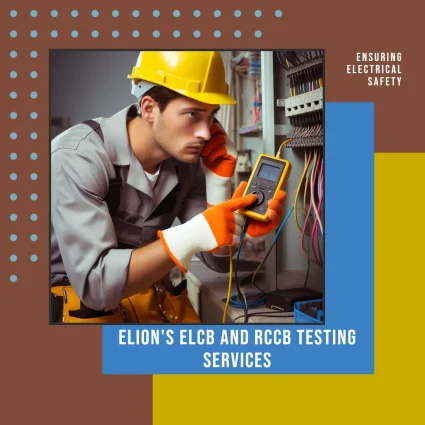
Elion team is leading service provider for testing of ELCB (Earth Leakage Circuit Breaker) and RCCB (Residual Current Circuit Breaker). Our team is equipped with best-in-class instrument to test your ELCB and RCCB. ELCB (Earth Leakage Circuit Breaker) and RCCB (Residual Current Circuit Breaker) are both types of circuit breakers designed to enhance electrical safety by protecting against electrical faults and current leakage. Testing these devices is crucial to ensure their proper functioning and to maintain a safe electrical environment.
Why it is important to test ELCB and RCCB?
Personal Safety:
ELCBs and RCCBs are vital for protecting individuals from electric shock and electrocution by quickly disconnecting the power supply in the event of a fault.
Regular testing ensures that these devices respond promptly to any leakage of current and effectively cut off the power supply, minimizing the risk of electrical accidents.
Equipment Protection: Testing helps ensure that the ELCB or RCCB functions correctly to protect electrical appliances and equipment from damage due to faults or leakage currents.
Compliance with Standards: Electrical safety standards often mandate the regular testing of protection devices. Adhering to these standards ensures that installations meet safety requirements.
Early Detection of Faults: Testing allows for the early identification of faults in ELCBs and RCCBs. Timely detection enables necessary repairs or replacements before a critical situation arises.
Reliability of Protection: Electrical installations can undergo changes or experience wear over time. Periodic testing helps verify that ELCBs and RCCBs remain reliable and capable of providing effective protection.
Legal Requirements: In many jurisdictions, there are legal requirements for the installation and testing of electrical safety devices, including ELCBs and RCCBs. Compliance with these regulations is essential for the safety of occupants and to avoid legal consequences.
Verification of Sensitivity: ELCBs and RCCBs are designed to detect small leakage currents. Testing helps ensure that these devices maintain their sensitivity, as they need to respond to even minor faults to guarantee safety.
Preventing Fire Hazards: Current leakage can lead to overheating and, in extreme cases, fire hazards. Ensuring the proper functioning of ELCBs and RCCBs is crucial for preventing electrical fires.
Maintaining System Integrity: Regular testing contributes to the overall integrity and reliability of the electrical distribution system by identifying issues that could compromise safety.
Testing is carried out in line with IS 15652:2006 requirements for residual current device trip-time and sensitivity.
So, whether you are Hospital, Industrial Customer, Hotel, Power Plant, Residential Building it is important to get your protective device tested.
ELCB and RCCB testing is an essential checkpoint in our electrical safety audit checklist for industrial and commercial facilities.
To get ELCB testing and RCCB testing contact Elion team on 9013890526.
Elion also deals in – Insulation Resistance Testing, Earthing System, Electrical Safety Audit
Definition – ELCB & RCCB Testing
ELCB and RCCB Testing is a safety check carried out on Earth Leakage Circuit Breakers (ELCBs) and Residual Current Circuit Breakers (RCCBs) to ensure they are working correctly and will instantly cut power when dangerous leakage currents occur. These devices protect people and electrical systems from shocks, electrocution, and fire hazards by detecting abnormal current flow to earth and disconnecting the circuit before harm can happen. Periodic testing confirms that both the breaker mechanism and sensitivity are functioning as intended.
Factors That Decide ELCB/RCCB Testing Cost in India
Cost depends on: number of ELCB/RCCB devices on site, facility type (residential, commercial, industrial, or hospital), and whether testing is bundled with a broader electrical safety audit. Request a fixed-fee quote with your device count and facility details.
What Does ELCB/RCCB Testing Check?
– Trip time — how quickly the device disconnects the circuit once leakage is detected
– Sensitivity — the minimum leakage current level the device correctly responds to
– Mechanical operation of the breaker mechanism
– Whether the device still meets its rated performance after time in service
FAQs
What is ELCB and RCCB Testing?
It’s a safety check on Earth Leakage Circuit Breakers and Residual Current Circuit Breakers to confirm they trip correctly and quickly enough when they detect a leakage current.
What exactly is tested during ELCB and RCCB testing?
We simulate a leakage fault using a test instrument to verify that the breaker detects earth leakage and trips properly within the required time and sensitivity.
Why should ELCB/RCCB testing be done regularly?
Even though these devices have a built-in test button, periodic professional testing ensures they will operate correctly under real fault conditions and haven’t become sluggish or faulty over time.
What risks does this testing help prevent?
Proper testing verifies protection against electric shocks, electrocution, and potential fire caused by insulation faults or current leakage in wiring or equipment.
How often should ELCB and RCCB be tested?
While manufacturer recommendations vary, professional periodic testing — ideally annually or as part of electrical safety audits — is a good practice to ensure ongoing protection.
Can pressing the test button on the breaker replace professional testing?
Proper testing verifies protection against electric shocks, electrocution, and potential fire caused by insulation faults or current leakage in wiring or equipment.
How often should ELCB and RCCB be tested?
While manufacturer recommendations vary, professional periodic testing — ideally annually or as part of electrical safety audits — is a good practice to ensure ongoing protection.
Can pressing the test button on the breaker replace professional testing?
No. The test button only confirms the internal mechanism can trip, but it doesn’t verify sensitivity or proper operation under real leakage fault conditions; professional testing is more comprehensive.
What’s the difference between an ELCB and an RCCB?
An ELCB (older earth leakage circuit breaker) detects leakage voltage on the earth wire, while an RCCB monitors the balance between live and neutral current to detect leakage. RCCBs are usually more reliable and widely used in modern installations.
Will testing cause any damage to electrical equipment?
No — when conducted by trained professionals using proper instruments, testing is safe and won’t harm your electrical system.
What happens if the breaker fails the test?
We’ll provide a clear assessment and recommend corrective action — whether that’s calibration, repair, or replacement — to ensure your system is protected.
Is testing only needed for new installations?
No. While it’s essential for new wiring, periodic testing of existing breakers is equally important, especially in commercial, industrial, and multi-occupancy buildings.
Does RCCB testing help with insurance or safety audits?
Yes. A certified test report can support electrical safety compliance requirements, insurance inspections, and regulatory audits.
Why is ELCB/RCCB testing important?
These devices are your last line of defence against electric shock and fire from insulation faults — testing confirms they’ll actually work when needed.
How often should ELCB/RCCB testing be done?
Periodic testing (commonly annual) is recommended as part of a routine electrical safety programme, alongside your electrical safety audit.
Isn't the built-in test button enough?
No — the test button confirms the mechanism moves, but doesn’t verify trip time or sensitivity under simulated fault conditions the way professional testing does.
What exactly is tested?
Trip time, leakage-current sensitivity, and overall mechanical reliability of the device — see the section above for details.
What instruments does Elion use?
Calibrated leakage-current test instruments that simulate a fault to confirm the device trips within the required time and sensitivity limits.
What happens if a device fails testing?
Elion flags the device for replacement or repair, with a clear recommendation in the compliance report.
Which facilities need ELCB/RCCB testing?
Hospitals, industrial sites, hotels, power plants, commercial buildings, and residential installations with these devices fitted.
What do I receive after testing?
A report listing each device tested, trip-time and sensitivity results, and pass/fail status with recommendations.
What does ELCB/RCCB testing cost in India?
Cost depends on the number of devices and facility type — request a fixed-fee quote with your device count and site details.