
Introduction
Industrial facilities, warehouses, commercial buildings, and large residential complexes have thousands of square metres of roof and facade area. Traditional inspection methods — rope access, scissor lifts, or scaffold — are expensive, slow, and require stopping operations in the inspection zone. Drone thermography covers the same area in hours, with higher detection rates for thermal anomalies that ground-based inspection misses entirely.
Elion provides drone thermography for building inspections as part of our broader thermography service portfolio. Our team deploys DGCA-compliant drones with calibrated thermal sensors to survey rooftops, facades, and structural elements, delivering GPS-tagged reports within 48 hours.
Drone thermography is fundamentally changing how Indian buildings are inspected by combining aerial access with infrared detection — covering entire building envelopes in hours rather than days, detecting defects 40% more reliably than ground inspections, and eliminating the need for scaffolding or rope access that disrupts building operations for extended periods. NBC 2016 Part 4 compliance inspections are among the primary adoption drivers for Indian facility managers.
A 25-storey residential tower in Mumbai recently replaced its traditional scaffold-based facade inspection (₹8.5 lakh, 12 days of operation disruption) with drone thermography (₹1.8 lakh, 6 hours). The drone survey identified 23 additional defects missed by previous scaffold inspections — including water ingress behind polished granite cladding detectable only through thermal differential — preventing ₹22 lakh in concealed structural damage from progressing to critical failure.
India’s real estate sector manages over 3.5 billion sq.ft of commercial and residential building stock. Periodic inspection of this ageing portfolio is mandated by local municipal bodies, housing societies (under RERA), and insurance requirements. Drone thermography enables cost-effective compliance inspections that were previously prohibitively expensive for mid-sized commercial properties, democratising access to professional-grade building condition assessment.
Drone thermography eliminates scaffolding costs (saving ₹3–8 lakh per high-rise survey), reduces inspection time from days to hours, accesses inaccessible facade areas safely, and detects hidden defects (water ingress, insulation gaps) with 40% higher accuracy than visual inspection. Full 20-storey building surveys complete in under 8 hours.
Key Takeaways
- Drone thermography is a non-destructive testing method that uses infrared technology to detect temperature differences in building materials.
- Using drones for building inspections offers advantages such as increased safety, cost-effectiveness, and the ability to access hard-to-reach areas.
- Drone thermography works by capturing thermal images of buildings, which can then be analyzed to identify potential issues such as moisture intrusion, insulation deficiencies, and electrical hotspots.
- Applications of drone thermography in building inspections include identifying energy inefficiencies, detecting roof leaks, and assessing structural integrity.
- Challenges and limitations of drone thermography include weather conditions, limited battery life, and the need for skilled operators, but the future of this technology in building inspections looks promising with advancements in drone capabilities and data analysis.
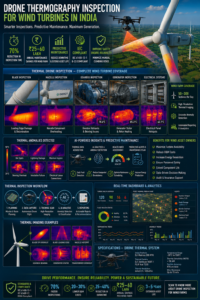
Drone thermography survey of 25-storey Mumbai residential tower: thermal overlay on RGB image identifies water ingress behind granite cladding (orange zones) missed by previous visual inspection. Survey completed in 6 hours, replacing 12-day scaffold operation.
What Drone Thermography Detects in Buildings
Roof Moisture and Leak Detection
Water trapped beneath a membrane roof or flat concrete roof retains heat longer than dry areas. After sunset, wet areas show as warmer zones in thermal imaging — wet/dry thermal differential inspection. This is the most reliable non-destructive method for locating active or latent roof leaks without cutting open the membrane. A single drone flight after dark can survey a 10,000 square metre roof in under two hours.
Facade Delamination and Moisture
Tiled facades, cladding systems, and rendered surfaces develop voids and delamination zones due to thermal cycling, moisture, and adhesive failure. Delaminated areas have different thermal mass than bonded areas and show distinct temperature patterns in morning or late afternoon sun. Drone thermography identifies these zones before they become safety hazards.
Insulation Performance Assessment
Poorly installed or degraded insulation creates thermal bridges — areas where heat transfers more readily than through the insulation system. These appear as warmer areas in winter thermal imaging or cooler areas when the building is air-conditioned. Identifying and correcting thermal bridges in large industrial facilities can yield significant energy savings.
HVAC and Mechanical System Surveys
Large rooftop HVAC installations, cooling towers, and exhaust systems can be surveyed by drone to identify overheating compressors, blocked condensers, and duct leakage — particularly useful for large commercial facilities where accessing all HVAC units by ladder or lift is time-consuming.
When to Inspect — Timing for Maximum Detection
| Defect Type | Best Inspection Time | Reason |
| Roof moisture or leaks | 1 to 3 hours after sunset | Wet areas retain heat longer — visible as warm patches against cooling dry membrane |
| Facade delamination | Morning 8 to 10 AM or evening 4 to 6 PM | Facade heating and cooling cycle maximises thermal contrast at delaminated zones |
| Insulation deficiency | Winter morning 6 to 9 AM | External temperature low, interior heat escaping through weak insulation |
| HVAC survey | During peak operating hours | Maximum load shows faulty components most clearly |
Know more about – Interpreting Thermal Images: Essential Skills for Drone Thermographers
FAQs
What is drone thermography?
Drone thermography is the use of drones equipped with thermal imaging cameras to capture and analyze the heat patterns emitted by objects and surfaces. This technology allows for the detection of temperature variations and anomalies that may indicate issues such as energy loss, water leaks, or structural defects in buildings.
How is drone thermography revolutionizing building inspections?
Drone thermography is revolutionizing building inspections by providing a non-invasive and efficient method for identifying potential issues in buildings. It allows inspectors to access hard-to-reach areas and capture detailed thermal images from a safe distance, reducing the need for manual inspections and improving overall safety and accuracy.
What are the benefits of using drone thermography for building inspections?
Some of the benefits of using drone thermography for building inspections include cost savings, time efficiency, improved safety for inspectors, and the ability to detect issues that may not be visible to the naked eye. Additionally, drone thermography can provide comprehensive and detailed thermal images that aid in the early detection of potential problems, allowing for timely maintenance and repairs.
What types of building issues can drone thermography detect?
Drone thermography can detect a wide range of building issues, including insulation deficiencies, moisture intrusion, electrical hotspots, HVAC system malfunctions, and structural defects. By capturing thermal images of a building’s exterior and interior, drone thermography can identify temperature variations that may indicate these and other issues.
Are there any limitations to using drone thermography for building inspections?
While drone thermography offers many advantages, it is important to note that it is not a standalone solution for building inspections. It should be used in conjunction with other inspection methods and tools to ensure comprehensive assessment of a building’s condition. Additionally, environmental factors such as weather conditions and sunlight can affect the accuracy of thermal imaging, so proper planning and execution are essential.