Training Coordinator, Industrial Paint Manufacturer
“The safety induction for new hires was handled smoothly. Elion brought their own AV equipment and kept the session engaging. We’re thinking of repeating this monthly.”

And Consulting Private Limited
And Consulting Private Limited
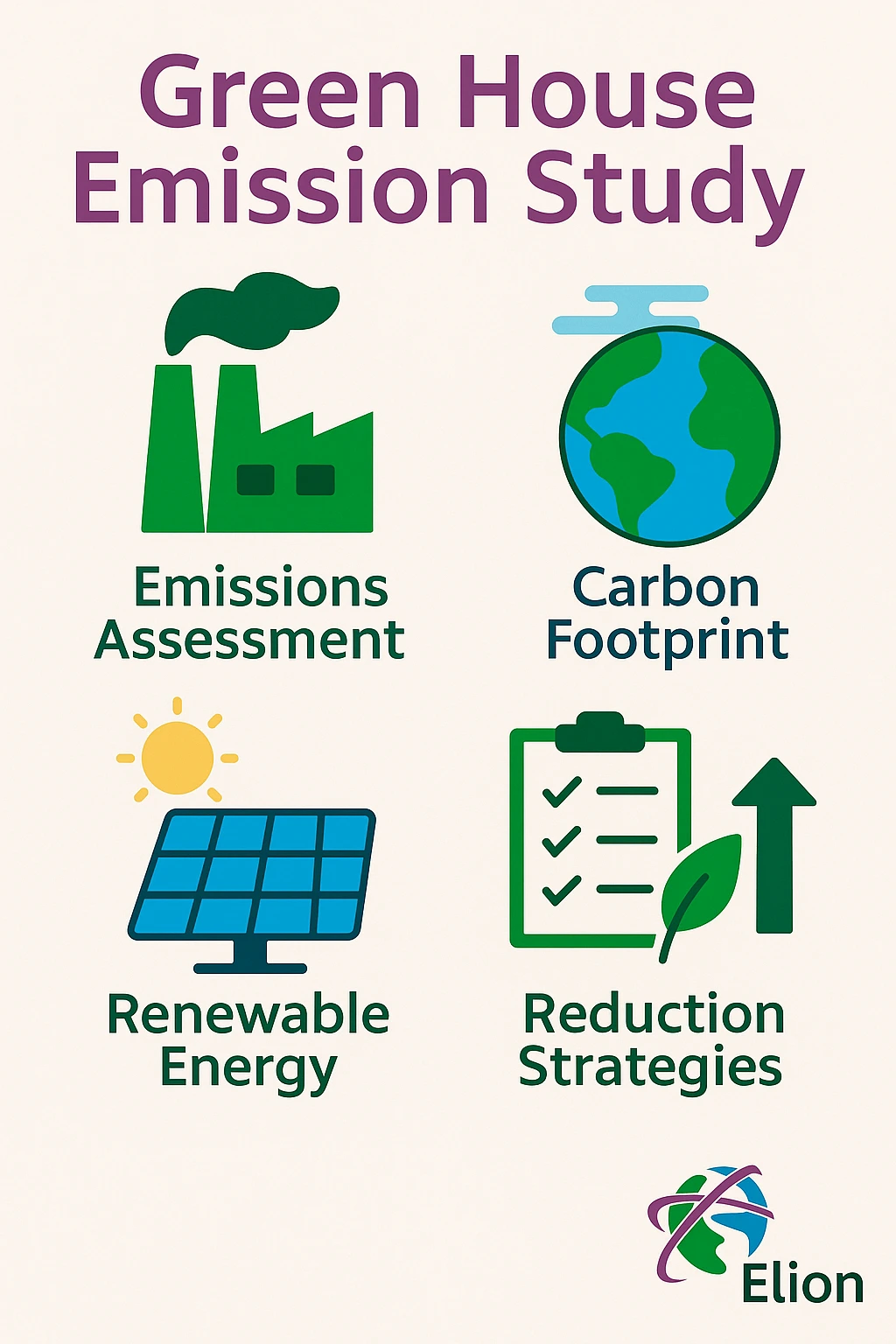
A Greenhouse Emission Study measures the greenhouse gases (GHGs) emitted by an organization across Scope 1 (direct emissions), Scope 2 (energy indirect), and Scope 3 (other indirect emissions). It is a critical step for carbon footprint reduction, ESG compliance, and sustainability initiatives.
Elion offers Greenhouse Emission Studies across India, helping organizations identify emission sources, quantify emissions, and develop strategies to reduce their carbon footprint.
Take your climate action and ESG initiatives forward with Elion’s expert Greenhouse Emission Study services.
Request a Quote or contact us at [email protected].
“The safety induction for new hires was handled smoothly. Elion brought their own AV equipment and kept the session engaging. We’re thinking of repeating this monthly.”
“Good response from our team for the chemical spill drill and awareness session. We had a minor leak last year and this training was timely. They even explained the MSDS sheet details clearly.”
“Elion conducted ergonomics training for our office support staff. They gave tips that don’t need any budget—just posture, breaks, and seating angles. Everyone found it useful.”
“Warehouse safety training was organized at our distribution center. The module covered stacking, material flow, and emergency handling. One or two team leads found the content basic, but the newcomers appreciated it.”
“The hot work and gas cutting safety training helped us address some recent near-misses. Our fabrication contractors said it was the first time anyone explained why permits matter, not just how to fill them.”
“We held a training on ergonomics and workstation safety. Elion’s speaker had a practical approach—suggested small furniture changes and posture tips that didn’t cost much but helped our office staff.”
“Elion covered cold storage safety and ammonia handling well. Some of our technicians said it was the first time they understood how to respond to leaks. We may request them for a follow-up drill.”
“Our garment unit required machine safety awareness for new joiners. Elion kept it interactive and used visuals from our own plant, which the workers related to.”
“The crane and material handling training helped reduce near misses in our yard. The trainer also gave tips that were not in the slides, based on their field experience. That made a difference.”
“We requested a training module on emergency evacuation procedures. Elion included site-specific examples which helped. The mock drill later was well-coordinated too. Our fire wardens felt more confident after the session.”
Greenhouse Emission Study help organizations measure and analyze the greenhouse gases produced from their operations, energy consumption, transportation, and industrial processes. The goal is to understand your carbon impact and identify practical ways to reduce emissions.
For carbon footprint reduction and ESG compliance.
Scope 1: Direct emissions, Scope 2: Energy indirect, Scope 3: Other indirect emissions.
Yes, aligned with GHG Protocol and ISO 14064.
It is becoming essential for ESG reporting and regulatory compliance.
Energy, fuel, logistics, supply chain, and waste data.
By identifying emission hotspots for targeted action.
Yes, in tCO₂e for reporting.
Yes, for BRSR, GRI, and CDP reporting.
Annually for accurate tracking.
A Greenhouse Gas Emission Study is a structured assessment that measures the total emissions of gases such as:
It evaluates emissions under:
The methodology generally aligns with frameworks like the Intergovernmental Panel on Climate Change and the Greenhouse Gas Protocol.
A Greenhouse Emission Study is a structured assessment that calculates how much greenhouse gas your organization releases into the atmosphere. It gives you a clear picture of where emissions are coming from and how your operations contribute to climate change.
Not at all. While large manufacturing units often require it for compliance, corporate offices, hospitals, educational institutions, and commercial buildings can also benefit. Any organization that uses electricity, fuel, or transportation generates emissions.
Scope 1 includes direct emissions from your own equipment or vehicles.
Scope 2 covers indirect emissions from purchased electricity or energy.
Scope 3 includes emissions from supply chains, travel, waste, and other indirect sources. A proper Greenhouse Emission Study evaluates all applicable scopes.
Fields marked with an asterisk (*) are required
Behavioral safety training is a proactive approach to workplace safety that focuses on changing employee behaviors to reduce the risk of accidents and injuries. This type of training is based on the idea that most workplace accidents are caused by unsafe behaviors rather than unsafe conditions, and that by addressing…
An on-site emergency plan is a crucial component of any organization’s overall safety and risk management strategy. It is designed to ensure the safety and well-being of employees, visitors, and the public in the event of an emergency or disaster. By having a well-thought-out emergency plan in place, organizations can…
In an era where health and safety have become paramount, especially in educational institutions, Team Elion has emerged as a pivotal force in promoting a culture of safety on university campuses. Their comprehensive training programs are designed to equip students and staff with the necessary skills and knowledge to navigate…
As we embark on our journey together, we find ourselves at the heart of Team Elion, a dynamic group dedicated to excellence in our respective fields. Our team is not just a collection of individuals; we are a cohesive unit that thrives on collaboration, innovation, and a shared vision for…
Safety training in hospitals is a critical component of healthcare operations, serving as a foundational element that ensures the well-being of both patients and staff. The healthcare environment is inherently complex, characterized by high-stakes situations, diverse patient populations, and a multitude of medical procedures. In such an environment, the potential…
Elion’s Mock Drill Training program is a systematic safety initiative that develops emergency response capabilities in manufacturing facilities. Manufacturing environments present significant safety risks, including potential equipment malfunctions, chemical exposures, and fire hazards, making comprehensive emergency preparedness essential for worker protection and operational continuity. The program utilizes simulation-based training to…
Industrial safety audits are an essential part of maintaining a safe and healthy work environment for employees. These audits involve a comprehensive review of the workplace to identify potential hazards and ensure that all safety protocols and regulations are being followed. The goal of an industrial safety audit is to…
The Occupational Safety and Health Administration (OSHA) has established regulations to protect workers from the harmful effects of noise exposure in the workplace. These regulations are designed to prevent hearing loss and other health issues that can result from prolonged exposure to high levels of noise. OSHA’s noise exposure regulations…
First aid training is an essential skill set that equips individuals with the knowledge and techniques necessary to respond effectively in emergencies. The ability to provide immediate care can significantly impact the outcome of various medical situations, from minor injuries to life-threatening conditions. In many cases, the first few minutes…
Construction safety training is an essential aspect of any construction project. It is crucial for ensuring the safety and well-being of all workers on the job site. The construction industry is inherently dangerous, with numerous hazards and risks present on a daily basis. Without proper safety training, workers are at…