Training Coordinator, Industrial Paint Manufacturer
“The safety induction for new hires was handled smoothly. Elion brought their own AV equipment and kept the session engaging. We’re thinking of repeating this monthly.”

And Consulting Private Limited
And Consulting Private Limited
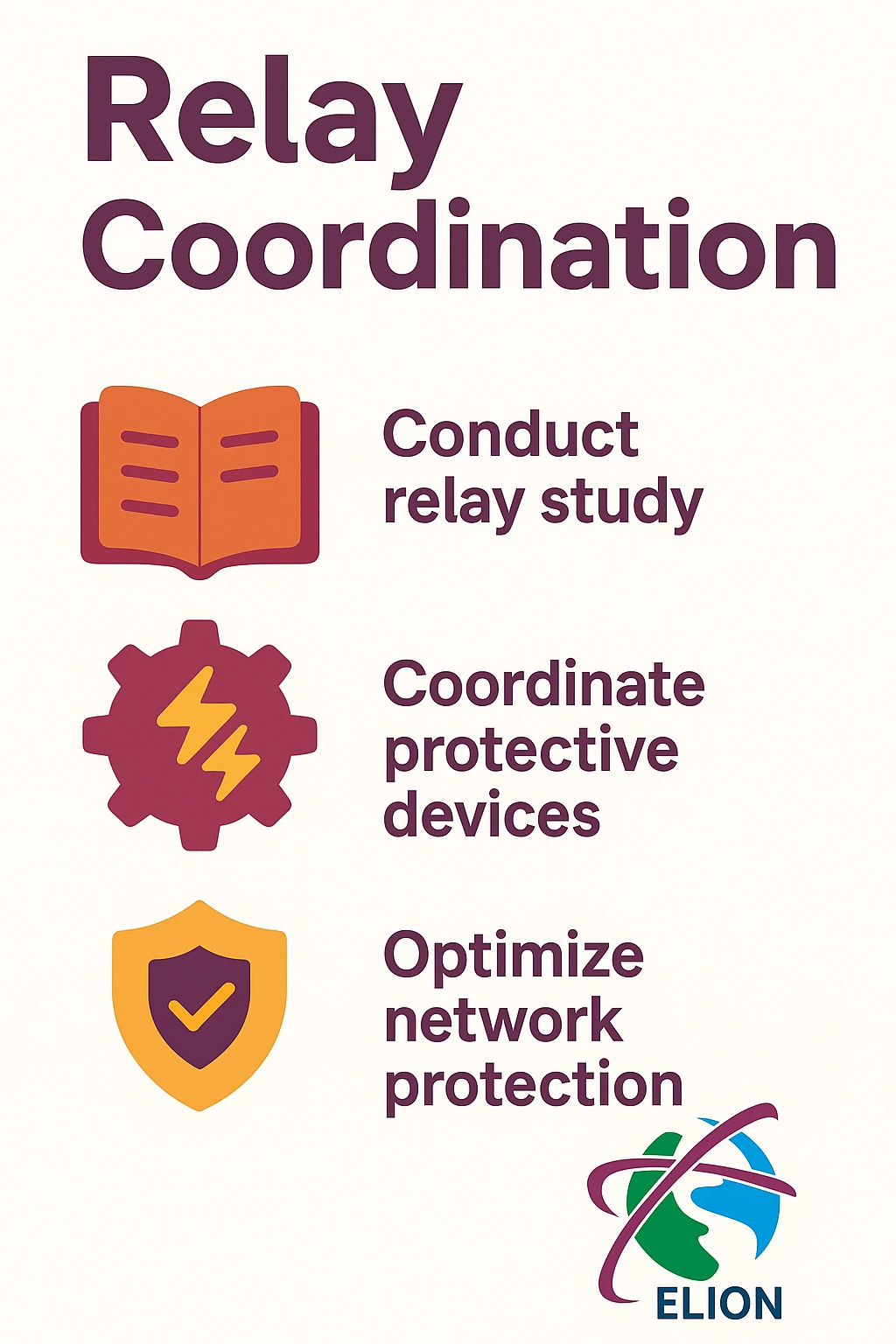
A relay coordination study optimizes protective relay settings so that only the faulty section of your electrical system is isolated during a fault, keeping the rest of the network powered. Elion analyzes LV, MV, and HV protection schemes using ETAP/PowerFactory simulation and delivers TCC plots with setting recommendations — trusted since 2010 across 30,000+ audits.
Relay Coordination involves setting and coordinating protective relays in an electrical system to ensure selective isolation during faults, minimizing disruption while protecting equipment and personnel.
A well-executed Relay Coordination Study helps optimize relay settings so that only the faulty section is isolated during a fault, maintaining power continuity in the rest of the system.
Cost depends on: number of relays and protection devices in the system, system voltage level (LV vs. MV vs. HV), whether a short circuit and load flow study is required alongside the coordination study, and whether field testing/setting validation is included. Request a fixed-fee quote with your system details.
Ensure the safety, reliability, and efficiency of your electrical system with Elion’s expert Relay Coordination Studies.
Request a Quote or contact us at [email protected].
“The safety induction for new hires was handled smoothly. Elion brought their own AV equipment and kept the session engaging. We’re thinking of repeating this monthly.”
“Good response from our team for the chemical spill drill and awareness session. We had a minor leak last year and this training was timely. They even explained the MSDS sheet details clearly.”
“Elion conducted ergonomics training for our office support staff. They gave tips that don’t need any budget—just posture, breaks, and seating angles. Everyone found it useful.”
“Warehouse safety training was organized at our distribution center. The module covered stacking, material flow, and emergency handling. One or two team leads found the content basic, but the newcomers appreciated it.”
“The hot work and gas cutting safety training helped us address some recent near-misses. Our fabrication contractors said it was the first time anyone explained why permits matter, not just how to fill them.”
“We held a training on ergonomics and workstation safety. Elion’s speaker had a practical approach—suggested small furniture changes and posture tips that didn’t cost much but helped our office staff.”
“Elion covered cold storage safety and ammonia handling well. Some of our technicians said it was the first time they understood how to respond to leaks. We may request them for a follow-up drill.”
“Our garment unit required machine safety awareness for new joiners. Elion kept it interactive and used visuals from our own plant, which the workers related to.”
“The crane and material handling training helped reduce near misses in our yard. The trainer also gave tips that were not in the slides, based on their field experience. That made a difference.”
“We requested a training module on emergency evacuation procedures. Elion included site-specific examples which helped. The mock drill later was well-coordinated too. Our fire wardens felt more confident after the session.”
It’s an analysis that optimizes protective relay settings so only the faulty section of an electrical system is isolated during a fault, maintaining supply to unaffected areas.
Without proper coordination, a single fault can trip more of the system than necessary, causing unnecessary outages, or fail to isolate the fault fast enough, risking equipment damage.
IS 3231, IEC 60255, IEEE 242, IEEE 399.
ETAP, PowerFactory, Dialux (for lighting coordination when relevant).
Graphs showing time-current behavior of relays for coordination visualization.
SLDs, equipment ratings, relay specs, fault data.
Calculation of fault levels to determine relay settings.
Yes, upon request.
Yes, by timely isolation during faults.
Every 3-5 years or after major system changes.
Without coordination:
The process includes:
✔ Collecting system data (diagrams, relay specs)
✔ Short-circuit and load flow analysis
✔ Analyzing time–current curves (TCCs)
✔ Calculating optimal relay settings
✔ Verifying coordination outcomes
✔ Preparing a detailed report and recommendations.
We recommend reviewing and updating your coordination study:
Every 3–5 years, or
After major system changes like new equipment, expanded loads, or protection upgrades.
LV, MV, and HV protection devices including ACB, MCCB, ELCB, and IDMT relays.
Simulation software including ETAP and PowerFactory for short circuit, load flow, and coordination analysis.
Field testing and relay setting validation can be included where required, in addition to the simulation-based study.
A Time-Current Characteristic plot showing how protective devices respond to fault current over time, used to verify correct coordination between devices.
After any system change (new equipment, load changes, network reconfiguration), and periodically as part of ongoing electrical safety review.
A detailed report with TCC plots, relay setting tables, and recommendations for setting adjustments.
Fields marked with an asterisk (*) are required
Construction safety training is an essential aspect of any construction project. It is crucial for ensuring the safety and well-being of all workers on the job site. The construction industry is inherently dangerous, with numerous hazards and risks present on a daily basis. Without proper safety training, workers are at…
Industrial safety training programs are essential for ensuring the well-being of employees and the success of a business. These programs provide employees with the knowledge and skills they need to identify and mitigate potential hazards in the workplace, ultimately reducing the risk of accidents and injuries. By investing in industrial…
Onsite safety training is a crucial aspect of workplace safety and is designed to educate employees on the potential hazards and risks associated with their job roles. This type of training is typically conducted at the workplace and is tailored to the specific needs and requirements of the industry. The…
Elion’s Road and Traffic Safety Training program is a comprehensive initiative designed to address the pressing need for enhanced safety measures in logistics operations. With the rapid growth of e-commerce and the increasing volume of goods transported across urban landscapes, the importance of effective road safety training cannot be overstated.…
Risk management is a crucial aspect of any business operation, as it helps to identify, assess, and mitigate potential risks that could impact the organization’s success. By understanding the importance of risk management, businesses can proactively address potential threats and minimize their impact on the company’s operations and bottom line.…
Occupational Safety and Health Administration (OSHA) training requirements in India are essential for ensuring the safety and well-being of employees in the workplace. OSHA is a regulatory body that sets and enforces standards to ensure safe and healthy working conditions for employees. In India, OSHA training requirements are governed by…
Lab safety training is an essential component of any laboratory environment. It is crucial for ensuring the safety and well-being of all personnel working in the lab, as well as for protecting the integrity of the research being conducted. Proper training helps to minimize the risk of accidents, injuries, and…
Personal Protective Equipment (PPE) is a crucial aspect of workplace safety. It encompasses a wide range of equipment and clothing designed to protect workers from potential hazards in their environment. The theoretical understanding of PPE involves learning about the different types of equipment available, their specific uses, and the regulations…
Elion’s Mock Drill Training program is a systematic safety initiative that develops emergency response capabilities in manufacturing facilities. Manufacturing environments present significant safety risks, including potential equipment malfunctions, chemical exposures, and fire hazards, making comprehensive emergency preparedness essential for worker protection and operational continuity. The program utilizes simulation-based training to…
Workplace safety is a critical aspect of any organization, as it not only ensures the well-being of employees but also contributes to the overall success of the business. Implementing safety measures and protocols can significantly reduce the risk of accidents and injuries, creating a safer and more secure work environment…