
Fire pumps are the backbone of any building’s fire suppression system. When a fire breaks out, they push water through your sprinklers and standpipes at the pressure and volume the system needs. Without a working pump, even the best-designed fire protection system becomes decoration.
Here’s the uncomfortable truth — most fire pumps look fine sitting idle. They only reveal problems when they’re put under load. That’s why fire pump testing exists.
This guide walks you through what testing involves, what NFPA requires, how inspections and maintenance fit into the picture, and what you should expect to pay for a professional testing service.
Table of Contents
- Why Fire Pump Testing Cannot Be Skipped
- Annual Fire Pump Testing: The Full Performance Check
- Fire Pump Churn Test: Weekly, Not Just Yearly
- Fire Pump Inspection Schedule: Three Tiers, One System
- Fire Pump Maintenance: What Testing Reveals, Maintenance Fixes
- What Fire Pump Testing Costs
- What Happens When a Pump Fails the Test?
- Get Certified Fire Pump Testing from Elion
- Frequently Asked Questions
Why Fire Pump Testing Cannot Be Skipped
A fire pump that hasn’t been tested isn’t a reliable pump — it’s just an untested assumption.
NFPA 25 (Standard for the Inspection, Testing, and Maintenance of Water-Based Fire Protection Systems) is the document that governs how and how often your pump gets tested. It’s not a suggestion. Across most Indian and international jurisdictions, compliance with NFPA 25 is a legal requirement for commercial, industrial, and high-rise residential properties.
Insurance companies reference it. Fire marshals enforce it. Authorities Having Jurisdiction (AHJs) require documented proof that your pump has been tested, maintained, and found fit for purpose.
Fail to produce records, and you’re looking at regulatory fines, increased insurance premiums, or the worst-case scenario — a pump that doesn’t perform during an actual fire.
Elion’s certified auditors have conducted NFPA fire pump testing across industrial, commercial, and high-rise facilities since 2010, providing structured compliance documentation that stands up to regulatory review.
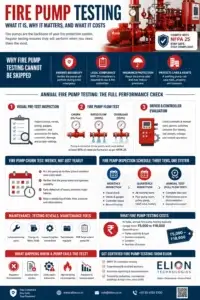
Annual Fire Pump Testing: The Full Performance Check
Annual fire pump testing is the most comprehensive evaluation your pump undergoes each year. It goes far beyond confirming the pump starts — it verifies that the pump can actually deliver the flow and pressure your system was designed around.
Here’s what a complete annual test covers:
1. Visual Pre-Test Inspection
Before any mechanical testing begins, the technician conducts a detailed fire pump inspection — checking for leaks, corrosion, incorrect valve positions, physical damage, and signs of deferred maintenance. This baseline step catches the obvious issues before the pump is put under load.
2. Fire Pump Flow Test
The fire pump flow test is the heart of the annual evaluation. The pump runs at three distinct operating points:
- Churn (shut-off): No water flow — establishes baseline pressure
- Rated flow (100%): Pump operates at its design flow rate
- Overload (150%): Pump pushed to 150% of rated flow
At each point, suction pressure, discharge pressure, and flow rate get recorded and plotted against the pump’s nameplate performance curve. Under NFPA 25, the pump must deliver at least 95% of its rated performance at the rated flow point. Drop below that, and you have a documented deficiency requiring corrective action.
3. Driver and Controller Evaluation
Whether your pump uses an electric motor or a diesel engine, the driver gets thoroughly checked. For diesel-driven pumps, this includes fuel system condition, battery voltage, coolant levels, and exhaust integrity. For both types, the automatic and manual controller start sequences are tested and verified.
Elion’s team recently completed a full annual fire pump testing service at a high-rise commercial tower in Gurgaon, documenting all three flow-test data points and controller performance for regulatory submission.
Fire Pump Churn Test: Weekly, Not Just Yearly
Here’s something building managers often miss. The annual test is comprehensive, but NFPA 25 also requires more frequent no-flow testing throughout the year.
Electric-driven fire pumps must run weekly for a minimum of 10 minutes under churn (no-flow) conditions. Diesel-driven pumps follow a comparable weekly schedule.
The fire pump churn test checks that the pump starts correctly, reaches operating speed, and runs without overheating — all without actually discharging water into the system. Parameters logged include RPM, suction and discharge pressures, packing gland drip rate, and bearing temperatures.
Think of it as test-driving your vehicle regularly to confirm it still starts — except the stakes are significantly higher than missing a meeting.
Skipping weekly churn tests is a compliance violation under NFPA 25, and it’s also one of the easiest ways to miss a developing mechanical problem before it becomes a full failure.
For a deeper look at how churn testing fits into the broader performance evaluation process, see Elion’s guide on maximizing fire pump performance through regular testing.
Fire Pump Inspection Schedule: Three Tiers, One System
A fire pump inspection isn’t a once-a-year event. NFPA 25 structures inspection requirements into three frequency tiers, each targeting different aspects of the system’s health.
| Inspection Frequency | What Gets Checked |
|---|---|
| Weekly | Automatic start function, pressure readings, packing gland, general condition |
| Monthly | Controller settings, heat or unusual sounds, relief valve condition |
| Annual | Full flow test, driver inspection, compliance documentation |
Many facilities integrate their fire pump inspections with broader fire safety audits — reviewing sprinkler heads, standpipe valves, alarm panels, and suppression system components in the same visit. This consolidates records and gives AHJs a cleaner compliance picture.
Fire Pump Maintenance: What Testing Reveals, Maintenance Fixes
Testing tells you the pump’s condition. Fire pump maintenance is what you do with that information.
Common maintenance tasks identified through routine inspections and annual testing include:
Packing gland adjustment — The pump shaft seal should produce a controlled, intentional drip. Too tight causes heat buildup and premature wear; too loose wastes water and indicates a sealing failure.
Bearing lubrication — Rotating components need periodic lubrication to prevent metal-to-metal wear. Missed lubrication intervals lead to bearing failure, which typically shows up first as elevated temperatures during a churn test.
Pressure relief valve service — Verifies the valve opens and reseats correctly, preventing overpressure damage to your piping system.
Controller testing and calibration — Ensures automatic start sequencing activates reliably at the correct pressure differential.
Diesel engine service — For engine-driven pumps, fuel condition, battery load testing, coolant, and oil intervals all require regular attention.
NFPA 25 Section 8 defines specific maintenance intervals for each component. A qualified fire pump testing service provider will follow these intervals and maintain a detailed maintenance log — something you’ll want available during any AHJ inspection or insurance audit.
For a complete overview of how performance testing and maintenance interact, Elion’s article on fire pump performance testing covers the technical detail well.
What Fire Pump Testing Costs
Fire pump testing cost depends on several variables: pump type (electric vs. diesel), number of pumps, system complexity, location, and how detailed the test report needs to be.
Here’s a realistic cost picture for most commercial facilities:
Annual flow test (single electric pump): ₹5,000 – ₹18,000 in India; approximately $400–$1,200 in the US market.
Diesel-driven pump testing: Typically higher due to the additional engine evaluation components.
Weekly churn testing (contracted service): Often included in a maintenance service agreement, running ₹800–₹2,500 per visit depending on travel and scope.
Full annual maintenance contract: For a mid-sized commercial facility with one or two pumps, bundled inspection, testing, and maintenance agreements typically range from ₹25,000–₹75,000 per year.
The math is straightforward. Regular testing catches problems early — a worn bearing identified during a maintenance visit costs a fraction of replacing a seized pump after emergency failure. And a failed pump during an actual fire isn’t a cost — it’s a catastrophe.
What Happens When a Pump Fails the Test?
If your annual flow test shows the pump performing below 95% of its rated values, NFPA 25 classifies that as a deficiency. Depending on the severity and your local AHJ’s response, this may trigger:
- A mandatory corrective action window before the system is cleared as operational
- Documentation requirements for your insurance provider
- A follow-up inspection once repairs are completed
Common causes of underperformance include impeller wear, motor degradation, water supply issues, and blocked or incorrectly positioned valves. Many of these develop gradually — which is exactly why the annual test and weekly churn schedule exist.
Elion’s fire pump testing 101 guide breaks down what common deficiencies look like in test data and what corrective actions typically follow.
Get Certified Fire Pump Testing from Elion
Elion Technologies & Consulting Pvt. Ltd. has delivered third-party fire pump testing and fire safety audits across India since 2010 — covering industrial plants, commercial towers, logistics parks, and institutional facilities.
Every test follows NFPA 25 protocols. Every report is instrument-measured, clearly documented, and suitable for regulatory submission, insurance review, or AHJ compliance verification.
View Elion’s Fire Pump Testing Services →
Frequently Asked Questions About Fire Pump Testing
Q1. How often should fire pump testing be done?
Fire pumps require testing at multiple intervals. A full annual fire pump testing (flow test) must happen once every 12 months as per NFPA 25. Beyond that, a fire pump churn test must be conducted weekly for a minimum of 10 minutes — for both electric and diesel-driven pumps. Monthly visual checks on controller settings and heat conditions are also required. Skipping any of these intervals puts you out of compliance and increases the risk of pump failure during an emergency.
Q2. What is the difference between a fire pump flow test and a churn test?
A fire pump flow test measures the pump’s actual performance against its design specifications — running the pump at 100% and 150% of its rated flow while recording pressure and flow data. It’s done annually and is the most comprehensive test. A fire pump churn test, on the other hand, runs the pump with no water discharge to verify it starts, reaches speed, and doesn’t overheat. It’s a quick operational check, done weekly, and doesn’t evaluate flow capacity. Both are required under NFPA 25 — one doesn’t replace the other.
Q3. What happens if my fire pump fails the annual test?
If your pump delivers less than 95% of its rated performance during the annual flow test, NFPA 25 flags it as a deficiency. Depending on how severe the shortfall is, your Authority Having Jurisdiction (AHJ) may require immediate repair before your fire protection system is considered operational. Your insurance provider may also need to be notified. Common causes include impeller wear, motor degradation, blocked valves, or neglected maintenance — most of which are preventable with a regular fire pump maintenance schedule.
Q4. Who can perform a certified fire pump inspection and test?
Fire pump testing should be carried out by qualified, certified professionals who follow NFPA 25 procedures and produce documented test reports. In India, look for third-party engineering audit firms with certified auditors, NFPA compliance experience, and a track record of testing across commercial and industrial facilities. Elion Technologies & Consulting Pvt. Ltd. has been providing independent fire pump testing services since 2010, with structured reports accepted by regulators, insurers, and AHJs across India.
Q5. What does fire pump testing cost in India?
Fire pump testing cost in India varies based on pump type, system size, and location. For a single electric-driven pump, a standard annual flow test typically ranges from ₹5,000 to ₹18,000. Diesel-driven pumps cost more due to additional engine evaluation. Full annual maintenance contracts covering inspection, testing, and minor maintenance for a mid-sized commercial facility generally range from ₹25,000 to ₹75,000 per year. Getting a bundled contract is almost always more cost-effective than booking individual visits throughout the year.
Sources: NFPA 25 (2023 Edition) — Standard for the Inspection, Testing, and Maintenance of Water-Based Fire Protection Systems; NICET Fire Protection Engineering Technology Program; Elion Technologies & Consulting Pvt. Ltd. field documentation.