
🏥 Quick Answer
Why EV Parking Is India’s Fastest-Growing Fire Safety Challenge
India registered over 1.7 crore electric vehicles by early 2026. Government mandates now require EV charging provision in all new residential complexes above a certain size, commercial buildings, hotels, and malls. The result: nearly every basement and podium car park being built today includes EV charging bays — often without any specific fire safety provision beyond what would be installed for a conventional ICE vehicle car park.
This is a serious and growing risk. An EV battery fire in a basement car park is not comparable to a petrol vehicle fire. The chemistry involved — lithium-ion thermal runaway — produces a self-sustaining reaction that generates temperatures up to 700°C, releases a cocktail of toxic and flammable gases, and can reignite days after the initial incident. Standard dry powder or CO₂ extinguishers — the default fire fighting tools in most Indian car parks — are largely ineffective against lithium-ion fires.
know more about – NBCS 2026 vs NBC 2016 Part 4: What Changed in India’s Fire Safety Standards
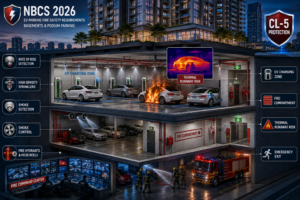
NBCS 2026 Part F, released in May 2026, is the first Indian building standard to specifically address EV parking fire safety. The requirements are significant — mandating the highest protection level (CL-5) for all buildings with EV parking in basements or podiums, regardless of building type or height.
Understanding Lithium-Ion Battery Thermal Runaway
To understand why NBCS 2026 mandates CL-5 — the highest possible protection level — for EV parking, it is essential to understand how lithium-ion battery fires behave differently from conventional vehicle fires.
Overcharging, physical damage, manufacturing defect, or external heat causes cell temperature to rise
Exothermic reactions begin in the battery cell. Temperature rises rapidly. Flammable gases (H₂, CO, HF) are generated and vented
Vented gases ignite. Battery fire reaches 500–700°C. Toxic gas plume — HF, CO, CO₂, SOₓ — makes the area uninhabitable within minutes
Partially cooled battery cells can reignite 24–72 hours after apparent extinguishment. High-volume water cooling is required throughout
⚠ Why Standard Car Park Fire Safety Is Insufficient for EV Parking
- Lithium-ion fires reach 500–700°C — far exceeding petrol vehicle fire temperatures (~300°C)
- Toxic gas release (HF, CO, CO₂) makes basement uninhabitable within minutes of ignition
- Dry powder and CO₂ extinguishers are largely ineffective — cannot penetrate battery pack
- High-volume water (hundreds of litres) needed for cooling — conventional hose reels inadequate
- Reignition risk 24–72 hours later — fire brigade cannot clear the area as quickly
- Standard sprinkler densities (designed for petrol vehicle fires) may be insufficient
- Rate-of-rise heat detectors needed — fixed temperature detectors respond too late
- Spread to adjacent vehicles is rapid — dense parking layouts amplify risk
- Basement smoke logging is extreme — no natural ventilation in enclosed car parks
NBCS 2026 EV Parking Fire Safety Requirements — Complete List
✅ All NBCS 2026 Requirements for EV Parking in Basements / Podiums
- CL-5 protection level mandatory for all buildings with EV parking in basement or podium — highest level, regardless of building type, height, or size New
- Rate-of-rise heat sensors mandatory in all EV parking areas and EV charging bays New
- Smoke detectors mandatory in all basement areas, except ICE-only vehicle parks New
- CO sensors mandatory in ICE vehicle parks, connected to activate mechanical ventilation New
- Compartmentation of all EV charging areas mandatory New
- Building clusters within 9 m with shared EV parking — CL-5 mandatory for all buildings in the cluster New
- Sprinkler density designed for EV (lithium-ion) fire suppression — not standard car park density New
- Basement clear height minimum 3.4 m (general basement requirement — applies to EV parks) Tightened
- Minimum 2 independent exits from all basement levels (general basement requirement) Tightened
- Ramps at all levels must be sprinkler protected (general sprinkler requirement — applies) New
What is CL-5 Protection Level?
NBCS 2026 Part F defines five protection levels — CL-1 through CL-5 — in Tables 7A to 7J, one per occupancy group. CL-5 is the highest. EV parking in basements or podiums must achieve CL-5 regardless of the primary building occupancy. Here is how the three highest levels compare:
- Automatic fire detection
- Manual call points
- First aid hose reels
- Portable extinguishers
- Emergency lighting
- Exit signage
- All CL-3 requirements +
- Automatic sprinkler system
- Wet riser and hydrant
- Voice evacuation system
- Pressurisation (if high-rise)
- Fireman’s lift (if applicable)
- All CL-4 requirements +
- High-density sprinkler system
- Firefighting shaft provisions
- Full wet riser with enhanced flow
- Rate-of-rise heat detection
- Compartmentation of EV zones
Which Buildings Are Affected?
The NBCS 2026 EV parking requirements apply to any building — regardless of primary occupancy — that has EV parking in a basement or podium structure. This is extraordinarily broad:
| Building Type | CL-5 Required? | Rate-of-Rise Sensors? | Compartmentation? |
|---|---|---|---|
| Residential apartment complex | Yes — if EV in basement | Yes | Yes |
| Commercial office building | Yes — if EV in basement/podium | Yes | Yes |
| Hotel (A-IV or A-V) | Yes — if EV in basement/podium | Yes | Yes |
| Hospital or healthcare facility | Yes — if EV in basement | Yes | Yes |
| Shopping mall or retail complex | Yes — if EV in basement/podium | Yes | Yes |
| IT park or SEZ campus | Yes — if EV in basement/podium | Yes | Yes |
| Standalone multi-level car park | Yes — if EV charging present | Yes | Yes |
| Building cluster (≤9 m apart) | Yes — for all buildings in cluster | Yes | Yes |
| At-grade (surface) EV parking only | Not triggered under basement/podium rule | Recommended | Recommended |
🔴 Critical: Existing Buildings Adding EV ChargersNBCS 2026 Clause 3.3 states that any alteration changing the fire risk profile of an existing building requires fire authority review. Installing EV chargers in an existing basement or podium car park without upgrading the fire protection system to CL-5 creates a compliance gap — and a serious liability in the event of a fire. A pre-installation fire safety review by an independent auditor is strongly recommended before deploying any EV charging infrastructure in an existing building.
Sprinkler Requirements for EV Parking
Standard automatic sprinkler systems in car parks are designed for SMIG (Sprinkler Manufacturers India Group) Category I — ordinary hazard protection for petrol and diesel vehicle fires. Lithium-ion battery fires require substantially higher water application rates for cooling. NBCS 2026 requires that sprinkler systems in EV parking areas be specifically designed for lithium-ion battery fire suppression — not default car park density.
Key sprinkler requirements for EV parking under NBCS 2026:
- CL-5 sprinkler specification — highest density, pump capacity, and water storage requirements
- All ramps at all levels must be sprinkler protected — not just parking bays
- Sprinkler head condition — heads must never be painted; 100 mm red band every 3 m on pipes
- ICV supervision switches — all isolation valves must be monitored by fire alarm panel
- Flow switch monitoring — all flow switches must report to fire alarm panel
- Water drainage — adequate drainage capacity for high-volume suppression discharge from EV fires
Detection System Requirements for EV Parking
| Zone | NBCS 2026 Requirement | Why |
|---|---|---|
| EV parking bays and charging areas | Rate-of-rise heat sensors New | Detects rapid temperature rise of thermal runaway before flames appear |
| All basement areas (mixed EV/ICE) | Smoke detectors New | Early smoke detection from EV off-gassing and battery events |
| ICE-only vehicle parks | CO sensors → activate ventilation New | Carbon monoxide from ICE vehicles triggers mechanical exhaust |
| EV charging infrastructure | Thermal monitoring recommended | Identifies overheating EVSE and charging cables before fire develops |
💡 Why Rate-of-Rise Detectors for EV Parks?Standard fixed-temperature heat detectors activate only when the surrounding air reaches a preset threshold — typically 57°C or 68°C. By the time ambient air reaches this temperature in a car park, a lithium-ion thermal runaway event is already well advanced. Rate-of-rise heat detectors trigger an alarm when temperature increases at more than 8–10°C per minute — the characteristic signature of early-stage thermal runaway — providing 3–5 minutes of additional warning time before flames appear. This is the difference between a managed evacuation and a chaotic emergency.
Compartmentation of EV Charging Areas
NBCS 2026 Clause 4.5.3.5 requires all EV charging areas to be compartmented from other occupancies and from ICE vehicle parking areas. This means:
- Fire-rated walls or Type A–E barriers between EV charging zones and ICE vehicle zones
- Fire-rated doors at every access point from EV zones to other building areas
- Cable penetrations sealed with fire-stopping materials
- EV charging infrastructure isolated within its own fire compartment
- EV charging areas not located directly below occupied building floors without 120-minute fire-rated floor/ceiling separation
Ventilation and Smoke Control for EV Parking
Smoke control requirements for basement EV parking follow the general basement ventilation provisions with additional considerations for the higher toxicity of EV fire gas plumes:
- Mechanical exhaust: minimum 12 ACPH (air changes per hour) — same as other basements
- Jet fan / impulse ventilation permitted for enclosed car parks — fans must be 250°C rated for 120 minutes
- CO sensor interlock to activate ventilation in ICE vehicle areas
- Smoke extraction must also activate on sprinkler flow switch actuation (NBCS 2026 — new)
- Supply air intake: minimum 5 m from any exhaust discharge
- Natural ventilation openings: minimum 2.5% of floor area where jet fans are not used
EVSE Electrical Safety Requirements
NBCS 2026 does not provide specific requirements for EV Supply Equipment (EVSE) — these fall under BIS/BEE electrical standards. However, from a fire safety perspective, the following EVSE provisions are critical:
- Earth leakage circuit breakers (ELCB/RCD) on all charging circuits
- Overload and short-circuit protection on each charging point
- Automatic shutdown of EVSE on fire alarm signal
- Cable routing away from fire exits and egress routes
- Charging cable condition inspection as part of annual fire safety audit
- Emergency isolation provision at each charging bay and at zone level
What NBC 2016 Said About EV Parking
📄 NBC 2016 Part 4 — EV ProvisionsNothing. NBC 2016 Part 4 contained zero provisions specific to electric vehicle parking or charging. EV parks were treated identically to conventional ICE vehicle car parks — with no requirement for rate-of-rise detection, specific sprinkler density, compartmentation, or CO sensing. NBCS 2026 corrects this comprehensively.
Compliance Pathway for Existing Buildings
If your building has existing EV charging in basements or podiums that pre-dates NBCS 2026, the recommended compliance pathway is:
- Commission an independent EV parking fire safety audit — identify all gaps against NBCS 2026 requirements
- Upgrade detection — add rate-of-rise heat sensors in all EV bays; smoke detectors in all basement areas if absent
- Review sprinkler coverage and density — verify adequacy for EV fire suppression, not just ICE vehicle design
- Add CO sensors in ICE areas with ventilation interlock
- Compartment EV charging zones — install fire-rated barriers if absent
- Apply to State fire authority with compliance documentation for Fire NOC amendment
Know More about – Data Centre Fire Safety Requirements in India 2026 — NBCS 2026 Group E-II Complete Guide