
🏥 Quick Answer
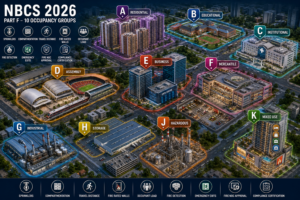
NBCS 2026 Part F defines 10 occupancy groups — A (Residential), B (Educational), C (Institutional), D (Assembly), E (Business, split into E-I and E-II Datacentres), F (Mercantile, split into F-I and F-II), G (Industrial), H (Storage), J (Hazardous), and K (Mixed Use). NBC 2016 had 9 groups. The two additions are Group K (Mixed Use, formally classified for the first time) and Group E-II (Datacentres, separated from general business). Minor occupancy threshold is raised from 10% to 30%.
What is Occupancy Classification and Why Does it Matter?
Occupancy classification is the foundation of fire safety design in any building code. The occupancy group a building is assigned to determines its required fire resistance ratings, sprinkler protection level, travel distances, compartment sizes, occupant load calculations, and dozens of other fire safety parameters.
Get the classification wrong — or fail to recognise when a building falls into multiple occupancy categories — and the entire fire safety design is built on a flawed premise. This is one of the most common root causes of Fire NOC rejection in India.
NBCS 2026 Part F Clause 3.1 establishes the occupancy classification framework. Understanding it is the essential first step for architects, fire safety engineers, facility managers, and building owners dealing with the new standard.
📋 Key Change from NBC 2016NBC 2016 Part 4 had 9 occupancy groups — A through J (skipping I). NBCS 2026 adds Group K for Mixed Use, splits Group E into E-I and E-II, and splits Group F into F-I and F-II. The minor occupancy threshold is raised from 10% to 30%.
Applicability Thresholds — When NBCS 2026 Applies
Before assigning an occupancy group, determine whether NBCS 2026 applies to the building at all. The following thresholds trigger full NBCS 2026 Part F compliance:
| Occupancy Group | Height Trigger | Area Trigger | Change from NBC 2016 |
|---|---|---|---|
| A — Residential | ≥ 24 m | 750 m² / floor | 24 m raised from 15 m |
| B — Educational | ≥ 9 m | 500 m² | 9 m lowered from 15 m |
| C — Institutional | ≥ 15 m | 500 m² | No change |
| D — Assembly | ≥ 9 m | 750 m² | 9 m lowered from 15 m |
| E — Business (E-I & E-II) | ≥ 15 m | 750 m² | No change in threshold |
| F — Mercantile (F-I & F-II) | ≥ 15 m | 1,000 m² | No change |
| G — Industrial | Any height | Total area > 2,000 m² | Area-based trigger clarified |
| H — Storage | ≥ 15 m | 1,000 m² | No change |
| J — Hazardous | Any height | Any area | No change |
| K — Mixed Use | Highest applicable occupancy threshold | Highest applicable area threshold | New formal classification |
💡 Self-Certification Provision — New in NBCS 2026Buildings with total floor area ≤ 500 m² AND height ≤ 24 m may use self-certification by a State-approved fire safety professional — without a full fire authority review. This provision did not exist in NBC 2016.
Minor Occupancy vs Mixed Occupancy — Critical Rule Change
When a building contains more than one type of occupancy, NBCS 2026 Clause 3.1 applies the following rule:
- Secondary occupancy ≤ 30% of floor area → Minor Occupancy. Building retains its primary occupancy classification. No additional separation requirements for the minor use.
- Secondary occupancy > 30% of floor area → Mixed Occupancy → Group K. Requires fire-rated separation between occupancy pairs as per the NBCS 2026 separation matrix.
This is a significant change from NBC 2016, which set the minor occupancy threshold at only 10%. The 30% threshold means many buildings previously classified as mixed occupancy can now be treated under their primary occupancy — simplifying compliance for a large number of buildings.
Group A — Residential
Apartments, row houses, hostels, dormitories, hotels, and boarding houses
Group A covers all buildings primarily used for sleeping and residential purposes. NBCS 2026 significantly expands the sub-classification of Group A — notably splitting hotels into A-IV (up to 4-star) and A-V (5-star and above) with different protection level requirements.
| Sub-Class | Description | Key Threshold |
|---|---|---|
| A-I | One and two family dwellings | NBC provisions apply; NBCS triggers at 24 m |
| A-II | Row housing, terraced housing | 2-storey: 0.75 m staircase width (new) |
| A-III | Flats and apartments | Sprinklers at ≥ 24 m; staircase 1.25 m |
| A-IV | Hotels and boarding houses — up to 4-star | CL-4 protection; 1.50 m staircase |
| A-V New | 5-star and above hotels | Higher protection level; separate requirements |
Key NBCS 2026 Fire Safety Requirements
- High-rise threshold raised to 24 m (was 15 m in NBC 2016)
- Sprinkler protection mandatory above 24 m
- Apartment staircase width reduced to 1.25 m (was 1.50 m) — more practical
- Hotel guest room corridors: 60-min compartmentation with 30-min fire doors
- A-V (5-star) hotels: higher baseline protection requirements than A-IV
- Occupant load: 12.5 m² net per person (unchanged)
- Travel distance: 30 m unsprinklered / 60 m sprinklered (up from 45 m)
Group B — Educational
Schools, colleges, universities, coaching centres, libraries, and training institutes
Group B covers all buildings used for education and training of people of all ages. The applicability threshold has been lowered to 9 m in NBCS 2026 — meaning many single-storey and double-storey school buildings that previously fell outside the code now require full fire safety compliance.
| Sub-Class | Description |
|---|---|
| B-I | Schools (up to Class 12), nurseries, kindergartens |
| B-II | Colleges, universities, professional institutes, coaching centres |
Key NBCS 2026 Fire Safety Requirements
- Applicability threshold lowered to 9 m height or 500 m² area
- AV/computer rooms and auditoriums: CL-3 sprinkler protection
- Staircase width: 1.50 m minimum
- Travel distance: 30 m unsprinklered / 45 m sprinklered
- Occupant load: 3.0 m² net per person (classroom)
- Dead-end corridor limit: 6 m
- Emergency lighting: mandatory in all escape routes
Group C — Institutional
Hospitals, nursing homes, aged care, children’s homes, jails, and mental health facilities
Group C is the most demanding occupancy in terms of life safety provisions because occupants typically cannot self-evacuate. NBCS 2026 significantly expands assisted evacuation provisions and defend-in-place strategies for this group.
| Sub-Class | Description | Key Feature |
|---|---|---|
| C-I | Hospitals — inpatient | Defend-in-place strategy; 11 m² net/person |
| C-II | Nursing homes, day surgery | 12 m² gross/person; assisted evacuation |
| C-III | Mental health, substance treatment | Access-controlled egress provisions |
| C-IV | Aged care, children’s homes | 750 m² compartments; 1,500 m² sprinklered |
| C-V | Prisons, detention centres | Controlled egress; special provisions |
Key NBCS 2026 Fire Safety Requirements
- Defend-in-place strategy formally recognised for hospital IPD
- Assisted evacuation provisions for non-ambulant patients
- Hospital IPD corridors: 60-min fire-rated walls + 30-min self-closing fire doors
- Staircase width: 2.00 m minimum for hospitals
- Compartmentation: 750 m² unsprinklered; 2,000 m² (hospitals) / 1,500 m² (aged care) sprinklered
- Travel distance: 30 m unsprinklered / 45 m sprinklered
Group D — Assembly
Theatres, cinema halls, auditoria, stadiums, places of worship, restaurants, malls, metro stations
Group D is the largest and most diverse occupancy group. NBCS 2026 adds metro stations (Cl. 6.4.4) as a specific sub-type of Assembly occupancy — a completely new provision absent from NBC 2016. Mall-like mixed occupancies (assembly + mercantile + cinema + restaurant) also get dedicated treatment.
| Sub-Class | Description |
|---|---|
| D-I | Assembly without fixed seating — halls, meeting rooms, exhibition areas |
| D-II | Assembly with fixed seating — theatres, auditoria, cinema halls |
| D-III | Restaurants, food courts, dining establishments |
| D-IV | Places of worship — temples, mosques, churches, gurudwaras |
| D-V | Outdoor stadiums and sports facilities |
| D-VI New | Metro stations and metro trainway occupancy |
Key NBCS 2026 Fire Safety Requirements
- Applicability threshold lowered to 9 m or 750 m²
- Exit door minimum width: 2,000 mm for assembly buildings (new)
- Staircase width: 2.00 m minimum (1.50 m if <150 persons)
- Occupant load — dining: 1.80 m² net/person (increased from 1.5 m²)
- Occupant load — concentrated (no seats): 0.65 m² net/person (unchanged)
- Travel distance: 30 m unsprinklered / 45 m sprinklered
- Metro stations (D-VI): Cl. 6.4.4 dedicated provisions — underground, elevated, at-grade
- Swimming pool water surface: 3.5 m² net/person (new)
Group E — Business E-II New
Offices, banks, professional services — and now datacentres as a dedicated sub-class
The most significant change in occupancy classification between NBC 2016 and NBCS 2026 is the creation of Group E-II for datacentres. Previously, datacentres fell under general Business occupancy with no specific provisions. E-II recognises that datacentres are machine-environment buildings with fundamentally different fire risks from human-occupied offices.
| Sub-Class | Description | Key Difference |
|---|---|---|
| E-I | Human-occupied business — offices, banks, professional services | Standard business provisions |
| E-II New | Machine-environment — datacentres, server farms, colocation facilities | VESDA, pre-action/gas suppression, always sprinklered |
Key NBCS 2026 Group E-II Requirements — Datacentres
- Sprinkler protection mandatory throughout — no unsprinklered option
- Aspiration high-sensitivity (VESDA-type) detection in server rooms and data halls
- Clean agent gas suppression OR pre-action sprinkler in data halls
- Maximum compartment size: 2,000 m² (sprinklered)
- Occupant load — data halls: 50 m² gross per person
- Occupant load — admin areas: 20 m² gross per person
- Travel distance: 60 m (sprinklered only — unsprinklered not applicable)
- All critical rooms (UPS, battery, electrical, server): 2-hour fire-rated enclosure
Key NBCS 2026 Group E-I Requirements — Business
- Occupant load: 7.1 m² net per person (made more conservative from 9.3 m² in NBC 2016)
- Travel distance: 30 m unsprinklered / 60 m sprinklered (increased from 45 m)
- Staircase width: 1.50 m minimum
Group F — Mercantile F-II New
Shops, markets, retail centres, department stores — and underground shopping as F-II
NBCS 2026 splits Mercantile occupancy into F-I (above-grade retail) and F-II (underground shopping centres) — recognising that underground retail presents fundamentally different fire safety challenges in terms of smoke management, egress, and firefighting access.
| Sub-Class | Description |
|---|---|
| F-I | Shops, markets, department stores, malls at or above grade |
| F-II New | Underground shopping centres and below-grade retail complexes |
Key NBCS 2026 Fire Safety Requirements
- F-I — Mall occupant loads: street floor 2.1 m² net/person; upper floors 4.3 m² net/person; food court 1.8 m² gross/person (all new)
- F-II — Sprinkler mandatory; compartment max 2,000 m²
- F-II — Minimum 2 independent exits from each underground level
- Travel distance: 30 m unsprinklered / 45 m sprinklered
- High-ceiling ground floor ≥10 m with sprinklers: travel distance may be doubled
Group G — Industrial
Manufacturing plants, workshops, processing facilities — classified by fire hazard level
Group G covers all industrial manufacturing and processing occupancies, classified by the fire hazard level of the processes and materials involved. The three-tier hazard classification is retained from NBC 2016 with updated guidance on high-hazard materials.
| Sub-Class | Hazard Level | Examples | Key Requirement |
|---|---|---|---|
| G-1 | Low hazard | Assembly, packaging, printing, woodwork | Travel distance 45/60 m; 1,500 m² compartment unsprinklered |
| G-2 | Moderate hazard | Dry cleaning, leather goods, auto workshops | Travel distance 45/60 m; fire separation required |
| G-3 | High hazard | Flammable liquid processing, aerosol manufacture, pyrotechnics | Sprinkler mandatory; travel distance 22.5/45 m; 500 m² compartment |
Key NBCS 2026 Fire Safety Requirements
- Applicability: any height when total area exceeds 2,000 m²
- Tables 9–11: hazard-specific detection and suppression suitability matrix (new)
- EV charging areas in industrial facilities: always compartmented
- Occupant load: G-1: 20 m² gross; G-2: 15 m² gross; G-3: 10 m² gross
- Industrial compartment (G-1, height <6.7 m): 1,500 m² unsprinklered / 10,000 m² sprinklered
Group H — Storage
Warehouses, cold storage, bulk storage facilities, and parking structures
Group H covers all buildings used primarily for the storage of goods. Car parking structures — both open and enclosed — fall under Group H. NBCS 2026 adds comprehensive provisions for EV parking in Annex G, which applies to Group H car park buildings.
Key NBCS 2026 Fire Safety Requirements
- Occupant load: 30 m² gross per person (unchanged)
- Travel distance: 30 m unsprinklered / 90 m sprinklered (increased significantly from 60 m)
- Warehouse compartment (<5 m height): sprinkler mandatory; 5,000 m² with sprinklers
- EV parking (Annex G): CL-5 protection, rate-of-rise heat sensors, compartmentation
- Car parking occupant load: 30 m² per person (under any other occupancy)
Group J — Hazardous
Buildings storing or handling explosive, highly flammable, or toxic materials
Group J covers buildings that handle materials posing extreme fire, explosion, or toxic risk — including explosive storage, highly flammable liquids in bulk, compressed gases, and toxic chemical storage. Annex B provides the detailed industrial hazard classification list.
Key NBCS 2026 Fire Safety Requirements
- Sprinkler installation mandatory throughout — no unsprinklered option
- Maximum compartment size: 500 m² (sprinklered)
- Travel distance: 22.5 m unsprinklered / 30 m sprinklered
- Occupant load: 10 m² gross per person
- Tables 9–11: hazard-specific suppression system suitability required
- Strict separation from other occupancies when in mixed use
Group K — Mixed Use New in NBCS 2026
Buildings combining two or more occupancies where the secondary use exceeds 30% of floor area
Group K is entirely new to NBCS 2026. It formally classifies mixed-use buildings for the first time in Indian building standards. Previously, mixed occupancy was dealt with under general provisions without a dedicated group. Group K triggers when any secondary occupancy exceeds 30% of the total floor area.
The critical fire safety requirement for Group K is fire-rated separation between each pair of occupancies. NBCS 2026 provides a matrix specifying the required rating between every combination:
| Occupancy Pair | A (Residential) | B (Educational) | C (Institutional) | D (Assembly) | E (Business) | F (Mercantile) | G (Industrial) |
|---|---|---|---|---|---|---|---|
| A — Residential | — | 120 min | 120 min | 120 min | 90 min | 120 min | 240 min |
| B — Educational | 120 min | — | 90 min | 90 min | 90 min | 120 min | 180 min |
| C — Institutional | 120 min | 90 min | — | 120 min | 90 min | 120 min | NP |
| D — Assembly | 120 min | 90 min | 120 min | — | 60 min | 90 min | 180 min |
| E — Business | 90 min | 90 min | 90 min | 60 min | — | 60 min | 120 min |
NP = Not Permitted combination. Values shown are indicative — full matrix in NBCS 2026 Cl. 3.1.11.
Key NBCS 2026 Group K Requirements
- Triggered when secondary occupancy exceeds 30% of floor area (was 10% in NBC 2016)
- Fire-rated separation between each occupancy pair as per NBCS 2026 matrix
- Each occupancy zone must meet its own individual fire safety requirements
- Certain occupancy combinations are Not Permitted — e.g. Institutional + Industrial
- Separate fire detection zones and suppression systems for each occupancy
- Change of occupancy always requires fire authority approval (Cl. 3.1.14)
Summary — What Changed from NBC 2016 to NBCS 2026
| Change | NBC 2016 Part 4 | NBCS 2026 Part F |
|---|---|---|
| Total occupancy groups | 9 (A–J, no I) | 10 (A–K) |
| Mixed Use classification | General provisions only | Group K — formal class |
| Datacentre classification | Under Group E (Business) | Group E-II — dedicated class |
| Underground retail | Under Group F (Mercantile) | Group F-II — dedicated sub-class |
| Metro stations | Under Group D (Assembly) — general | Group D-VI — specific provisions Cl. 6.4.4 |
| Minor occupancy threshold | 10% of floor area | 30% of floor area |
| Residential high-rise trigger | 15 m | 24 m |
| Educational high-rise trigger | 15 m | 9 m |
| Hotel classification | Single A-IV category | A-IV (≤4-star) and A-V (5-star+) |
| Self-certification | Not available | ≤500 m² and ≤24 m: permitted |