
NBCS 2026 Part F replaces NBC 2016 Part 4 as India’s fire safety reference standard. Key changes include: a raised high-rise threshold (24 m for residential), a new datacentre occupancy class (Group E-II), mandatory EV parking fire safety, metro station provisions, dramatically expanded compartmentation rules, and 14 new detection technologies. Crucially, NBCS 2026 is advisory — not a mandatory code. State adoption determines enforceability.
The Bureau of Indian Standards released the National Building Construction Standards (NBCS) 2026 in May 2026 — the first comprehensive revision of India’s fire safety building standard since NBC 2016. At 269 pages (vs approximately 120 in NBC 2016 Part 4), Part F covers fire prevention, life safety, and fire protection with substantially more depth, new occupancy types, and technology-specific guidance that reflects how buildings and fire risks have evolved over the last decade.
This article provides a structured comparison for fire safety engineers, facility managers, architects, and compliance professionals. We cover every major section where the two standards diverge.
⚠ Important Note on Legal StatusNBCS 2026 Part F explicitly states it is “only for guidance and referral for the state government/local authority.” Fire Services is a State subject under Article 243(w) of the Constitution. NBC 2016 was framed as a mandatory national code. This shift is significant — NBCS 2026 becomes enforceable only when a State Government adopts it through Building Bye-Laws or their Fire Services Act. Check your applicable State regulation before assuming compliance obligations.
1. Document Structure & Scope
NBC 2016 Part 4 was a single part within the larger National Building Code. NBCS 2026 Part F is similarly structured but stands at more than double the page count, primarily due to expanded tables, new annexures, and technology-specific guidance.
| Aspect | NBC 2016 Part 4 | NBCS 2026 Part F |
|---|---|---|
| Volume | ~120 pages | 269 pages |
| Annexures | A to H (8 total) | A to N (14 total) |
| Legal status | Mandatory code reference | Advisory/guidance only |
| Definitions | ~40 terms | 70 terms (Cl. 2.1–2.70) |
| Occupancy groups | 9 groups (A–J) | 10 groups (A–K, adding Mixed Use) |
Applicability Thresholds
NBC 2016 applied broadly based on a 15 m “high-rise” trigger for most occupancies. NBCS 2026 introduces a more nuanced table:
| Occupancy | NBC 2016 Height Trigger | NBCS 2026 Height Trigger | NBCS 2026 Area Trigger |
|---|---|---|---|
| Residential | ≥15 m | ≥24 m Changed | 750 m² |
| Educational | ≥15 m | ≥9 m Changed | 500 m² |
| Institutional | ≥15 m | ≥15 m ✓ | 500 m² |
| Assembly | ≥15 m | ≥9 m Changed | 750 m² |
| Business | ≥15 m | ≥15 m ✓ | 750 m² |
| Mercantile | ≥15 m | ≥15 m ✓ | 1,000 m² |
| Industrial G-1, G-2 | Height + area | Any height, total area >2,000 m² | 2,000 m² |
Two new applicability provisions are notable: self-certification is now allowed for buildings ≤500 m² and ≤24 m height by a State-approved professional; and Performance-Based Design (PBD) is formally scoped in Cl. 1.4 and Annex M, though restricted to heritage buildings and large special-purpose buildings with State authority approval.
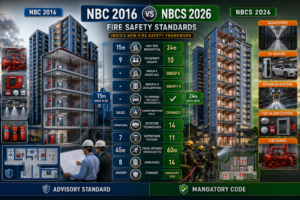
Key differences between NBCS 2026 Part F and NBC 2016 Part 4, including EV parking safety, datacentre fire protection, compartmentation, and updated fire safety requirements.
2. Occupancy Classification — What’s New
Group K: Mixed Use (New)
NBC 2016 treated mixed occupancy as a general provision. NBCS 2026 creates Group K as a formal occupancy class, with a detailed matrix specifying the fire resistance rating required between every pair of occupancies.
🔥 Key Rule: Minor Occupancy Threshold RaisedNBC 2016 allowed incidental occupancy up to 10% of floor area without reclassification. NBCS 2026 raises this to 30%. Only beyond 30% does the building get classified as mixed occupancy (Group K).
Group E-II: Datacentres (New)
This is one of the most significant additions. NBC 2016 lumped datacentres under general Business occupancy. NBCS 2026 creates a dedicated sub-classification E-II with its own occupant loads, travel distances, detection technology, and suppression requirements — reflecting the explosion of datacentre construction in India.
Hotels Split: A-IV and A-V
Hotels are now split into A-IV (up to 4-star) and A-V (5-star and above) with separate protection level requirements. Five-star hotels have higher baseline requirements including mandatory CL-5 protection up to 60 m height.
Mercantile: F-II Underground Shopping
Underground shopping centres are formally classified as Group F-II with specific requirements distinct from above-grade retail.
3. Life Safety — Exit and Egress Changes
Travel Distances (Table 4)
Travel distances with sprinklers have been extended for several occupancies:
| Occupancy | NBC 2016 Sprinklered | NBCS 2026 Sprinklered | Change |
|---|---|---|---|
| Residential (A) | 45 m | 60 m | +15 m |
| Business (E) | 45 m | 60 m | +15 m |
| Storage (H) | 60 m | 90 m | +30 m |
| Datacentre (E-II) | Not listed | 60 m | New |
| Educational, Institutional, Assembly, Mercantile | 45 m | 45 m | No change |
| Industrial G-1/G-2 | 60 m | 60 m | No change |
Key Exit Requirement Changes
Residential riser max: 190 mm
Residential stair width (1-2 family): 0.90 m
Apartment stair width: 1.50 m
Residential riser max: 175 mm
Residential stair width (1-2 family): 1.00 m
Apartment stair width: 1.25 m
New Basement Rules (Cl. 4.2.19)
Basement safety provisions are significantly tightened. NBCS 2026 now explicitly prohibits the following uses in basements:
- Sleeping purposes
- Classrooms
- Hazardous industry operations
- Restaurant kitchens using LPG
- Battery rooms and UPS rooms
- Fuel oil storage
Additional basement requirements: minimum clear height raised to 3.4 m; minimum 2 independent exits mandatory in all cases; smoke ventilation systems and high-density sprinklers required.
4. Compartmentation — Major Overhaul
Compartmentation is the most dramatically expanded section in NBCS 2026. NBC 2016 provided basic guidance on fire barriers. NBCS 2026 introduces five formal barrier types and a detailed 13-row Table 6 with sprinklered and unsprinklered compartment sizes for every building category.
Five Formal Barrier Types (New)
| Type | Description |
|---|---|
| Type A | Masonry construction with fire-rated door assembly |
| Type B New | Fire-rated fabric dropdown curtain assembly (3 sub-types by integrity + radiation + insulation ratings) |
| Type C New | Fire-rated glazed partition and door assembly (2 sub-types) |
| Type D New | Gypsum board / cementitious board assembly |
| Type E New | Masonry construction with fire-rated metal sliding door |
Compartment Size Table (Selected, Table 6)
| Building Type | Without Sprinkler | With Sprinkler |
|---|---|---|
| Enclosed basement car parking | 750 m² | 5,000 m² |
| Hospitals / nursing homes | 750 m² | 2,000 m² |
| Custodial (aged / children) | 750 m² | 1,500 m² |
| Business buildings | 750 m² | 3,000 m² |
| Hotels | 750 m² | 3,000 m² |
| Datacentres (E-II) | Sprinkler mandatory | 2,000 m² |
| Industrial (<6.7 m height) | 1,500 m² | 10,000 m² |
| Hazardous buildings | Sprinkler mandatory | 500 m² |
| Warehouses (<5 m height) | Sprinkler mandatory | 5,000 m² |
Always-Required Compartmentation (New, Cl. 4.5.3.2)
Regardless of size or area, the following rooms must always be enclosed with 2-hour fire-rated construction:
- Electrical rooms, UPS rooms, battery rooms
- Server rooms, IT networking rooms, MDF/IDF rooms
- Lift machine rooms
- Network switch rooms, MCR rooms, MUX rooms, telecom equipment rooms
- Janitor storage rooms, chemical storage rooms, QA/QC laboratories
Also new: all live cooking areas (any fuel — induction, LPG, PNG) must be segregated with 120 min fire-rated construction (Cl. 4.5.3.6). Pantries, buffet stations, and microwave areas are exempt.
5. EV Parking Fire Safety — Entirely New
NBC 2016 had no provisions for electric vehicle parking. NBCS 2026 introduces a complete framework:
- All buildings with EV parking in podium or basements → sprinklered to CL-5 level (the highest protection level)
- Rate-of-rise heat sensors mandatory in EV parks and charging areas
- Smoke detectors in all basement areas except ICE vehicle parks
- CO sensors in ICE vehicle parks to activate ventilation systems
- EV charging areas must be compartmented
- Buildings closer than 9 m apart with EV parking → CL-5 protection regardless of other factors
⚡ Practical ImpactIf you are developing any building with an EV charging facility in the basement or podium — residential, commercial, or mixed-use — NBCS 2026 mandates the highest protection level. This affects budgets, sprinkler design, and fire alarm specifications significantly.
6. Datacentre Fire Safety (Group E-II)
The creation of Group E-II is arguably the most consequential new occupancy classification in NBCS 2026, given the pace of datacentre investment in India.
| Provision | NBC 2016 Part 4 | NBCS 2026 Part F (E-II) |
|---|---|---|
| Occupancy class | Under Business (Group E) | Dedicated Group E-II |
| Occupant load — data halls | Not specified | 50 m² gross/person |
| Occupant load — admin areas | 9.3 m² net/person | 20 m² gross/person |
| Travel distance | 30/45 m (un/sprinklered) | NA unsprinklered / 60 m sprinklered |
| Compartmentation | Not specified | 2,000 m² (sprinklered, mandatory) |
| Smoke detection | Standard fire alarm | Aspiration high-sensitivity (VESDA-type) |
| Suppression options | General | Clean agent gas or pre-action sprinkler |
| Sprinkler requirement | Area-based | Always mandatory |
7. Fire Detection and Suppression — New Technologies
NBC 2016 referenced IS 2189 broadly. NBCS 2026 goes further, formally classifying 14 detection technologies and 11 suppression systems with a hazard-suitability matrix (Tables 9–11) — a first for any Indian building standard.
New Detection Technologies Formally Recognised
- Pneumatic linear high-sensitivity heat detection (copper/steel/Teflon tubing)
- Aspiration high-sensitivity smoke detection (VESDA-type)
- Flame / gas / spark detection (UV, IR, multi-spectrum)
- Video smoke/flame detection
- Gas detection (CO, CO₂, H₂, LPG, refrigerants)
- Fuel leak detection (hydrocarbon sensing cables)
- High-ceiling beam detectors (for spaces >8 m)
- Linear heat sensing cable
- Probe-type heat detectors
New Suppression Systems Formally Recognised
- Automatic water mist systems (Cl. 5.1.8)
- Extinguishing systems with clean agents (Cl. 5.1.9)
- Modular panel/rack suppression systems
- Nitrogen injection systems
- Aerosol-based fire suppression systems
- Wet chemical kitchen suppression systems
💡 New Rule on Hypoxic Air TechnologyNBCS 2026 explicitly prohibits hypoxic air (oxygen-reduced atmosphere) fire prevention systems in occupiable areas, citing tenancy concerns. This technology must be used only with specific caution and authority consultation.
8. Fire Protection System Upgrades
Pump and Water Storage Changes
- Soft starter or VFD mandatory for all fire pumps (was not specified in NBC 2016)
- Pump shutoff pressure: must not exceed 12 bar for buildings >60 m
- Multi-level pumping required for building clusters >45 m; water storage at every 45 m above ground
- Cluster of buildings: 2,500 lpm at 10 bar + 2,55,000 litres water storage for up to 5 buildings
- Water storage sharing now permitted between adjacent properties/industry clusters
- Dry riser alternative now formally permitted where municipal supply maintains 24×7 adequate pressure
Sprinkler Installation Changes
- All ramps at all levels must be sprinkler-protected (new requirement)
- Sprinkler flow switches must be monitored by fire alarm panel
- Provisions mandatory to prevent water from sprinkler/hydrant operations entering lifts and electrical rooms
- Pendant sprinkler without false ceiling: 250 mm circular plate required around sprinkler head
- Sprinkler piping may match interiors but must have 100 mm red band every 3 m; heads must never be painted
Smoke Exhaust Fan Rating (New)
All mechanical smoke exhaust fans must now be fire-rated at 250°C for 120 minutes — a specific requirement absent from NBC 2016.
9. Gas Safety — New Provisions
- LPG kitchens explicitly prohibited in basements — only induction/PNG/electricity-based kitchens permitted (Cl. 4.7.9)
- Gas lines prohibited in: enclosed staircases, electrical shafts, escape routes, refuge areas/floors (Cl. 4.7.8)
- Seismic shut-off valve now required at main distribution point for mixed-use assembly and institutional buildings >15 m (Cl. 4.7.5)
- Buildings >100 m using LPG reticulation: gas leak detectors mandatory, monitored from fire command centre, using circuit integrity cables (Cl. 4.7.7)
10. New Annexures in NBCS 2026
| Annexure | Topic | Status |
|---|---|---|
| Annex F | Requirements for Data Centres | New |
| Annex G | Car Parking Facilities (incl. EV charging) | New |
| Annex K | Refuge Area Design Requirements | New |
| Annex M | Performance-Based Fire Safety Design | New |
| Annex A | Calorific Values of Common Materials | Retained |
| Annex B | Industrial Hazard Classification | Retained |
| Annex C | Fire Resistance Data (expanded — steel protection) | Expanded |
| Annex D | Additional Requirements for High-Rise Buildings | Expanded |
| Annex E | Atrium Requirements | Retained |