
Most arc flash labels I’ve seen on Indian factory floors are wrong.
Some show 2002-era calculations that haven’t been touched since. Others show numbers copied straight from a switchgear vendor’s catalogue, which is not how arc flash works. And a fair number show nothing useful at all, just a sticker that says “Danger” with no incident energy value, no boundary, no PPE category.
That’s the state of arc flash assessment in a lot of Indian plants right now. And it’s a problem, because an arc flash event at a 415V MCC can release 8 cal/cm² in under 200 milliseconds. That’s enough to cause third-degree burns through cotton overalls.
This post walks through what an arc flash assessment actually is, what’s changed in the calculation method since 2018, and how to know if your last study is still defensible.
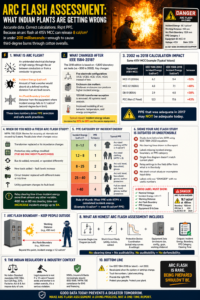
Outdated arc flash studies put workers at risk. Learn how IEEE 1584-2018 changed electrical safety assessments and PPE requirements.
What an arc flash assessment actually does
An arc flash assessment calculates two numbers for every piece of energised equipment in your plant.
Incident energy (cal/cm²) tells you how much heat a worker would absorb at a defined working distance if an arc fault occurred. Arc flash boundary (mm or inches) tells you how far away from the equipment a person needs to be to avoid a second-degree burn.
From those two numbers, you select PPE. A 6 cal/cm² calculation means the worker needs an arc-rated suit with at least 8 cal/cm² rating. A 40 cal/cm² calculation means full Category 4 PPE, a hood, voltage-rated gloves, and probably a hard look at whether the work needs to be energised at all.
The assessment is the engineering input. The label, the PPE matrix, and the work permit system are the outputs.
Why arc flash study results changed after 2018
IEEE 1584 is the calculation standard. It was rewritten in 2018, and the new model is based on roughly 1,800 laboratory arc tests. The previous edition used about 300.
A few things shifted.
The new model recognises five electrode configurations (VCB, VCBB, HCB, VOA, HOA) instead of two. Configuration affects how the arc plasma behaves inside an enclosure, and that affects incident energy by a meaningful margin. The 2002 model lumped most enclosures together. The 2018 model doesn’t.
Enclosure size now matters explicitly. A shallow 480V/2000A panel can produce higher incident energy than a deeper one of the same rating, because the plasma ejects toward the worker faster.
The 125 kVA transformer exception is gone. Earlier, you could skip arc flash analysis for systems fed by transformers under 125 kVA. The 2018 standard removed that carve-out.
The practical result: when plants recalculate using the 2018 model, incident energy values often go up by 20 to 50 percent on the same equipment. PPE that was adequate in 2017 may not be today.
If your last arc flash risk assessment was done before late 2019 and uses 2002 equations, you’re working with stale data.
When you actually need a fresh study
NFPA 70E-2024 says incident energy analysis must be reviewed for accuracy at intervals not exceeding five years. Reviewed isn’t the same as recalculated.
A review checks whether anything has changed. A recalculation runs the numbers again.
You need a recalculation when:
- A transformer is replaced or its impedance changes
- Protective relay settings are modified (this is the big one most plants miss)
- A bus tie is added, removed, or operated differently
- New loads push fault levels up
- A circuit breaker is replaced with one of a different make or trip time
- The utility upstream changes its fault level
Relay settings deserve special attention. I’ve seen plants spend ₹6 lakh on an arc flash study, then have a contractor “fine-tune” the overcurrent relays six months later, and now every label in the plant is technically wrong. The arc duration drives incident energy more than almost any other variable. A relay that takes 400 ms to clear instead of 80 ms can quintuple the cal/cm² value.
What an honest arc flash assessment looks like
A defensible study has these inputs:
- A short-circuit study with utility fault contribution, motor contributions, and cable impedances modelled
- A protective device coordination study showing actual relay curves and their settings
- Equipment data: enclosure dimensions, electrode configuration, working distance, gap between conductors
- Single-line diagram that matches the plant as it stands today, not as it was commissioned
The output should include the cal/cm² value at each bus, the arc flash boundary, the recommended PPE category, and the assumed clearing time. If the report doesn’t show clearing times, you can’t audit it.
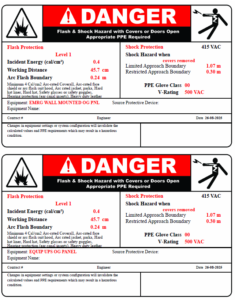
Labels go on every piece of equipment a qualified person might work on while energised. MCCs, distribution boards, switchgear, large drives, capacitor banks. The label needs nominal voltage, incident energy, working distance, arc flash boundary, and equipment ID that ties back to the SLD.
The Indian regulatory situation
There’s no Indian standard that mandates arc flash assessment the way OSHA and NFPA 70E do in the US. CEA Regulations 2010 require safe working procedures for electrical work. The Factories Act asks for safe systems. IS 5216 covers electrical safety guidance. None of them say “thou shalt calculate incident energy per IEEE 1584.”
But the legal exposure is real. If a worker is injured in an arc flash event and the investigation finds that the employer issued cotton overalls when a 12 cal/cm² hazard was present, the question of whether IEEE 1584 was “mandatory” becomes academic. The duty of care under the Factories Act and the IE Act is sufficient.
Multinationals operating in India usually require IEEE 1584 / NFPA 70E compliance through their global EHS standards. So do most insurers underwriting industrial assets above ₹50 crore. Banks financing greenfield projects increasingly ask for arc flash documentation as part of lender’s engineer reports.
For domestic plants, the question is usually framed as: do we wait for an incident, or do we get ahead of it?
How long an assessment takes and what drives the cost
A typical arc flash study for a mid-sized Indian plant (one 11kV incomer, two transformers, 8 to 12 LV panels, 30 to 50 motor starters) runs about 10 to 15 working days.
Roughly:
- 2 to 3 days site survey
- 4 to 5 days modelling and short-circuit calculation
- 2 days protection coordination
- 2 days arc flash calculation and report
- 1 day labelling
What pushes cost up: missing protection settings (we’ve had to commission tests), poor SLD documentation, multiple incomers with parallel operation, captive generation, and unusual configurations like ring mains or DC systems.
What keeps cost down: good drawings, accessible relay set sheets, a single point of contact who knows the system, and a willingness to schedule the survey when panels can actually be opened.
A quick way to check if your current study holds up
Pull out your most recent arc flash report. Look at five things.
- Does the methodology section cite IEEE 1584-2018? If it cites 2002, the numbers are old.
- Does it list the electrode configuration for each bus? If every bus shows the same configuration, the engineer probably didn’t field-verify.
- Is the clearing time shown for each calculation? If not, you can’t tell whether the result is sensitive to relay settings.
- Was the protection coordination study done by the same firm at the same time? If the arc flash study used assumed settings rather than measured ones, treat it as a desktop estimate.
- Have relay settings changed since the study? Check the maintenance log and the relay event records.
If three or more of those answers go the wrong way, you need a fresh study before your next planned shutdown.
Where Elion fits
Elion conducts arc flash studies for industrial clients across India, using IEEE 1584-2018 methodology with ETAP or EasyPower modelling. Every study includes the short-circuit calculation, protection coordination, incident energy analysis, and field labelling, signed off by a qualified electrical engineer.
If you’re planning a study or want a second opinion on the one you already have, write to us at elion.co.in or call us. Happy to take a look at your SLD and tell you what a defensible scope would cost for your plant.
Related reading: power quality audit, electrical safety audit, energy audit, QRA. All available at elion.co.in.