
Walk into any industrial facility in India, and you’ll find an SLD (single-line diagram) somewhere — possibly taped to a control room wall, possibly buried in a cabinet, and possibly embarrassingly out of date. That last part is a problem. A serious one.
A single-line diagram is the electrical backbone of every commercial and industrial facility. It summarizes the entire power distribution system — from the incoming supply point down to every feeder, transformer, switchgear, and protective device — in a clean, simplified schematic. Get it wrong, and you’re not just looking at a paperwork gap. You’re looking at arc flash incidents, failed safety audits, and equipment damage that could have been avoided.
This article breaks down what SLD verification actually involves, why regular updates are non-negotiable, and how Indian facilities can stay compliant and safe.
What Is a Single-Line Diagram (SLD) and Why Does It Matter?
An SLD is the foundational document for any electrical system. It gives engineers, auditors, and electricians a bird’s-eye view of how power flows through a facility — without showing every wire. It’s “single-line” because it represents three-phase systems with a single conductor line for clarity.
SLDs are required by the Bureau of Indian Standards (BIS) under IS 5083 and aligned with the Central Electricity Authority (CEA) Regulations, 2010, which mandate accurate electrical documentation for all HT (high-tension) and LT (low-tension) installations. They are also a core requirement during electrical safety audits, energy audits, and arc flash assessments.
Here’s what makes them so critical: every protective relay coordination study, every arc flash hazard calculation, and every load flow analysis depends on the data in the SLD. If the SLD says a transformer is rated 1000 kVA but it was replaced with a 1600 kVA unit three years ago — every protection study done since then is based on fiction.
What Does SLD Verification Actually Involve?
SLD verification is the process of cross-checking every element in the diagram against the actual installed equipment. It’s not a desk exercise — it requires a physical walkdown of the electrical distribution network.
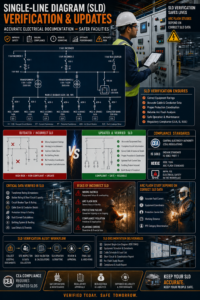
A thorough SLD verification covers:
- Incoming supply details — voltage level, supply authority (DISCOM), number of feeders, metering arrangement
- Transformers — kVA rating, voltage ratio (e.g., 11kV/433V), vector group (Dyn11), impedance percentage, and cooling type
- Switchgear — type (ACB, VCB, MCCB, MCB), rating in amps, breaking capacity (kA), and make/model
- Busbars — rated current, material (copper/aluminium), fault level withstand
- Cables — size, material, type, and route
- Protection relays — type, settings, coordination status
- Capacitor banks and power factor correction equipment
- Earthing/grounding arrangements
- Emergency and standby systems — DG sets, UPS, ATS (Automatic Transfer Switch)
Every discrepancy between the diagram and the installed condition is logged as a “finding” with a risk rating. This becomes the basis for the corrected, updated SLD.
How Often Should SLD Verification Be Done?
An SLD should be verified at least once every three years — or immediately after any significant change to the electrical system.
This is not a random number. The CEA (Measures Relating to Safety and Electric Supply) Regulations, 2010 require annual electrical inspections of HT installations and periodic re-verification of documentation. The National Electrical Code (NEC) of India and insurance frameworks for industrial facilities similarly reinforce the need for current, accurate drawings.
In practice, most facilities update their SLDs only when forced to — during an audit, after an incident, or when a regulatory authority visits. That’s reactive. A proactive verification schedule catches problems before they become hazards.
Trigger points that must prompt an immediate SLD update include:
- Addition or removal of any transformer, switchboard, or major load
- Change in incoming supply voltage or capacity
- Replacement of protective devices (relays, breakers) with different ratings
- Expansion of the facility — new wings, new production lines, new buildings
- Change in DG set capacity or paralleling arrangement
- Any incident involving electrical failure, trip, or arc flash event
What Are the Most Common Errors Found During SLD Verification?
The most frequent issue is outdated ratings — transformers upgraded, breakers changed, cables rerouted — but the drawing never caught up. Here are the top discrepancies found during professional SLD audits:
1. Wrong Transformer Ratings
Facilities often upsize transformers without updating documentation. A site showing a 500 kVA transformer may actually have a 750 kVA or 1000 kVA unit installed — which completely changes the fault current levels at the LT busbar.
2. Missing or Incorrectly Rated Protective Devices
This is a major arc flash risk. If an MCCB of 200A breaking capacity is shown on the SLD but a 400A device has been installed — the protection coordination is wrong. Personnel relying on the diagram for arc flash PPE selection may be dangerously under-protected.
3. Absent Earthing Details
Many SLDs omit the earthing system entirely, or show a generic “earth” symbol without specifying electrode count, resistance values, or connection type. IS 3043 (Code of Practice for Earthing) requires specific earthing design documentation.
4. DG Set Integration Not Shown
Standby generation is frequently added as an afterthought. The interlocking arrangement (how the DG connects to the grid supply), the ATS logic, and the changeover mechanism are often absent from legacy SLDs.
5. Disconnected or Bypassed Devices
Equipment shown as “active” on a drawing may have been physically removed, bypassed, or decommissioned. This is especially common in older facilities that have gone through multiple expansions.
Why Is SLD Accuracy Critical for Arc Flash Studies?
Arc flash calculations are only as accurate as the data fed into them — and the SLD is the primary data source.
IEEE 1584 (Guide for Performing Arc Flash Hazard Calculations) is the globally referenced standard for arc flash analysis, and it requires detailed knowledge of transformer impedance, protective device ratings, their settings, and upstream fault current levels. All of this comes from the SLD.
An error in transformer rating of even 20% can change the incident energy at a panel from a Category 2 hazard (requiring an 8 cal/cm² rated suit) to a Category 3 hazard (requiring a 25 cal/cm² rated suit). Wearing the wrong PPE because of an incorrect SLD is a compliance failure and a life safety risk.
In 2022, the National Fire Protection Association (NFPA 70E) reinforced that electrical safety programs must be based on verified, up-to-date equipment documentation — not assumptions or memory.
What Is the Process for Updating an SLD After Verification?
Updating an SLD is a structured technical process — not just redrawing lines. Here’s how professional electrical engineering firms handle it:
Step 1: Physical Walkdown and Data Collection
Engineers physically inspect every distribution board, transformer, switchgear panel, and cable route. Photos are taken, equipment nameplates are recorded, and relay settings are documented.
Step 2: Comparison with Existing Documentation
The collected field data is compared line by line with the existing SLD. Discrepancies are highlighted and classified by severity.
Step 3: Drafting the Updated SLD
Using AutoCAD Electrical, ETAP, or similar software, the updated diagram is prepared. Modern SLDs produced for Indian facilities typically follow IS 5083 symbols and include a revision block tracking every change made.
Step 4: Validation and Engineer Sign-off
The updated SLD is reviewed by a qualified electrical engineer (ideally a licensed Electrical Inspector or certified energy auditor). Signatures and stamps create the document trail required for regulatory compliance.
Step 5: Distribution and Version Control
The finalized SLD is distributed to the maintenance team, pasted in the control room, and filed with the electrical safety management records. Old versions are archived — not destroyed — for audit trail purposes.
Know about – The Ultimate Guide to Creating Accurate and Effective Single Line Diagrams
How Does SLD Verification Support Regulatory Compliance in India?
India’s electrical safety regulatory framework makes SLD accuracy a legal requirement, not just a best practice.
The CEA (Measures Relating to Safety and Electric Supply) Regulations, 2010 require every consumer installation above 250 kVA to maintain updated single-line diagrams and submit them to the State Electrical Inspectorate. Non-compliance can result in disconnection of supply, penalties, or refusal of occupancy certificates.
Beyond the CEA, accurate SLDs are a prerequisite for:
- Electrical Safety Audits — mandated under various State Factory Acts, including for installations under the Factories Act, 1948
- Energy Audits — the Bureau of Energy Efficiency (BEE) requires accurate baseline data, and the SLD is a core document for any energy audit report
- Fire NOC and Insurance — insurers increasingly require verified SLDs as part of risk assessment, especially for high-value industrial premises
- ESG and Sustainability Reporting — for facilities targeting ISO 50001 (Energy Management) or ISO 14001 (Environmental Management), accurate energy flow documentation is essential
What Technology Is Being Used for SLD Verification Today?
Digital tools and AI-assisted review are changing how SLD verification is conducted — making it faster, more accurate, and better documented.
Traditional SLD verification was paper-intensive and slow. Today’s methods include:
- ETAP and SKM software for live single-line modeling with real-time load flow and fault analysis
- Digital SLDs with embedded asset data — each element hyperlinks to equipment datasheet, maintenance records, and test reports
- Thermal imaging (thermography) during walkdowns to identify hot spots invisible to the naked eye — often conducted alongside SLD verification
- OCR-based SLD digitization — older hand-drawn or paper SLDs are scanned and converted to editable digital files, enabling comparison and updating without starting from scratch
- BIM integration for greenfield and major brownfield projects, where the SLD lives as part of a broader digital twin
For older Indian industrial facilities especially, OCR-based digitization of legacy SLDs is becoming an important first step — converting decades-old paper drawings into working digital documents before verification can even begin.
What Should You Look for in an SLD Verification Service Provider?
Not every electrical consultant is equipped for this work. SLD verification requires a combination of field experience, software capability, and regulatory knowledge.
When evaluating a service provider, check for:
- Qualified electrical engineers with experience in HT/LT systems
- Familiarity with CEA Regulations and IS standards
- Capability to produce AutoCAD or ETAP-based digital SLDs
- Track record in arc flash studies and protection coordination
- Pan-India deployment capability for multi-site facilities
Elion Technologies & Consulting (elion.co.in) is one of India’s established independent electrical safety audit and compliance firms, with over a decade of experience in SLD verification, arc flash studies, electrical safety audits, and energy management services across pan-India industrial and commercial facilities.
Final Thoughts: Don’t Let Your SLD Become a Museum Piece
An SLD that hasn’t been verified in five years isn’t a safety document — it’s a historical artifact. And in electrical safety, operating from outdated information isn’t just a compliance gap. It’s a hazard waiting to materialize.
Regular SLD verification and updates cost a fraction of what a single electrical incident or failed statutory audit costs. The math is simple. The decision should be simpler.
If your facility hasn’t had its SLD professionally verified in the last three years — or after any significant electrical change — now is the time to schedule that walkdown.
Sources and references: CEA (Measures Relating to Safety and Electric Supply) Regulations 2010 | IS 5083: Graphical Symbols for Electrical Diagrams | IS 3043: Code of Practice for Earthing | IEEE 1584: Arc Flash Hazard Calculations | NFPA 70E: Standard for Electrical Safety in the Workplace | Bureau of Energy Efficiency (BEE), India | National Electrical Code (NEC) of India