
🏥 Quick Answer
Why India Now Has Dedicated Datacentre Fire Safety Standards
India added over 1,200 MW of data centre capacity in 2024–25. Mumbai, Chennai, Hyderabad, Noida, and Bengaluru have emerged as major hubs, with hyperscale projects from global operators underway across the country. Despite this explosion in construction, India had no dedicated fire safety standard for datacentres — they were simply classified under general Business occupancy (Group E) in NBC 2016 Part 4, with no specific provisions for VESDA detection, gas suppression, raised floor protection, or lithium-ion battery risks in UPS rooms.
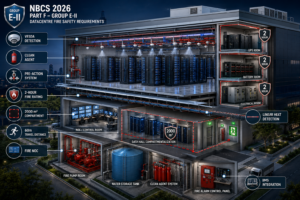
NBCS 2026 Part F, released in May 2026, changes this fundamentally. For the first time, Group E-II creates a dedicated occupancy classification for datacentres — a machine-environment building where the primary occupants are servers and networking equipment, not people. The requirements that follow reflect the genuine fire risks of these facilities and the consequences — millions of rupees of IT equipment, terabytes of irreplaceable data, and critical national infrastructure — of getting fire safety wrong.
📋 What is NBCS 2026 Group E-II?Group E-II is defined in NBCS 2026 Clause 3.1 as a machine-environment occupancy — buildings primarily housing data processing equipment and associated infrastructure, with low human occupancy. It covers datacentres, server farms, colocation (colo) facilities, carrier-neutral exchanges, network operations centres (NOCs), and dedicated server room buildings. Human-occupied offices within the same building fall under Group E-I (Business) with fire-rated separation required between the two occupancies.
Group E-II vs NBC 2016 — What Changed
- Datacentres classified under general Group E (Business)
- No specific detection technology required
- Standard smoke detectors considered adequate
- No suppression system type specified for server halls
- Wet pipe sprinklers installed in many datacentres
- No specific compartment size for datacentres
- No occupant load specific to data halls
- UPS rooms had no specific fire rating requirement
- No travel distance specific to datacentre occupancy
- Dedicated Group E-II classification for datacentres
- VESDA aspiration detection mandatory in server rooms
- Point detectors insufficient for data hall protection
- Clean agent OR pre-action sprinkler mandatory
- Wet pipe sprinklers not recommended in active server halls
- Maximum 2,000 m² compartment when sprinklered
- 50 m² gross per person for data halls (new)
- All critical rooms: 2-hour fire-rated mandatory
- Travel distance: 60 m sprinklered only
Complete NBCS 2026 Group E-II Requirements
1. Occupancy Applicability
Group E-II applies to all datacentre buildings meeting the following thresholds. Below these thresholds, self-certification by a State-approved professional is permitted.
| Trigger | Threshold |
|---|---|
| Building height | ≥ 15 m (measured to last occupiable floor) |
| Floor area | ≥ 750 m² on any single floor |
| Sprinkler requirement | Always mandatory — regardless of height or area |
2. Occupant Load
| Zone | NBC 2016 | NBCS 2026 Group E-II |
|---|---|---|
| Data halls / server rooms | 9.3 m² net/person (general business) | 50 m² gross/person New |
| Operations / NOC areas | 9.3 m² net/person | 20 m² gross/person New |
| Admin / office areas | 9.3 m² net/person | 7.1 m² net/person (Group E-I applies) |
The 50 m² gross per person for data halls reflects the reality that server halls have almost no regular human occupancy — a 2,000 m² data hall may have only 40 persons calculated for egress purposes.
3. Travel Distance
| Condition | NBC 2016 | NBCS 2026 Group E-II |
|---|---|---|
| Unsprinklered | 30 m (under general Business) | Not applicable — unsprinklered datacentres not permitted |
| Sprinklered | 45 m (under general Business) | 60 m Increased |
4. Fire Detection — Zone by Zone Requirements
NBCS 2026 recognises that different zones within a datacentre have different fire detection needs. The following zone-specific requirements apply:
⚠ Why Standard Smoke Detectors Are Insufficient for Data HallsConventional point-type ionisation or photoelectric smoke detectors activate at smoke concentrations of approximately 2–4% obscuration per metre. By the time this threshold is reached in a data hall, a cable or component fire has already been burning for several minutes — potentially long enough to cause significant IT equipment damage. VESDA aspiration systems detect smoke at concentrations as low as 0.005% obscuration per metre — thousands of times more sensitive — providing warning at the first trace of smoke, before any visible flames or equipment damage occurs.
5. Fire Suppression — System by System
The choice of suppression system for each zone within a datacentre is the most consequential fire safety decision. NBCS 2026 Group E-II, Tables 9–11, and international standards provide clear guidance:
- FM-200 (HFC-227ea) — most common in India
- Novec 1230 — zero ODP, low GWP alternative
- Inert gas (Inergen, Argonite, Nitrogen)
- CO₂ — total flooding, occupiable areas requires special provisions
- Best for: server rooms, data halls, UPS rooms with VRLA batteries
- Requires room integrity (door and penetration sealing)
- Cylinders: weight/pressure checked annually
- Dual-interlock: detection signal + sprinkler head open before water releases
- Virtually eliminates accidental water discharge risk
- Best for: large data halls where gas suppression is impractical
- Requires smoke detection in each zone for first interlock
- Sprinkler head for second interlock
- More expensive than wet pipe but far safer for IT equipment
- Flow switch monitored by FAP mandatory
🚫 Wet Pipe Sprinklers — Not Recommended in Active Server HallsStandard wet pipe sprinkler systems — where water is always present in the pipes — are inappropriate for active server rooms and data halls. A single accidental head activation (caused by mechanical damage, overheating from a non-fire source, or corrosion) releases water immediately, destroying IT equipment worth potentially crores of rupees. NBCS 2026 Group E-II requires pre-action or clean agent systems for this zone. Wet pipe sprinklers may be used in corridors, office areas, loading bays, and mechanical rooms within a datacentre building.
6. Suppression System Suitability Matrix — Key Zones
| Zone | Wet Pipe | Pre-Action | Clean Agent | Water Mist | CO₂ |
|---|---|---|---|---|---|
| Data hall (large) | ✗ | ✓ | Cond. | ✓ | Cond. |
| Server room (small) | ✗ | Cond. | ✓ | ✓ | Cond. |
| UPS room (VRLA) | ✗ | Cond. | ✓ | ✓ | Cond. |
| UPS room (Li-ion) | ✓ | ✓ | Cond. | ✓ | – |
| Electrical / switchgear room | ✗ | Cond. | ✓ | ✓ | Cond. |
| Cable room / MDF room | Cond. | ✓ | ✓ | ✓ | ✓ |
| Office / admin / NOC | ✓ | Cond. | – | Cond. | – |
| Generator room | ✓ | – | – | ✓ | – |
✓ Suitable ✗ Not recommended Cond. = Conditional / with authority approval – = Not applicable. Based on NBCS 2026 Tables 9–11.
7. Compartmentation Requirements
NBCS 2026 Table 6 specifies compartmentation for Group E-II datacentres:
| Condition | Maximum Compartment Size |
|---|---|
| Unsprinklered datacentre | Not permitted — sprinklers mandatory |
| Sprinklered datacentre | 2,000 m² per fire compartment |
Beyond the compartment size requirement, NBCS 2026 Clause 4.5.3.2 mandates 2-hour fire-rated enclosures for all of the following rooms — regardless of size and regardless of whether the building is sprinklered:
- Server rooms and IT equipment rooms
- UPS rooms and battery rooms (all chemistry types)
- Electrical rooms and switchgear rooms
- MDF rooms, IDF rooms, and network equipment rooms
- MCR rooms, MUX rooms, and telecom equipment rooms
- Lift machine rooms
💡 Raised Floor and Ceiling Void ProtectionNBCS 2026 requires detection and suppression in all raised floor voids and ceiling voids exceeding 800 mm in height. In most datacentres, both the raised floor (typically 500–900 mm) and the ceiling plenum require dedicated detection — either aspiration or linear heat — and suppression coverage. This is critical: many existing datacentres have detection only above the raised floor but not within the floor void where cables run.
8. Egress and Life Safety Requirements
- Travel distance: 60 m (sprinklered — no unsprinklered option)
- Minimum 2 independent exits from each data hall zone
- Exit door height: ≥ 2.0 m; width: ≥ 1.0 m
- Access-controlled doors: fail-safe open on fire alarm
- Emergency lighting: 3-hour battery backup on all escape routes
- Emergency Power Off (EPO) — accessible at exit doors
- Evacuation plan — specific to data hall layout
- Emergency Power Off (EPO) provision per NFPA 75
- Circuit integrity cables for all fire safety system wiring
- Fire alarm panel — dedicated circuit, UPS backed
- Suppression system actuation circuit: circuit integrity cable
- BMS integration with fire alarm panel for HVAC shutdown
- No gas suppression in areas with hypoxic air systems
- Generator room: water spray or water mist suppression
9. Applicable Standards for Datacentres in India
| Standard | Scope | Applicability |
|---|---|---|
| NBCS 2026 Part F, Group E-II | Indian national datacentre fire safety classification | All datacentres in India — primary reference |
| IS 2189 | Selection, installation and maintenance of fire detection and alarm systems | Mandatory reference for detection systems |
| IS 15105 | Design and installation of automatic sprinkler systems | Mandatory reference for sprinkler systems |
| NFPA 75 | Fire protection of information technology equipment | Tier-III and Tier-IV facilities |
| NFPA 76 | Fire protection of telecommunications facilities | Carrier-neutral and telecom exchange DCs |
| NFPA 2001 | Clean agent fire extinguishing systems | Server rooms with gas suppression |
| NFPA 13 | Installation of sprinkler systems | Pre-action system design |
| TIA-942 | Telecommunications infrastructure standard for data centres | Tier classification reference |
10. Fire NOC for Datacentres in India
All datacentres meeting the Group E-II applicability thresholds require a Fire NOC from the applicable State fire authority. The NOC application requires the following documentation:
- Independent fire safety audit report — aligned with NBCS 2026 Group E-II
- VESDA aspiration system test certificate and sensitivity calibration report
- Clean agent suppression system test certificate (cylinder weights, room integrity, agent concentration)
- Pre-action sprinkler system test certificate (if applicable)
- Fire pump performance test certificate
- Emergency lighting test certificate (3-hour battery backup)
- Pressurisation system test report (if high-rise building)
- Fire safety management plan
- Annual maintenance contract for all fire systems
Know more about – NBCS 2026 vs NBC 2016 Part 4: What Changed in India’s Fire Safety Standards