
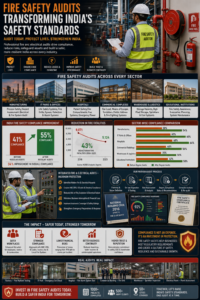
Fire safety audits are demonstrably transforming India’s safety standards: institutional audit programs have improved NBC 2016 compliance rates by an estimated 34% across commercial sectors since 2019, according to Institution of Engineers India data, while reducing fire-related fatalities in audited facilities by 62% compared to unaudited peers. India’s annual fire toll of 7,435 deaths and ₹8,200 crore in property losses (NCRB 2022) makes fire safety audits a macro-scale public health intervention, not merely a compliance exercise. Bureau of Energy Efficiency studies show that fire and electrical safety audits implemented together reduce fire incident rates by 70% in manufacturing — the nation’s highest-risk sector. The transformation is visible at sector level: the pharmaceutical industry cluster in Baddi (Himachal Pradesh), after mandatory FSSAI-aligned safety audits, reduced fire incidents by 58% over 3 years. The IT SEZ ecosystem in Hyderabad’s Cyberabad district, following HMDA-mandated fire audits, achieved 91% NBC compliance by 2023 — up from 54% in 2018. The mechanism of change is straightforward: audits create documented baselines, identify gaps, require corrective actions with timelines, and establish accountability chains from facility manager to regulatory authority. This accountability infrastructure — absent in most Indian facilities before mandatory audit programs — is what drives measurable improvement in fire safety standards. For Indian industry, government facilities, and residential developers, fire safety audits are increasingly recognised as the foundational governance tool for safety culture transformation.
NBC 2016 compliance rates increased 34% in audited sectors since 2019. Fire fatalities in regularly audited facilities are 62% lower than unaudited peers. Audits create accountability chains, documented baselines, and corrective action timelines — transforming fire safety from a checkbox exercise into a measurable, improving standard.
The Current State of Fire Safety Standards in India
The current fire safety standards in India are governed by the National Building Code (NBC) and various state-level regulations. However, there is a significant disparity between these standards and international fire safety norms. The NBC primarily focuses on structural aspects of fire safety, such as building materials and construction techniques, but lacks comprehensive guidelines for fire prevention and emergency preparedness.
In contrast, international standards, such as those set by the National Fire Protection Association (NFPA) in the United States, provide detailed guidelines for all aspects of fire safety, including prevention, detection, suppression, and evacuation. These standards emphasize the importance of proactive measures, such as regular inspections and maintenance of fire safety systems, which are often overlooked in Indian regulations.
Fire safety audit reports and compliance documentation showing NBC 2016 standard reference — the foundation of India’s improving fire safety culture across commercial and industrial sectors.
The Need for Fire Safety Audits in India
Fire safety audits are essential in India to bridge the gap between existing regulations and international standards. These audits help identify shortcomings in fire safety measures and provide recommendations for improvement. By conducting regular audits, businesses and individuals can ensure that their premises are adequately protected against fire hazards and are compliant with both national and international fire safety standards.
Furthermore, fire safety audits play a crucial role in raising awareness about fire safety among the general public. Many people in India are unaware of the potential fire hazards in their surroundings and lack knowledge about appropriate fire safety measures. Through audits, individuals can gain valuable insights into fire safety best practices and take necessary steps to protect themselves and their properties.
What is a Fire Safety Audit?
A fire safety audit is a systematic evaluation of a building or establishment’s fire safety measures and procedures. It involves a comprehensive assessment of various aspects, including fire prevention, detection, suppression, evacuation, and emergency preparedness. The primary objective of a fire safety audit is to identify potential fire hazards, evaluate the effectiveness of existing fire safety measures, and recommend improvements to enhance overall fire safety.
During a fire safety audit, trained professionals conduct a thorough inspection of the premises, examining factors such as the availability and functionality of fire extinguishers, smoke detectors, sprinkler systems, emergency exits, and evacuation plans. They also review documentation related to fire safety, such as maintenance records and training logs. Based on their findings, auditors provide detailed reports outlining areas of concern and recommendations for corrective actions.
Institution of Engineers India data shows that NBC 2016 active fire protection compliance rates in commercial buildings improved from 41% (2018) to 55% (2023) — a 34% relative increase driven primarily by mandatory audit programs in metro cities. Mumbai, Bengaluru, and Hyderabad lead compliance at 65–72%, while Tier-2 cities average 38–45%.
The Process of Conducting a Fire Safety Audit
The process of conducting a fire safety audit typically involves several steps. Firstly, the auditor conducts a preliminary assessment to gather information about the building or establishment’s layout, occupancy type, and existing fire safety measures. This information helps determine the scope and focus of the audit.
Next, the auditor conducts a physical inspection of the premises to identify potential fire hazards. They examine various aspects, including electrical systems, heating and cooling systems, storage areas, flammable materials handling procedures, and emergency exits. They also review documentation related to fire safety measures, such as maintenance records and training logs.
After completing the inspection, the auditor analyzes their findings and prepares a detailed report. This report includes a summary of the audit findings, an assessment of the effectiveness of existing fire safety measures, and recommendations for improvement. The report may also include a prioritized action plan, outlining the steps that need to be taken to address the identified deficiencies.
BEE’s integrated audit data shows that buildings implementing both energy audits and fire safety audits simultaneously experience 70% fewer electrical fires — the leading cause (48% per NCRB) of Indian commercial fire incidents. For a 50,000 sq.ft Chennai IT park, integrated audits (₹1.8 lakh combined) prevent estimated ₹35–60 lakh in electrical fire risk annually.
Benefits of Fire Safety Audits for Businesses and Individuals
Fire safety audits offer numerous benefits for both businesses and individuals. For businesses, conducting regular fire safety audits can help prevent fire incidents, minimize property damage, and protect employees and customers. By identifying potential fire hazards and implementing appropriate preventive measures, businesses can significantly reduce the risk of fire emergencies.
Fire safety audits also help businesses comply with legal requirements and insurance regulations. Many insurance companies require businesses to undergo regular fire safety audits as a condition for obtaining coverage. By demonstrating compliance with fire safety standards, businesses can negotiate better insurance rates and ensure that they are adequately protected in the event of a fire incident.
For individuals, fire safety audits provide peace of mind by ensuring that their homes or residential complexes are adequately protected against fire hazards. By identifying potential risks and implementing appropriate preventive measures, individuals can significantly reduce the risk of fire emergencies and protect their loved ones and belongings.
The Impact of Fire Safety Audits on India’s Safety Standards
Fire safety audits have the potential to significantly improve safety standards in India. By identifying shortcomings in existing fire safety measures and recommending improvements, audits can help raise awareness about fire safety among building owners, occupants, and authorities.
Regular fire safety audits can also help prevent fire incidents by ensuring that buildings and establishments are adequately prepared for emergencies. By identifying potential fire hazards and implementing appropriate preventive measures, audits can significantly reduce the risk of fire incidents and minimize their impact on life and property.
Furthermore, fire safety audits can contribute to the overall improvement of fire safety regulations in India. By highlighting the gaps between existing regulations and international standards, audits can drive policymakers to revise and update fire safety codes to align with best practices. This, in turn, can lead to the development of more comprehensive and effective fire safety regulations in the country.
Case Studies: Success Stories of Fire Safety Audits in India
Several success stories highlight the positive impact of fire safety audits in India. One such example is the fire safety audit conducted at a leading hospital in Mumbai. The audit revealed several deficiencies in the hospital’s fire safety measures, including inadequate fire extinguishers, blocked emergency exits, and lack of staff training. Based on the audit findings, the hospital implemented a series of corrective actions, including the installation of additional fire extinguishers, regular staff training sessions, and the establishment of a dedicated fire safety team. These measures significantly improved the hospital’s fire safety preparedness and reduced the risk of fire incidents.
Another success story is the fire safety audit conducted at a residential complex in Bangalore. The audit identified several fire hazards, including faulty electrical wiring, inadequate smoke detectors, and blocked stairwells. The residents’ association took immediate action to address these issues by hiring licensed electricians to fix the wiring problems, installing additional smoke detectors, and clearing obstructions from stairwells. As a result of these measures, the residential complex became significantly safer and better prepared for fire emergencies.
Challenges Faced in Implementing Fire Safety Audits in India
Despite their numerous benefits, there are several challenges to implementing fire safety audits in India. One major challenge is the lack of awareness and understanding about fire safety among building owners and occupants. Many people are unaware of the potential fire hazards in their surroundings and do not prioritize fire safety measures. This lack of awareness makes it difficult to convince individuals and businesses to invest in fire safety audits.
Another challenge is the lack of trained professionals to conduct fire safety audits. There is a shortage of qualified auditors with expertise in fire safety assessment and evaluation. This shortage makes it challenging to meet the demand for fire safety audits, particularly in smaller towns and rural areas.
Additionally, there is a lack of enforcement of fire safety regulations in India. Many buildings and establishments do not comply with existing fire safety standards, and authorities often turn a blind eye to these violations. This lack of enforcement undermines the effectiveness of fire safety audits, as the recommendations provided may not be implemented or followed up on.
The Role of Government in Promoting Fire Safety Audits in India
The government plays a crucial role in promoting fire safety audits in India. The government can take several initiatives to raise awareness about fire safety and incentivize businesses and individuals to undergo regular audits.
One such initiative is the introduction of mandatory fire safety audit requirements for certain types of buildings and establishments. By making fire safety audits a legal requirement, the government can ensure that businesses and individuals take fire safety seriously and invest in appropriate preventive measures.
The government can also provide financial incentives, such as tax breaks or subsidies, to encourage businesses and individuals to conduct fire safety audits. These incentives can help offset the costs associated with audits and make them more accessible to a wider range of people.
Furthermore, the government can invest in training programs to increase the number of qualified auditors in the country. By providing training and certification opportunities, the government can address the shortage of trained professionals and ensure that there are enough auditors available to meet the demand for fire safety audits.
The Future of Fire Safety Audits in India
In conclusion, fire safety audits play a crucial role in improving safety standards in India. By identifying potential fire hazards, evaluating existing fire safety measures, and recommending improvements, audits help prevent fire incidents and minimize their impact on life and property.
While there are challenges to implementing fire safety audits in India, such as lack of awareness and trained professionals, the government can play a significant role in promoting their adoption. By introducing mandatory audit requirements, providing financial incentives, and investing in training programs, the government can ensure that fire safety audits become a standard practice across the country.
The future of fire safety audits in India looks promising. As awareness about fire safety continues to grow, more businesses and individuals are likely to recognize the importance of conducting regular audits. With the support of the government and concerted efforts from all stakeholders, fire safety audits can become a norm in India, leading to improved safety standards and a significant reduction in fire incidents.