
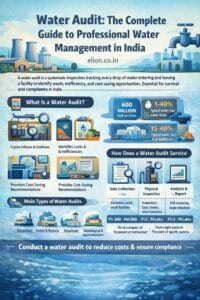
A water audit is a systematic inspection that tracks every drop of water entering and leaving a facility to identify waste, inefficiency, and cost-saving opportunities. Think of it as a financial audit, but instead of money, you’re tracking water—where it comes from, where it goes, and where it’s vanishing without adding value.
In India, where the Ministry of Jal Shakti reports that 600 million people face high to extreme water stress, conducting a water audit isn’t just good practice—it’s becoming essential for survival and compliance.
What Is a Water Audit and Why Does It Matter?
A water audit examines your entire water consumption system from source to disposal. The process maps water flow through your facility, measures usage at different points, identifies leaks and losses, and recommends practical fixes.
The Central Ground Water Board (CGWB) under India’s Ministry of Jal Shakti has made water audits mandatory for industries consuming more than 10,000 liters per day in several states. This isn’t bureaucratic overhead—it’s a response to India extracting groundwater 2.5 times faster than it can be replenished, according to NITI Aayog’s Composite Water Management Index.
Most facilities lose 15-40% of their water to undetected leaks, inefficient processes, or simple negligence. A proper audit typically identifies savings equivalent to 3-6 months of your annual water bill within the first year alone.
How Does a Water Audit Service Actually Work?
Professional water audit services follow a structured methodology that takes 3-8 weeks depending on facility size.
The first phase involves data collection. Auditors gather your water bills, meter readings, process diagrams, and past consumption records. They’ll interview your operations team to understand seasonal variations, production cycles, and any known water issues.
Phase two is the physical inspection. This is where auditors walk every inch of your facility with flow meters, leak detection equipment, and pressure gauges. They’re checking cooling towers, process lines, toilets, irrigation systems, wastewater treatment plants—anywhere water moves.
The Bureau of Indian Standards (BIS) has published IS 15479:2004 specifically for water auditing methodology. Certified water audit companies follow this standard to ensure consistency and regulatory acceptance.
Analysis comes next. Auditors create a water balance sheet showing inputs versus outputs, calculate unaccounted-for-water (UFW) percentages, and identify high-consumption areas. They’ll compare your usage against industry benchmarks—for example, textile units should typically use 150-200 liters per kg of fabric processed according to Central Pollution Control Board (CPCB) guidelines.
The final deliverable is a detailed report with prioritized recommendations, ROI calculations for each suggested improvement, and an implementation roadmap.
What Are the Main Types of Water Audits?
Water audits come in three distinct categories, each serving different purposes. Here’s how they compare:
| Audit Type | Duration | What’s Covered | Best For | Typical Cost | Compliance Level |
| Preliminary Audit | 1-3 days | • Visible leaks • Meter accuracy checks • Basic consumption patterns • Quick facility walkthrough |
• Initial screening • Small facilities • Budget-conscious assessments • Identifying obvious issues |
₹15,000 – ₹40,000 | Basic compliance, not sufficient for certifications |
| Comprehensive Audit | 3-8 weeks | • Complete metering of all water points • Every tap, valve, and pipe • Detailed water balance sheets • Industry benchmark comparison • Prioritized recommendations |
• ISO 14001 certification • Mandatory compliance (Maharashtra, Karnataka) • High-consumption industries • Large facilities |
₹1.5 – ₹8 lakhs | Meets regulatory requirements and certification standards |
| Specialized Audit | Varies by system | • Focused on specific systems: – Cooling towers (HVAC) – Process water (manufacturing) – Irrigation systems – Wastewater treatment • System-specific protocols |
• HVAC-heavy facilities • Manufacturing plants • Hotels and campuses • Agricultural settings • Specific problem areas |
Varies by scope | Sector-specific compliance (e.g., CWC protocols for irriga |
Who Needs a Water Audit Service in India?
The short answer: pretty much everyone consuming significant water.
State pollution control boards across Maharashtra, Karnataka, Gujarat, Tamil Nadu, and Delhi have made water audits mandatory for industries, commercial complexes, and institutions above certain thresholds. Penalties for non-compliance range from ₹50,000 to facility closure in extreme cases.
Hotels and resorts are prime candidates. The Federation of Hotel & Restaurant Associations of India (FHRAI) reports that hotels can reduce water consumption by 30-40% post-audit through simple fixes like aerator installations and linen reuse programs.
Manufacturing facilities—especially textiles, pharmaceuticals, chemicals, and food processing—face dual pressure. First, from regulatory bodies like CPCB demanding better water management. Second, from customers and certification bodies (LEED, IGBC) requiring demonstrated sustainability.
Educational institutions and hospitals increasingly seek water audits voluntarily. The University Grants Commission (UGC) now awards additional points in NAAC accreditation for institutions demonstrating water conservation through documented audits.
Even residential complexes with 50+ units benefit significantly. Housing societies in Bangalore and Pune have reported 40-60% reduction in water bills after implementing audit recommendations, mainly through leak repairs and rainwater harvesting optimization.
How Much Does a Water Audit Company Charge?
Pricing varies dramatically based on facility size, complexity, and audit depth.
Small Facilities (₹15,000 – ₹40,000)
- 100-room hotels or 20,000 sq ft offices
- Preliminary audit only
- Basic assessment with obvious recommendations
- 1-3 day turnaround
Mid-Sized Facilities (₹1.5 – ₹4 Lakhs)
- Manufacturing units
- Large commercial complexes
- Educational campuses
- Includes detailed instrumentation
- Water balance calculations
- Prioritized action plans
Large Industrial Complexes (₹5 – ₹12 Lakhs)
- Multiple process lines
- Captive power plants
- Complex wastewater systems
- Typically identifies savings worth 2-5x the audit cost within first year
- National Productivity Council (NPC) reports average payback: 8-18 months
Watch Out for Hidden Costs:
- Specialized water quality testing
- Microbiological analysis
- Follow-up site visits
- Implementation support
- Always get everything in writing upfront
What Qualifications Should a Water Audit Company Have?
Not all water audit companies are created equal, and India’s market has its share of weekend warriors with flow meters.
Essential Certifications:
- CGWB Empanelment – Central Ground Water Board approved agencies list
- BIS Certification – Following IS 15479:2004 standards
- NABL Accreditation – For water quality testing (if applicable)
Team Credentials to Verify:
- Environmental engineers on staff
- CWM (Certified Water Manager) from Association of Water Professionals of India
- Industry-specific experience in your sector
- Example: 50+ textile audits for textile facilities
Documents to Request:
- Sample audit reports with detailed water balance sheets
- Not just generic recommendation lists
- Previous client references (3-5 recent similar projects)
- Insurance certificates (professional indemnity + general liability)
Red Flags to Avoid:
- No government empanelment
- Generic reports without industry context
- Refusing to provide references
- Unrealistic timeline promises (2-week comprehensive audits)
- No follow-up support offered
Before You Sign:
- Call their previous clients directly
- Ask about report quality and practical value
- Verify post-audit support availability
- Check methodology details in proposal
- Confirm instrumentation they’ll use
What Results Can You Expect from a Professional Water Audit?
Tangible outcomes vary by facility type, but patterns emerge from documented case studies.
Leak detection alone saves 10-25% of total consumption in most facilities. The Indian Green Building Council (IGBC) reports that their certified buildings average 22% water savings post-audit, primarily from fixing undetected leaks and toilet flapper valves.
Process optimization delivers another 15-30% for manufacturing units. A pharmaceutical facility in Hyderabad reduced water consumption by 34% by implementing counter-current washing systems recommended in their audit, according to CPCB case studies.
Behavior change shouldn’t be underestimated. When employees see actual consumption data and understand costs, usage patterns shift. Hotels implementing audit-recommended awareness programs report 8-12% additional savings beyond mechanical fixes.
Regulatory compliance is immediate. Your audit report becomes proof of due diligence for environmental clearances, renewals, and inspections. Several companies have avoided penalties by presenting recent audit reports during PCB inspections.
The Jal Shakti Ministry’s Jal Shakti Abhiyan has documented over 4,000 institutional water audits since 2019, with average reported savings of 28% in the first year post-implementation.
How Do You Choose the Right Water Audit Service Provider?
Start with your specific needs. Regulatory compliance audits require different expertise than cost-optimization audits.
Get detailed proposals from 3-4 shortlisted companies. Compare scope, not just price. A ₹2 lakh audit with detailed sub-metering and monthly follow-ups for six months offers better value than a ₹1.2 lakh audit with a one-time report.
Ask about audit methodology specifically. Will they install temporary sub-meters? How many site visits? What instrumentation will they use? How will they handle night shifts if you run 24/7 operations?
Implementation support matters enormously. Some companies provide design specifications for recommended improvements, help with vendor selection, and offer commissioning support. Others hand you a report and disappear. Clarify this upfront.
Verify insurance coverage. Auditors will access all areas of your facility. Ensure the company carries adequate professional indemnity and general liability insurance.
Timeline commitments should be realistic and documented. A comprehensive audit of a medium manufacturing facility takes 4-6 weeks minimum. Anyone promising 2-week turnarounds is cutting corners.
What Happens After the Water Audit Is Complete?
The audit report is your starting point, not your finish line.
Prioritize recommendations by ROI and implementation difficulty. Quick wins like fixing leaking taps and installing aerators should happen within 2-4 weeks. Longer-term projects like rainwater harvesting or wastewater recycling need phased planning.
Many facilities implement in three waves: immediate fixes (0-3 months), medium-term improvements (3-12 months), and capital projects (1-2 years). This approach maintains cash flow while steadily reducing consumption.
Monitoring is critical. Set up monthly tracking of water consumption per unit of production (specific water consumption). This metric tells you whether improvements are holding or backsliding. The Energy and Resources Institute (TERI) recommends quarterly reviews for the first year post-audit.
Some water audit companies offer retainer services for ongoing monitoring and annual re-audits. This ensures sustained performance and catches new issues before they become expensive problems.
Certification bodies increasingly want to see multi-year data. If you’re pursuing LEED, IGBC, or ISO 14001 certification, consistent post-audit monitoring strengthens your application significantly.
Is Water Auditing Mandatory by Law in India?
The regulatory landscape varies significantly by state and facility type.
Several states have made water audits legally mandatory. Maharashtra requires audits for industries using over 10,000 liters per day under the Maharashtra Groundwater (Development and Management) Act. Karnataka mandates audits for all industries in over-exploited and critical groundwater zones.
The Central Ground Water Board has issued guidelines making audits compulsory for industries extracting groundwater above prescribed limits. Specific thresholds vary by aquifer status—stricter limits apply in over-exploited zones.
Tamil Nadu’s Water Supply and Drainage Board requires water audits for bulk consumers in Chennai and other major cities as part of connection renewal processes. Delhi Jal Board has similar provisions for commercial and industrial consumers above 20 kiloliters per day.
Non-compliance penalties are real and escalating. Initial violations typically draw warnings and deadlines. Repeated non-compliance can result in groundwater extraction licenses being revoked, which effectively shuts down water-dependent operations.
The National Water Policy 2012 strongly recommends periodic water audits for all major water users, though implementation authority rests with state governments. As India’s water crisis deepens, expect mandatory audit requirements to expand geographically and cover more facility types.
The Bottom Line on Water Audits
Water auditing has evolved from an optional sustainability exercise to a business necessity in India. Whether driven by regulatory mandates, cost pressures, or environmental commitments, facilities that audit water usage consistently outperform those that don’t.
The best time for a water audit? Yesterday. The second-best time is right now—before regulations tighten further, before water becomes scarcer, and before your competitors gain the efficiency advantage.
Professional water audit services pay for themselves, keep you compliant, and increasingly become a competitive differentiator in markets where sustainability credentials matter to customers and investors alike.
Frequently Asked Questions (FAQs)
Q. What is the main purpose of a water audit?
Ans. To analyze water usage, identify losses, and improve efficiency.
Q. Is water audit mandatory in India?
Ans. Not universally, but required in many industries under environmental regulations.
Q. How long does a water audit take?
Ans. Typically 3–10 days depending on facility size.
Q. Can water audits reduce costs?
Ans. Yes, most facilities achieve 10–30% savings.
Q. Who conducts water audits?
Ans. Qualified engineering firms specializing in water audit services.