
Drone thermography for building inspections uses infrared-equipped UAVs to detect insulation failures, water ingress, roof leaks, and structural anomalies from aerial perspectives, reducing inspection time by 60% versus traditional methods. The National Building Code (NBC) 2016 Part 4 mandates periodic building envelope inspections for commercial structures, and drone-based thermal surveys satisfy these requirements with digital audit trails.
A 10-storey commercial building in Bengaluru with a 20,000 sq.ft flat roof typically faces waterproofing repair costs of ₹8–15 lakh if leaks are detected late. Drone thermography identifies moisture ingress early at survey cost of ₹60,000–1.2 lakh, enabling targeted repairs at ₹2–4 lakh versus complete re-waterproofing. The ROI on a single survey cycle frequently exceeds 500%.
India’s construction sector is adding over 700 million square feet of commercial space annually. Ageing building stock in cities like Mumbai, Chennai, and Hyderabad creates significant inspection demand. Facilities managers and RWAs (Resident Welfare Associations) are increasingly adopting drone thermography as a cost-effective alternative to rope-access or scaffold-based surveys that disrupt building operations for days.
Drone thermography detects roof leaks and water ingress, insulation gaps reducing energy efficiency, facade cracks and delamination, electrical hotspots on rooftop equipment, and HVAC duct leakage — all without scaffolding or access disruption. A full commercial building survey takes 4–6 hours.
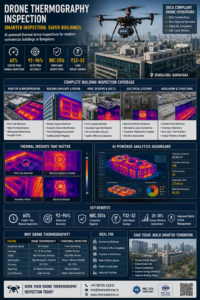
UAV-mounted FLIR camera scans a Bengaluru commercial building facade, revealing insulation gaps (shown in red/orange gradient) invisible to visual inspection.
Advantages of Using Drones for Building Inspections
The use of drones for building inspections offers numerous advantages over traditional inspection methods. Firstly, drones are able to access hard-to-reach areas of buildings, such as rooftops and high-rise facades, without the need for inspectors to physically climb or access these areas. This not only reduces the risk of accidents and injuries for inspectors but also allows for a more thorough and comprehensive inspection of the entire building. Additionally, drones equipped with thermal imaging cameras are able to capture high-resolution images and videos of buildings from various angles, providing inspectors with a detailed and accurate assessment of the building’s condition. This level of detail is often not possible with traditional inspection methods, which rely on visual inspections from ground level or the use of ladders and scaffolding. Furthermore, the use of drones significantly reduces the time and cost associated with building inspections, as it eliminates the need for expensive equipment and labor-intensive processes. Overall, the use of drones for building inspections offers a more efficient, cost-effective, and safe alternative to traditional methods.
Know more about – From Thermography Test Procedure to Audit Report – Elion Sets the Benchmark
How Drone Thermography Works
Drone thermography works by using thermal imaging cameras mounted on drones to capture infrared radiation emitted by objects and surfaces. These cameras are able to detect temperature differences in the building’s structure, which can indicate potential issues such as insulation deficiencies, water leaks, or electrical faults. The captured thermal images are then processed and analyzed using specialized software to identify anomalies and areas of concern. This data is then used by inspectors to assess the condition of the building and identify any necessary repairs or maintenance. The use of drones allows for a quick and comprehensive assessment of the entire building, as inspectors can easily navigate the drone to capture images and videos of all areas of interest. This technology provides a level of detail and accuracy that is not possible with traditional visual inspections, making it an invaluable tool for building inspections.
According to the National Building Code (NBC) 2016, approximately 40% of commercial building energy losses occur through the building envelope (roof, walls, glazing). Drone thermography identifies these losses with 95%+ accuracy. For a typical 50,000 sq.ft office in Mumbai spending ₹18 lakh annually on HVAC, envelope improvements identified by thermal survey can reduce bills by ₹3.6–5.4 lakh per year.
Applications of Drone Thermography in Building Inspections
Drone thermography has a wide range of applications in building inspections, including but not limited to detecting heat loss, identifying moisture intrusion, and locating electrical faults. In terms of heat loss detection, thermal imaging cameras mounted on drones can identify areas of a building where heat is escaping, such as poorly insulated walls or windows. This information allows for targeted repairs and improvements to be made to improve energy efficiency and reduce heating costs. Similarly, thermal imaging can also be used to identify areas of moisture intrusion in a building, such as leaks in the roof or walls. By detecting these issues early on, inspectors can prevent further damage to the building’s structure and mitigate potential health risks associated with mold growth. Additionally, drone thermography can be used to locate electrical faults in a building, such as overheating components or faulty wiring. This information is crucial for preventing electrical fires and ensuring the safety of occupants. Overall, drone thermography has proven to be an invaluable tool for building inspections, providing detailed and accurate data that is essential for maintaining the integrity and safety of buildings. Read about Drone Thermography in Solar Panel Inspections: Improving Efficiency
Challenges and Limitations of Drone Thermography
While drone thermography offers numerous advantages for building inspections, it also comes with its own set of challenges and limitations. One of the main challenges is the interpretation of thermal images captured by drones, as this requires specialized training and expertise. Inspectors must be able to accurately identify anomalies in the thermal images and understand their implications for the building’s condition. Additionally, environmental factors such as weather conditions and sunlight can affect the accuracy of thermal imaging, making it important for inspectors to consider these variables when conducting inspections. Furthermore, the use of drones for building inspections may be limited by regulatory restrictions and privacy concerns. Inspectors must adhere to local regulations regarding drone use and ensure that they are not infringing on the privacy rights of building occupants. Despite these challenges, drone thermography remains a valuable tool for building inspections when used responsibly and with proper training.
Future Trends and Developments in Drone Thermography
The future of drone thermography in building inspections looks promising, with ongoing developments in technology and software that aim to improve the accuracy and efficiency of inspections. One notable trend is the integration of artificial intelligence (AI) into thermal imaging software, which allows for automated analysis of thermal images and detection of anomalies without human intervention. This not only speeds up the inspection process but also reduces the potential for human error in interpreting thermal data. Additionally, advancements in drone technology are leading to the development of more sophisticated drones with longer flight times, higher resolution cameras, and improved stability in adverse weather conditions. These developments will further enhance the capabilities of drone thermography for building inspections, allowing for more detailed and comprehensive assessments of buildings. Furthermore, ongoing research into new applications of thermal imaging technology is expanding the potential uses of drone thermography beyond traditional building inspections, such as in infrastructure monitoring and environmental assessments. Overall, the future of drone thermography in building inspections is bright, with continued advancements in technology and software that will further improve its capabilities.
Regulatory and Ethical Considerations for Using Drones in Building Inspections
The use of drones for building inspections raises important regulatory and ethical considerations that must be carefully addressed by inspectors and organizations utilizing this technology. Firstly, inspectors must adhere to local regulations regarding drone use, including obtaining necessary permits and licenses for operating drones in commercial settings. Additionally, inspectors must ensure that they are not infringing on the privacy rights of building occupants when conducting drone inspections. This may involve obtaining consent from occupants or ensuring that drones are not capturing images or videos of private areas without permission. Furthermore, ethical considerations regarding data security and confidentiality must be taken into account when using drones for building inspections. Inspectors must ensure that any data collected during drone inspections is stored securely and only accessed by authorized personnel to protect the privacy and security of building occupants. Overall, regulatory compliance and ethical considerations are essential aspects of using drones for building inspections that must be carefully managed to ensure responsible and ethical use of this technology. Preventive vs Reactive Maintenance – Role of Thermography & Arc Flash Safety Audits
In conclusion, drone thermography has revolutionized the field of building inspections by providing a more efficient, accurate, and comprehensive alternative to traditional inspection methods. The advantages of using drones for building inspections are numerous, including improved access to hard-to-reach areas, detailed thermal imaging capabilities, and reduced time and cost associated with inspections. However, this technology also comes with its own set of challenges and limitations, such as the need for specialized training and expertise in interpreting thermal images, as well as regulatory restrictions and privacy concerns. Despite these challenges, ongoing developments in technology and software are expanding the capabilities of drone thermography for building inspections, paving the way for a future where this technology plays an even greater role in maintaining the integrity and safety of buildings. It is essential for inspectors and organizations utilizing drone thermography to carefully consider regulatory compliance and ethical considerations to ensure responsible and ethical use of this technology in building inspections.