Training Coordinator, Industrial Paint Manufacturer
“The safety induction for new hires was handled smoothly. Elion brought their own AV equipment and kept the session engaging. We’re thinking of repeating this monthly.”

And Consulting Private Limited
And Consulting Private Limited
Fire drill and evacuation planning covers both the written evacuation plan for your site (exit routes, assembly points, roles and responsibilities) and the practical drill that tests it. Elion prepares a site-specific evacuation plan and facilitates the drill, evaluating response time and identifying gaps — trusted since 2010 across 30,000+ audits.
In a fire emergency, even a few seconds can make the difference between life and death. Fire drills and structured evacuation planning ensure your staff knows how to react quickly, reach safe zones, and coordinate without panic. This training builds awareness, improves speed, and reduces confusion during real incidents.
Elion delivers on-site fire drill and evacuation training customized to your building layout, fire exits, assembly zones, occupant load, and emergency roles. Whether for offices, manufacturing units, hospitals, schools, or warehouses — we prepare teams to respond confidently in fire situations.
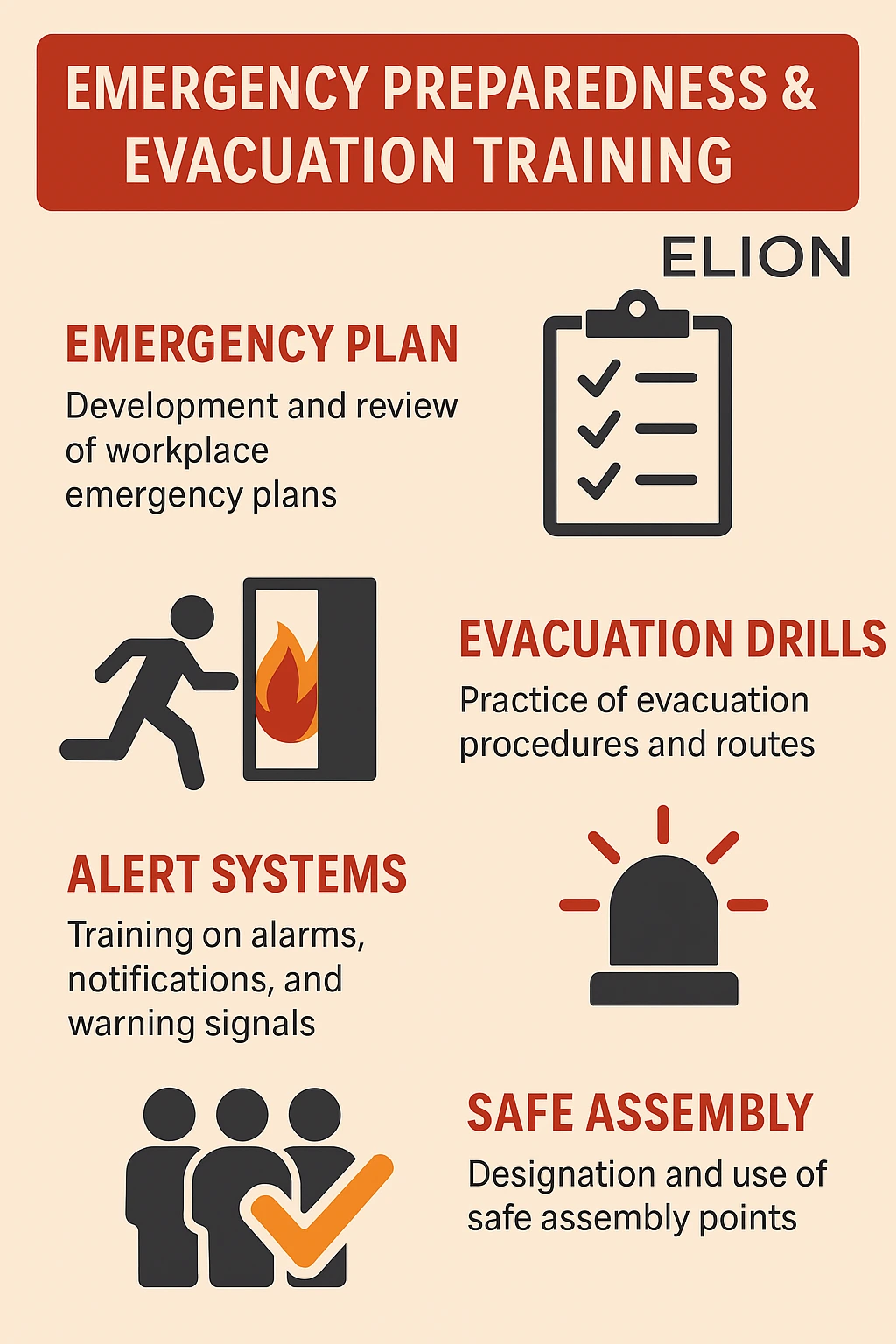
Participants receive a Certificate of Participation from Elion Technologies. The training complies with:
An evacuation plan is the written document: exit routes, assembly points, designated roles (fire wardens, floor marshals), and communication protocols. A fire drill is the practical rehearsal of that plan, timed and observed to check it actually works under real conditions. Elion provides both — the plan is prepared first, then tested through a facilitated drill.
Cost depends on: whether you need a new evacuation plan prepared from scratch or an existing plan reviewed, building size and occupant count, number of floors/zones requiring separate plans, and whether ongoing annual drill facilitation is included. Request a fixed-fee quote with your facility details.
Looking to organize F0ire evacuation at your plant, warehouse, or office?
Request a Quote or contact us at [email protected].
“The safety induction for new hires was handled smoothly. Elion brought their own AV equipment and kept the session engaging. We’re thinking of repeating this monthly.”
“Good response from our team for the chemical spill drill and awareness session. We had a minor leak last year and this training was timely. They even explained the MSDS sheet details clearly.”
“Elion conducted ergonomics training for our office support staff. They gave tips that don’t need any budget—just posture, breaks, and seating angles. Everyone found it useful.”
“Warehouse safety training was organized at our distribution center. The module covered stacking, material flow, and emergency handling. One or two team leads found the content basic, but the newcomers appreciated it.”
“The hot work and gas cutting safety training helped us address some recent near-misses. Our fabrication contractors said it was the first time anyone explained why permits matter, not just how to fill them.”
“We held a training on ergonomics and workstation safety. Elion’s speaker had a practical approach—suggested small furniture changes and posture tips that didn’t cost much but helped our office staff.”
“Elion covered cold storage safety and ammonia handling well. Some of our technicians said it was the first time they understood how to respond to leaks. We may request them for a follow-up drill.”
“Our garment unit required machine safety awareness for new joiners. Elion kept it interactive and used visuals from our own plant, which the workers related to.”
“The crane and material handling training helped reduce near misses in our yard. The trainer also gave tips that were not in the slides, based on their field experience. That made a difference.”
“We requested a training module on emergency evacuation procedures. Elion included site-specific examples which helped. The mock drill later was well-coordinated too. Our fire wardens felt more confident after the session.”
This training equips employees with the knowledge and preparedness to respond swiftly and safely during fire emergencies. It covers structured evacuation procedures, fire alarm response, assembly points, and roles of fire wardens or marshals.
All employees, including facility staff, security personnel, supervisors, fire wardens, and emergency coordinators should attend to ensure proper execution of evacuation protocols.
The training includes:
Yes. A mock fire drill is conducted as part of the training to simulate a real evacuation scenario and assess response time, crowd control, and clarity of roles.
The training is generally completed in 3–4 hours, including the briefing, evacuation drill, and post-drill debrief session.
Yes. A Certificate of Participation is issued by Elion Technologies for all attendees and key personnel who successfully complete the session.
Absolutely. The training is based on NBC 2016 – Part 4 (Fire & Life Safety), IS 2190, and other applicable BIS standards for evacuation planning.
Yes, we tailor the evacuation plan, signage, and drill execution based on your building layout, occupancy type (commercial, industrial, residential), and critical zones.
The training can be conducted in English, Hindi, or regional languages to ensure full understanding by all participants.
Exit routes, assembly points, designated fire warden/floor marshal roles, communication protocols, and special provisions for occupants who may need assistance evacuating.
At least annually is standard practice, with more frequent drills recommended for high-occupancy or high-risk facilities.
Both — Elion prepares the site-specific evacuation plan first, then facilitates a drill to test it.
Through timed evacuation, observer feedback at each floor/zone, and a post-drill debrief identifying gaps in the plan or execution.
Drills are brief and scheduled to minimize disruption, though a short pause in normal activity is expected during the exercise itself.
Yes, Personal Emergency Evacuation Plans (PEEPs) can be developed for occupants who may need assistance during an evacuation.
Plans are developed in line with National Building Code (NBC) guidance on means of egress and applicable local fire safety regulations.
A report covering evacuation time, observed gaps, and specific recommendations to improve the plan before the next drill.
Cost depends on whether a new plan is needed, building size, number of zones, and whether ongoing drill facilitation is included — request a fixed-fee quote with your facility details.
Fields marked with an asterisk (*) are required
At Elion, we recognize that the safety of our employees is paramount, especially in high-risk environments such as hydropower plants. Our Safety Training Program is meticulously designed to equip our workforce with the necessary skills and knowledge to navigate the complexities of their roles while prioritizing their well-being. This program…
In the bustling area of Dwarka, New Delhi, Elion has emerged as a beacon of excellence in safety training. As we navigate through an era where workplace safety is paramount, Elion’s commitment to fostering a culture of safety cannot be overstated. The organization has meticulously crafted a training program that…
Chemical spills can occur in a variety of settings, from industrial facilities to transportation accidents. These spills can pose serious risks to human health and the environment, and it is important to understand the potential hazards associated with different types of chemicals. Chemical spills can release toxic, flammable, or corrosive…
Elion’s Mock Drill Training program is a systematic safety initiative that develops emergency response capabilities in manufacturing facilities. Manufacturing environments present significant safety risks, including potential equipment malfunctions, chemical exposures, and fire hazards, making comprehensive emergency preparedness essential for worker protection and operational continuity. The program utilizes simulation-based training to…
Risk assessment is a crucial process for any organization, as it helps to identify potential risks and hazards that could impact the business operations. By conducting a thorough risk assessment, businesses can proactively identify and mitigate potential threats, thereby reducing the likelihood of costly disruptions and ensuring the safety of…
Fire drills and safety training are crucial for any organization to ensure the safety and well-being of its employees. In the event of a fire or other emergency, it is essential that employees know how to respond quickly and effectively to minimize the risk of injury or loss of life.…
Gender-driven safety audits are a crucial tool in empowering women in the workplace. These audits are designed to specifically address the unique safety concerns and challenges that women face in their work environments. By conducting gender-driven safety audits, organizations can identify and address potential hazards and risks that may disproportionately…
Elion, a leader in chemical processing, prioritizes safety and preparedness throughout its operations. Recognizing the inherent risks in the industry, the company has implemented comprehensive mock drill training as a fundamental component of its safety protocols. These simulations recreate emergency scenarios under controlled conditions, enabling employees to practice appropriate response…
Safety training for engineers is of utmost importance in ensuring the well-being of both the workers and the community at large. Engineers are responsible for designing, constructing, and maintaining various structures and systems that have the potential to impact public safety. Without proper safety training, engineers may overlook critical safety…
An on-site emergency plan is a crucial component of any organization’s overall safety and risk management strategy. It is designed to ensure the safety and well-being of employees, visitors, and the public in the event of an emergency or disaster. By having a well-thought-out emergency plan in place, organizations can…