
A thermal image identifies that something is wrong. An RGB image shows exactly where it is. Without both, a thermographer working from thermal images alone must manually search for the anomalous module among thousands — adding hours to data processing and introducing location errors. With simultaneous RGB capture, every thermal anomaly has a precisely matched visible image showing the module number, row, and section in the plant layout. The combination reduces report turnaround time and eliminates location ambiguity. IEC 62446-3 specifically requires that thermal anomaly reports include both the thermal and visible image for each finding.
Combining RGB (visible light) and thermal infrared cameras on a single drone platform provides comprehensive defect detection that neither technology achieves alone — visual imaging confirms physical damage while thermal imaging reveals hidden heat anomalies, together improving defect identification rates by 35% over single-sensor surveys. This dual-sensor approach is increasingly specified in infrastructure inspection contracts by agencies like NHAI and PSUs.
In a 2024 inspection of a Chennai petrochemical facility, a dual-sensor drone survey covering 120,000 sq.ft identified 47 defects: 19 detected by thermal only (concealed pipe insulation failures), 12 by visual only (surface corrosion and mechanical damage), and 16 by both sensors together providing spatial correlation. Total repair cost of identified defects: ₹38 lakh versus estimated ₹1.8 crore in reactive maintenance had they progressed undetected.
The synergy between RGB and thermal imaging is particularly valuable in Indian industrial environments where equipment is often older and failure modes more varied. IS 5571 (Electrical equipment in hazardous areas) and IS 6665 (Industrial lighting) compliance audits benefit significantly from dual-sensor approaches, as visual and thermal evidence together create more defensible compliance documentation than either alone.
RGB cameras capture visible defects (corrosion, cracks, loose fittings), while thermal cameras detect hidden anomalies (heat buildup, insulation failures, moisture). Fusion of both datasets identifies 35% more defects than either alone, with geo-tagged visual + thermal image pairs enabling precise repair location mapping.
Key Takeaways
- RGB imaging captures visible light, while thermal imaging captures heat radiation
- Combining RGB and thermal imaging allows for more comprehensive inspections
- Advanced techniques such as image fusion and data analysis enhance the integration of RGB and thermal imaging
- Combined imaging is useful for infrastructure inspections, agriculture, and search and rescue operations
- Challenges include data synchronization, calibration, and the need for specialized training for drone pilots
The Benefits of Combining RGB and Thermal Imaging for Drone Inspections
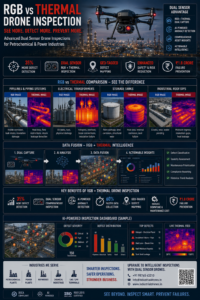
Dual-sensor drone survey of Mumbai industrial facility: RGB image (left) shows surface condition; thermal image (right) reveals moisture-saturated insulation sections invisible to visual inspection.
Comprehensive and Detailed View
The integration of RGB and thermal imaging provides a more comprehensive and detailed view of the inspected area. RGB imaging captures high-resolution visual data, allowing inspectors to see fine details and potential issues. Meanwhile, thermal imaging detects temperature differences that may indicate structural defects, equipment malfunctions, or energy inefficiencies. By combining these two types of imaging, inspectors can identify a wider range of problems and make more informed decisions.
Improved Efficiency
The integration of RGB and thermal imaging can improve the efficiency of inspections. Instead of conducting separate inspections using different technologies, inspectors can capture both visual and thermal data in a single drone flight. This not only saves time but also reduces the need for multiple site visits, minimizing disruption to operations and reducing inspection costs.
Enhanced Safety
The use of drones for combined RGB and thermal imaging can enhance safety by eliminating the need for inspectors to access hazardous or hard-to-reach areas. This reduces the risk of accidents and injuries, making the inspection process safer and more reliable.
Advanced Techniques for Integrating RGB and Thermal Imaging on Drones
Integrating RGB and thermal imaging on drones requires advanced techniques to ensure accurate data capture and analysis. One common method is to use dual-sensor payloads that are equipped with both RGB and thermal cameras. These payloads are designed to capture synchronized images and videos, allowing inspectors to overlay thermal data onto visual images for a comprehensive view of the inspected area.
Additionally, advanced image processing software can be used to analyze and interpret the combined data, enabling inspectors to identify anomalies and potential issues more effectively. Another advanced technique for integrating RGB and thermal imaging on drones is the use of machine learning algorithms. These algorithms can be trained to recognize patterns and anomalies in the combined data, helping inspectors to quickly identify potential problems without the need for manual analysis.
Furthermore, the use of real-time data transmission technology can enable inspectors to receive immediate feedback on the captured data, allowing them to make on-the-spot decisions and take timely action.
Applications of Combined RGB and Thermal Imaging in Inspection Scenarios
The combined use of RGB and thermal imaging on drones has a wide range of applications in inspection scenarios across various industries. In the construction industry, this technology can be used to identify structural defects, insulation issues, and energy inefficiencies in buildings. By capturing both visual and thermal data, inspectors can assess the condition of roofs, walls, and HVAC systems more comprehensively, leading to more accurate maintenance and repair decisions.
In the energy sector, combined RGB and thermal imaging can be used to inspect power lines, solar panels, and wind turbines. Thermal imaging can detect overheating components or electrical malfunctions, while RGB imaging can provide visual evidence of physical damage or corrosion. By using drones equipped with dual-sensor payloads, inspectors can conduct efficient and thorough inspections of energy infrastructure, reducing downtime and minimizing the risk of equipment failure.
Challenges and Considerations for Using RGB and Thermal Imaging Together
While the combination of RGB and thermal imaging offers numerous benefits for drone inspections, there are also challenges and considerations that need to be addressed. One challenge is the integration of data from different sensors into a coherent and actionable format. Inspectors need to have the right tools and software to overlay and analyze RGB and thermal data effectively, as well as the expertise to interpret the combined information accurately.
Another consideration is the impact of environmental factors on data capture and analysis. Weather conditions such as sunlight, humidity, and wind can affect the quality of both visual and thermal images captured by drones. Inspectors need to take these factors into account when planning and conducting inspections to ensure reliable and accurate results.
Additionally, the interpretation of thermal data requires an understanding of heat transfer principles and material properties to distinguish between normal variations and potential issues.
Training and Certification for Pilots Using Combined RGB and Thermal Imaging
Sensor Integration and Data Capture
sensor integration, data capture techniques, image processing software, and interpretation of combined data.
Flight Planning and Safety Procedures
pilots also need to be trained in flight planning and safety procedures specific to inspections using dual-sensor payloads.
Practical Assessments and Certification
certification programs should include practical assessments to evaluate pilots’ ability to capture and analyze combined RGB and thermal data accurately. This may involve simulated inspection scenarios or real-world case studies to test pilots’ skills in identifying potential issues based on the integrated data. By completing comprehensive training and certification programs, pilots can demonstrate their proficiency in using combined RGB and thermal imaging for drone inspections.
RGB + Thermal for Solar Farm Inspection
For solar farm inspections, our drones capture every module in both thermal and RGB simultaneously. The RGB image allows us to cross-reference the module against the plant layout map to assign a module ID to every thermal finding. It also helps distinguish true thermal anomalies from optical artefacts: a shadow from a cable tray shows as a dark patch in thermal imaging, but the RGB image immediately reveals the cause. Soiling from bird droppings is visible in both images — the RGB shows the physical deposit and the thermal shows its impact on module temperature.
RGB + Thermal for Transmission Line Inspection
For transmission line inspections, RGB imaging serves a different purpose: documentation and asset condition assessment. While the thermal sensor identifies overheating components, the RGB sensor documents visible conditions — corroded hardware, missing corona rings, cracked insulators, and bird nesting on towers. Many utilities in India request both thermal and visual inspection reports in a single flight, since the marginal cost of adding RGB documentation to a thermal inspection is minimal.
RGB imagery from transmission inspection can also be processed into orthomosaic maps of the corridor, providing a GIS-compatible asset register of tower locations, access routes, and vegetation encroachment on the right-of-way.
Future Developments and Innovations in Combined RGB and Thermal Imaging Technologies
As technology continues to advance, there are several future developments and innovations in combined RGB and thermal imaging technologies that are expected to enhance the capabilities of drone inspections. One area of development is the improvement of sensor integration and synchronization to capture more accurate and reliable combined data. This may involve the use of advanced calibration techniques and sensor fusion algorithms to ensure seamless integration of visual and thermal images.
Another area of innovation is the development of artificial intelligence (AI) algorithms for automated analysis of combined RGB and thermal data. AI can be trained to recognize patterns and anomalies in the integrated data more efficiently than manual analysis, enabling inspectors to quickly identify potential issues without extensive manual review. Additionally, advancements in drone technology such as longer flight times, higher payload capacities, and improved stability will further enhance the capabilities of combined RGB and thermal imaging for inspections.
In conclusion, the combination of RGB and thermal imaging on drones offers a powerful tool for conducting comprehensive inspections across various industries. By integrating visual and thermal data, inspectors can gain a more thorough understanding of the inspected area and identify a wider range of potential issues. Advanced techniques such as sensor synchronization, machine learning algorithms, and real-time data transmission further enhance the capabilities of combined RGB and thermal imaging.
While there are challenges and considerations that need to be addressed, specialized training and certification programs can ensure the safe and effective use of this technology. Looking ahead, future developments in sensor integration, AI algorithms, and drone technology are expected to further enhance the capabilities of combined RGB and thermal imaging for drone inspections.
For more information on advanced drone inspection techniques, check out this article on safety audit in Indore. This article discusses the importance of conducting safety audits in industrial settings to ensure the well-being of workers and the integrity of equipment. It provides valuable insights into the process of identifying and mitigating potential hazards, which is crucial for industries utilizing advanced drone inspection techniques for maintenance and monitoring.
FAQs
What is RGB imaging?
RGB imaging refers to the use of red, green, and blue color channels to capture and display images. It is the standard color model for electronic displays, such as computer monitors and television screens.
What is thermal imaging?
Thermal imaging, also known as infrared thermography, is a technology that captures the heat emitted by an object or surface and converts it into a visible image. It is commonly used for detecting heat loss, electrical issues, and insulation problems.
How can drones be used for inspection using RGB and thermal imaging?
Drones equipped with RGB and thermal imaging cameras can be used to inspect infrastructure, such as buildings, bridges, and power lines. The RGB camera captures high-resolution visual images, while the thermal camera detects temperature differences that may indicate structural issues or equipment malfunctions.
What are the benefits of combining RGB and thermal imaging for drone inspections?
Combining RGB and thermal imaging allows for a more comprehensive inspection of infrastructure. The visual images captured by the RGB camera provide context and detail, while the thermal images reveal temperature variations that may not be visible to the naked eye. This combination can help identify potential problems more accurately and efficiently.
What industries can benefit from advanced drone inspection techniques?
Various industries can benefit from advanced drone inspection techniques, including construction, energy, utilities, and infrastructure maintenance. These techniques can help identify structural issues, equipment malfunctions, and energy inefficiencies, leading to cost savings and improved safety.