

Introduction
Energy costs continue to represent one of the largest and most controllable operating expenses for industrial plants, commercial buildings, and institutional facilities across India. Despite this, a significant proportion of organizations continue to operate their facilities without a structured, data-driven understanding of where energy is actually being consumed and where it is being wasted.
A walk-through inspection identifies surface-level issues. A utility bill review reveals only aggregate consumption trends. Neither approach provides the depth of analysis needed to make meaningful capital investment decisions in energy efficiency. This is precisely why ASHRAE Level 2 energy audits exist — and why they have become the international benchmark for detailed energy assessments.
For facility managers, plant engineers, EHS professionals, and business decision-makers in India, understanding what an ASHRAE Level 2 audit entails, how it is conducted, and what value it delivers is critical to building an effective energy management strategy.
What Is an ASHRAE Level 2 Energy Audit?
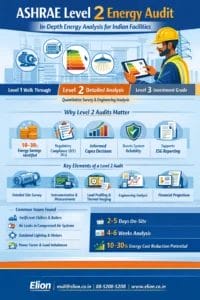
The American Society of Heating, Refrigerating and Air-Conditioning Engineers (ASHRAE) has defined a globally recognized three-tier framework for energy audits:
- Level 1 – Walk-Through Analysis: Preliminary assessment identifying obvious inefficiencies and rough savings estimates.
- Level 2 – Detailed Energy Survey and Analysis: A comprehensive site-specific investigation with quantitative analysis of all major energy systems.
- Level 3 – Investment-Grade Audit: Rigorous engineering analysis with project-specific calculations for major capital-intensive improvements.
An ASHRAE Level 2 energy audit goes significantly beyond the walk-through level. It involves a detailed survey of all energy-consuming systems within a facility, quantitative measurement and data collection, analysis of operational patterns, and the development of specific Energy Conservation Measures (ECMs) with estimated costs, savings, and return on investment calculations.
The output of a Level 2 audit provides facility stakeholders with actionable recommendations backed by measured data — not estimates based on assumptions. This makes it the most commonly specified audit level for organizations planning energy investment programs, regulatory submissions, or sustainability reporting.
| ASHRAE Level 2 Definition
A Level 2 energy audit consists of a detailed energy survey and engineering analysis that identifies and develops potential ECMs, including capital and operational improvements, supported by quantitative analysis of energy savings, implementation costs, and simple payback periods. |
Why the ASHRAE Level 2 Audit Is Important for Indian Facilities
1. Quantified Energy Cost Savings
India’s industrial and commercial sector accounts for over 50% of total national energy consumption. For large facilities, energy costs of Rs. 2 crore to Rs. 50 crore per year are common. An ASHRAE Level 2 audit typically identifies savings potential in the range of 10–30% of annual energy spend, with recommendations prioritized by payback period. This makes the audit’s cost marginal relative to achievable returns.
2. Regulatory Compliance
The Bureau of Energy Efficiency (BEE) under India’s Ministry of Power has established mandatory energy audit requirements for Designated Consumers (DCs) under the Energy Conservation Act, 2001. Facilities in sectors such as manufacturing, hotels, commercial buildings, and institutions exceeding prescribed energy consumption thresholds are legally required to undergo periodic energy audits by BEE-certified auditors. An ASHRAE Level 2 audit, conducted by qualified professionals, aligns well with these regulatory requirements.
3. Capital Investment Decision Support
Unlike a preliminary assessment, the Level 2 audit generates project-level financial analysis for each identified opportunity. Decision-makers receive payback period calculations, ROI projections, and implementation cost estimates — enabling informed capital allocation for energy projects.
4. Operational Reliability and System Life
The detailed system analysis that forms part of a Level 2 audit frequently reveals operational inefficiencies, equipment degradation, and suboptimal control settings that not only waste energy but accelerate equipment wear. Correcting these issues improves system reliability and extends asset life.
5. Insurance and ESG Reporting
With ESG (Environmental, Social, and Governance) reporting gaining prominence among large Indian corporates and their supply chains, documented energy audit findings and implemented ECMs contribute directly to sustainability disclosures, green building certifications, and insurance underwriting requirements.
Relevant Standards and Regulatory Frameworks
An ASHRAE Level 2 energy audit conducted in India typically operates within the framework of multiple standards and regulations:
- ASHRAE Standard 211 (Commercial Building Energy Audits): Defines audit procedures, scope, and reporting requirements for commercial buildings.
- Bureau of Energy Efficiency (BEE) – Energy Conservation Act, 2001: Governs mandatory audits for Designated Consumers; specifies qualifications for energy auditors.
- IS 14885: Indian Standard for energy management systems in industrial establishments.
- ISO 50001: International standard for energy management systems, increasingly adopted by Indian manufacturers and infrastructure operators.
- National Building Code (NBC) of India: Prescribes energy performance requirements for new and existing buildings, including HVAC, lighting, and envelope standards.
- IEC 60364 Series: Electrical installation standards relevant to electrical load analysis components of the audit.
- CEA (Central Electricity Authority) Regulations: Applicable for electrical infrastructure audits, particularly relevant for facilities with high-voltage connections up to 132 kV.
For industrial facilities, additional standards such as OISD guidelines (Oil Industry Safety Directorate) and sector-specific BEE norms may apply depending on industry classification.
Common Problems Identified During ASHRAE Level 2 Audits
Field experience across hundreds of industrial and commercial facilities in India reveals a consistent pattern of energy waste and inefficiency. The following issues are among the most frequently identified:
HVAC Systems
- Chiller plants operating at part-load conditions with poor COP (Coefficient of Performance) due to oversizing or outdated controls.
- Air handling units with dirty or clogged filters causing increased fan energy and reduced airflow efficiency.
- Cooling towers with scale buildup, reducing heat rejection capacity and forcing chillers to operate at higher condensing temperatures.
- Absence of variable frequency drives (VFDs) on pumps and fans operating at fixed speeds under variable demand.
Electrical and Lighting Systems
- Lighting systems still using fluorescent or metal halide technology in areas where LED retrofits would provide 40–70% energy savings.
- Power factor values below 0.95, resulting in additional utility charges and increased distribution losses.
- Motors and transformers operating in inefficiency zones due to consistent under-loading.
- Absence of sub-metering, preventing identification of energy-intensive sub-processes.
Compressed Air Systems
- System-wide leakage rates of 20–40% of total compressed air generation — a chronic problem in Indian industrial facilities.
- Compressors operating at higher-than-necessary delivery pressure, increasing energy consumption by approximately 7% per bar of excess pressure.
- Lack of pressure zoning and sub-metering across large compressed air networks.
Steam and Process Heating
- Steam trap failure (both failed-open and failed-closed) causing significant thermal energy losses.
- Insulation degradation on steam and condensate lines, particularly in outdoor or high-humidity environments.
- Boiler blowdown rates not optimized, resulting in unnecessary heat and water losses.
- Absence of condensate recovery systems, wasting both thermal energy and treated water.
Building Envelope
- Inadequate thermal insulation in cold storage, server rooms, or air-conditioned spaces, increasing cooling load.
- Air infiltration through poorly sealed doors, windows, and building penetrations.
How Professionals Conduct an ASHRAE Level 2 Energy Audit
A professionally executed ASHRAE Level 2 audit follows a structured methodology that ensures completeness, accuracy, and actionable outcomes.
Phase 1: Pre-Site Review and Data Collection
- Obtain 12–36 months of utility billing data (electricity, gas, diesel, steam) and develop an energy use baseline.
- Review existing building drawings, equipment schedules, maintenance records, and operational schedules.
- Analyze utility tariff structures, demand charges, power factor penalties, and time-of-use variations.
- Establish Energy Use Intensity (EUI) benchmarks and compare against industry norms.
Phase 2: Detailed Site Survey and Inspection
- Conduct a comprehensive walkthrough of all energy systems: HVAC, lighting, electrical distribution, compressed air, steam, process equipment, building envelope.
- Interview facility personnel including operators, maintenance staff, and facility managers.
- Document operating schedules, setpoints, control strategies, and current maintenance practices.
- Photograph equipment, control panels, nameplate data, and areas of visible energy waste.
Phase 3: Measurements and Instrumentation
This is a defining feature of the ASHRAE Level 2 audit — quantitative field measurements are essential:
- Electrical power measurements: kW demand, kVA, power factor, harmonic distortion, and load profiles using power quality analyzers.
- Lighting measurements: Lux levels, luminaire wattage verification, and occupancy patterns.
- HVAC measurements: Airflow rates, supply/return temperatures, chiller COP, cooling tower approach temperatures, and refrigerant pressures.
- Motor load measurements: Current, voltage, and power factor measurements on major motors to determine actual loading.
- Steam and thermal measurements: Steam flow rates, condensate temperatures, trap condition, and boiler efficiency.
- Compressed air: Pressure drop surveys, leak detection using ultrasonic equipment, and flow metering.
- Building envelope: Thermal imaging to detect insulation gaps and air infiltration.
Phase 4: Engineering Analysis and ECM Development
- Analyze all collected data to establish system-level energy consumption baselines.
- Develop specific Energy Conservation Measures (ECMs) for each identified opportunity.
- Calculate annual energy savings (kWh, kVAr, fuel) for each ECM using engineering calculations or simulation tools.
- Estimate implementation costs including equipment, installation, and commissioning.
- Calculate Simple Payback Period (SPP) and where appropriate, Net Present Value (NPV) and Internal Rate of Return (IRR).
Phase 5: Reporting
- Compile comprehensive written audit report with executive summary, facility baseline, ECM descriptions, financial analysis, and implementation roadmap.
- Prioritize ECMs by investment requirement and payback period into short-term (0–1 year), medium-term (1–3 years), and long-term (3+ years) categories.
- Provide supporting data appendices including measured data, calculations, and instrumentation records.
Tools and Instruments Used in ASHRAE Level 2 Audits
The reliability and accuracy of an ASHRAE Level 2 audit depend directly on the quality and calibration of the instruments used. Professionally conducted audits use NABL-calibrated instruments to ensure measurement traceability.
- Power Quality Analyzers: Measure electrical parameters including kW, kVA, kVAr, power factor, voltage, current, and harmonic distortion across single and three-phase systems. Essential for load profiling, demand analysis, and power factor assessment.
- Thermal Imaging Cameras (Infrared Thermography): Identify insulation failures, steam trap conditions, electrical hotspots, building envelope air leakage, and motor overheating. One of the most diagnostically powerful tools in energy auditing.
- Ultrasonic Leak Detectors: Pinpoint compressed air, gas, and steam leaks in pressurized systems — inaudible to the human ear but clearly identifiable using ultrasonic sensors.
- Portable Flow Meters (Clamp-on Ultrasonic): Non-invasive measurement of water, chilled water, and condensate flow rates without pipe cutting.
- Lux Meters and Luminance Meters: Measure illuminance levels across facility spaces to compare against recommended standards and identify over/under-lit areas.
- Gas Analyzers / Flue Gas Analyzers: Measure combustion efficiency of boilers, furnaces, and DG sets by analyzing O2, CO2, CO, and NOx content in flue gas.
- Data Loggers: Record electrical parameters, temperatures, and flow rates over extended periods to capture operational patterns and load profiles.
- Vibration Analyzers: Identify mechanical inefficiencies in rotating equipment such as misalignment and bearing wear that increase motor energy consumption.
- Thermal Anemometers: Measure air velocity in ducts and across AHU coils to assess HVAC airflow performance.
Expert Insights from Field Audits
The engineering team at Elion Technologies & Consulting Pvt. Ltd. has conducted energy audits across a broad spectrum of facility types since 2010, accumulating practical insights that go beyond textbook methodology.
| Field Observation: Compressed Air Systems
In a large manufacturing plant audited by Elion’s team, ultrasonic leak detection identified over 200 individual leak points across a compressed air distribution network. Quantified leakage represented approximately 28% of total compressor output — equivalent to running one of the three installed 75 kW compressors continuously to supply leaking air alone. Repair cost was minimal; the annual energy savings exceeded Rs. 18 lakhs. |
| Field Observation: Chiller Plants in Commercial Buildings
In a multi-floor commercial complex, power measurements revealed chillers operating at an average part-load ratio of 35-40% for over 70% of operating hours. The absence of variable speed drives on chilled water pumps and the use of constant-volume air handling resulted in pumping energy 2.4 times higher than engineering-optimal. Installing VFDs and implementing chiller sequencing controls resulted in 22% reduction in HVAC electricity consumption. |
Across 30,000+ technical audits conducted pan-India, Elion’s engineers have observed that facilities with ISO 50001 energy management systems in place still frequently demonstrate 15–20% unaccounted energy use at the sub-system level — primarily due to the absence of sub-metering and inadequate monitoring of secondary systems such as compressed air, cooling towers, and auxiliary pumping.
Common Mistakes Organizations Make
- Treating energy audits as a compliance checkbox rather than a management tool — submitting audit reports to BEE without implementing recommended measures.
- Relying solely on utility bills for energy management instead of real-time or interval sub-metering data.
- Commissioning Level 1 walk-through audits when a decision-grade Level 2 analysis is needed for capital investment justification.
- Using unqualified or instrument-poor vendors who provide reports without actual field measurements.
- Failing to engage facility operations staff during the audit, missing critical information about actual operating schedules, seasonal variations, and known system issues.
- Not establishing a post-audit implementation monitoring program, resulting in efficiency gains degrading within 2–3 years.
- Overlooking behavioral and operational ECMs (low-cost, high-return) in favor of only capital-intensive equipment upgrades.
- Allowing significant time gaps between the audit and implementation, during which facility conditions change and savings estimates become outdated.
Practical Checklist: Preparing for an ASHRAE Level 2 Energy Audit
Organizations can use the following checklist to prepare effectively for a Level 2 audit engagement:
- Compile 24–36 months of utility invoices (electricity, gas, diesel, steam, water) with monthly consumption and demand data.
- Prepare single-line electrical diagrams and equipment schedules including nameplate ratings for major loads.
- Provide equipment manuals and maintenance logs for major energy systems (chillers, boilers, compressors, major motors).
- Document facility operating schedules including shifts, seasonal variations, and planned shutdowns.
- Identify energy-intensive processes and any areas of known inefficiency.
- Arrange facility access including rooftops, plant rooms, electrical panels, and utility connections.
- Designate an internal energy coordinator to accompany auditors and provide operational context.
- Provide any previous audit reports, energy studies, or equipment performance records.
- Identify any planned capital projects that may affect energy systems — these should be considered in ECM development.
- Obtain clearance for electrical panel opening and instrument connection from safety and maintenance teams.
The Role of Independent Third-Party Energy Audits
There is a meaningful difference between an internal self-assessment and an independent third-party ASHRAE Level 2 audit. Organizations that rely solely on internal teams or equipment vendors for energy assessments frequently encounter several limitations:
- Internal teams may lack specialized instrumentation required for accurate electrical, thermal, and fluid measurements.
- Equipment suppliers providing ‘free energy assessments’ have an inherent commercial incentive to recommend their own products, which may not represent the optimal solution.
- Regulatory submissions, bank financing for energy projects, and ESG disclosures often require independent third-party audit certification.
- Third-party auditors bring cross-industry benchmarking experience that internal teams cannot replicate from a single-facility perspective.
An independent audit firm with no affiliation to equipment suppliers, energy service companies, or financing entities provides findings that are commercially neutral and technically objective — a critical requirement when audit results will drive capital allocation decisions.
About Elion Technologies & Consulting Pvt. Ltd.
Elion Technologies & Consulting Pvt. Ltd. is an independent engineering audit and safety compliance company headquartered in India. Established in 2010, Elion has conducted over 30,000 technical audits across industrial plants, commercial buildings, hotels, warehouses, banks, retail chains, and infrastructure facilities throughout India.
Elion’s energy audit practice is staffed by qualified engineers and BEE-certified energy auditors working with professional-grade, NABL-calibrated instruments. The firm maintains independence from equipment manufacturers and energy service contractors, ensuring that all findings and recommendations reflect technical merit rather than commercial considerations.
Elion’s client portfolio includes organizations from diverse sectors, including Adani Enterprises, Reliance, Vedanta, Havells, Tata Group, Indian Railways, IOCL, HPCL, PVR Cinemas, and Aditya Birla Group, among many others. The firm’s experience extends to electrical systems up to 132 kV, making it equipped to handle both small commercial facilities and large industrial complexes.
Elion’s ASHRAE Level 2 energy audit services provide clients with comprehensive, measurement-based analysis, defensible ECM financial projections, and regulatory-compliant documentation.
| Elion at a Glance
✔ Independent engineering audit firm — no equipment sales or contracting affiliations ✔ Operating since 2010 ✔ 30,000+ technical audits completed across India ✔ BEE-certified energy auditors ✔ NABL-calibrated professional instruments ✔ Pan-India coverage across all major industrial and commercial sectors ✔ Electrical audit capability up to 132 kV systems |
Conclusion
An ASHRAE Level 2 detailed energy survey and analysis represents the appropriate standard of rigor for organizations seeking to make evidence-based decisions about energy investment. It moves beyond cursory walk-through observations to deliver a quantified, system-level understanding of energy consumption, waste, and improvement opportunity.
For Indian facilities navigating BEE compliance requirements, rising energy tariffs, ESG reporting expectations, and the financial pressure of energy costs, the Level 2 audit provides the technical foundation for an effective, data-driven energy management program.
The quality of an ASHRAE Level 2 audit is ultimately determined by the competence of the auditing team, the quality of instrumentation deployed, and the independence of the analysis. Organizations that invest in properly conducted audits by certified professionals consistently achieve better ROI on their energy investment programs.
Frequently Asked Questions (FAQ)
Q: What is the difference between ASHRAE Level 1, Level 2, and Level 3 energy audits?
A: ASHRAE Level 1 is a walk-through analysis providing a rough assessment of energy saving opportunities. Level 2 is a detailed energy survey with quantitative measurements, system-level analysis, and financial projections for each Energy Conservation Measure (ECM). Level 3 is an investment-grade audit providing in-depth engineering analysis for major capital projects. Level 2 is the most commonly specified for facility energy management programs.
Q: How long does an ASHRAE Level 2 energy audit take?
A: The duration depends on facility size and complexity. For a mid-sized industrial plant (10,000 to 50,000 sq.m.), a Level 2 audit typically involves 2–5 days of site work followed by 2–4 weeks of analysis and report preparation. Larger or more complex facilities may require longer site engagement and data logging periods to capture representative operational profiles.
Q: What facilities are required to undergo energy audits under BEE regulations?
A: Under India’s Energy Conservation Act, 2001, Designated Consumers (DCs) — facilities in specified industrial and commercial sectors exceeding prescribed annual energy consumption thresholds — are legally required to undergo energy audits by BEE-accredited auditors at prescribed intervals. Categories include thermal power plants, steel, cement, fertilizer, chemicals, textile, railways, hotels, commercial buildings, and others.
Q: What does an ASHRAE Level 2 audit report include?
A: A Level 2 audit report typically includes an executive summary, facility energy baseline (including Energy Use Intensity), a description of all major energy-consuming systems, a list of identified Energy Conservation Measures (ECMs) with energy savings estimates, implementation costs, and payback periods, measurement data appendices, and an implementation prioritization roadmap categorized by investment level and payback period.
Q: What energy savings can be expected from an ASHRAE Level 2 audit?
A: Savings potential varies by facility type, age, and existing efficiency level. For facilities that have not undergone a structured energy program previously, an ASHRAE Level 2 audit typically identifies 10–30% savings on annual energy spend across all ECMs. Not all ECMs are implemented simultaneously; even implementing the top-priority, lowest-cost measures typically yields 8–15% savings with payback periods under 2 years.
Q: Does an ASHRAE Level 2 audit cover both electrical and thermal energy?
A: Yes. A comprehensive Level 2 audit covers all energy vectors consumed by the facility, including electricity, diesel, natural gas, LPG, steam, hot water, and chilled water as applicable. The analysis examines all major consuming systems: HVAC, lighting, electrical motors, compressed air, steam and process heat, building envelope, and utility supply systems.
Q: What is the cost of an ASHRAE Level 2 energy audit in India?
A: Audit costs depend on facility size, complexity, geographic location, and the scope of instrumentation required. For independent, professionally conducted Level 2 audits in India, investment typically ranges from Rs. 1.5 lakhs to Rs. 15 lakhs for most industrial and commercial facilities. Given that identified ECMs commonly deliver savings of Rs. 10–50 lakhs or more annually, the audit represents a high-ROI investment.
Q: How is an ASHRAE Level 2 audit different from an ISO 50001 energy management system?
A: An ASHRAE Level 2 audit is a point-in-time technical assessment that identifies energy saving opportunities and quantifies their financial value. ISO 50001 is a management system standard that establishes ongoing organizational processes for energy monitoring, targeting, and continual improvement. The two are complementary: Level 2 audit findings often serve as the technical baseline and ECM pipeline for an ISO 50001 implementation.