Water Balancing Services

Elion provides Water Balancing services for industrial, commercial, and institutional facilities to quantify water inflow, usage, storage, losses, reuse, and discharge, and to establish an accurate, verifiable water balance aligned with operational and regulatory requirements.

Pan-India Execution

Independent Consultant

Statutory-Ready Reports

Multi-Industry Experience

Why Water Balancing is Critical for Your Facility

Water balancing is a fundamental engineering exercise used to establish control over water systems and verify that all water entering a facility is properly measured, allocated, and accounted for. In most facilities, water is supplied through multiple sources and consumed across diverse applications such as process operations, utilities, domestic use, cooling systems, landscaping, and treatment plants. Without a validated water balance, discrepancies between supplied water and recorded consumption remain unidentified.

Unaccounted losses such as leakages, tank overflows, unmetered usage, excessive backwash, meter inaccuracies, and undocumented reuse can persist for extended periods without detection. These gaps not only increase water procurement costs but also weaken operational control and water stewardship efforts.

A structured water balancing study establishes a quantitative baseline by reconciling all water inputs with measured outputs, reuse, storage variation, and losses. It enables identification of high-loss areas, supports rationalization of metering and monitoring systems, and provides reliable data for water efficiency improvement planning. Water balancing also supports statutory compliance, sustainability reporting, and internal audits where accurate water accounting and groundwater abstraction or discharge data are required. Elion’s approach focuses on measured data, systematic reconciliation, and implementation-ready findings to ensure the study delivers practical operational value.

Water Balancing: Technical Methodology & System Reconciliation

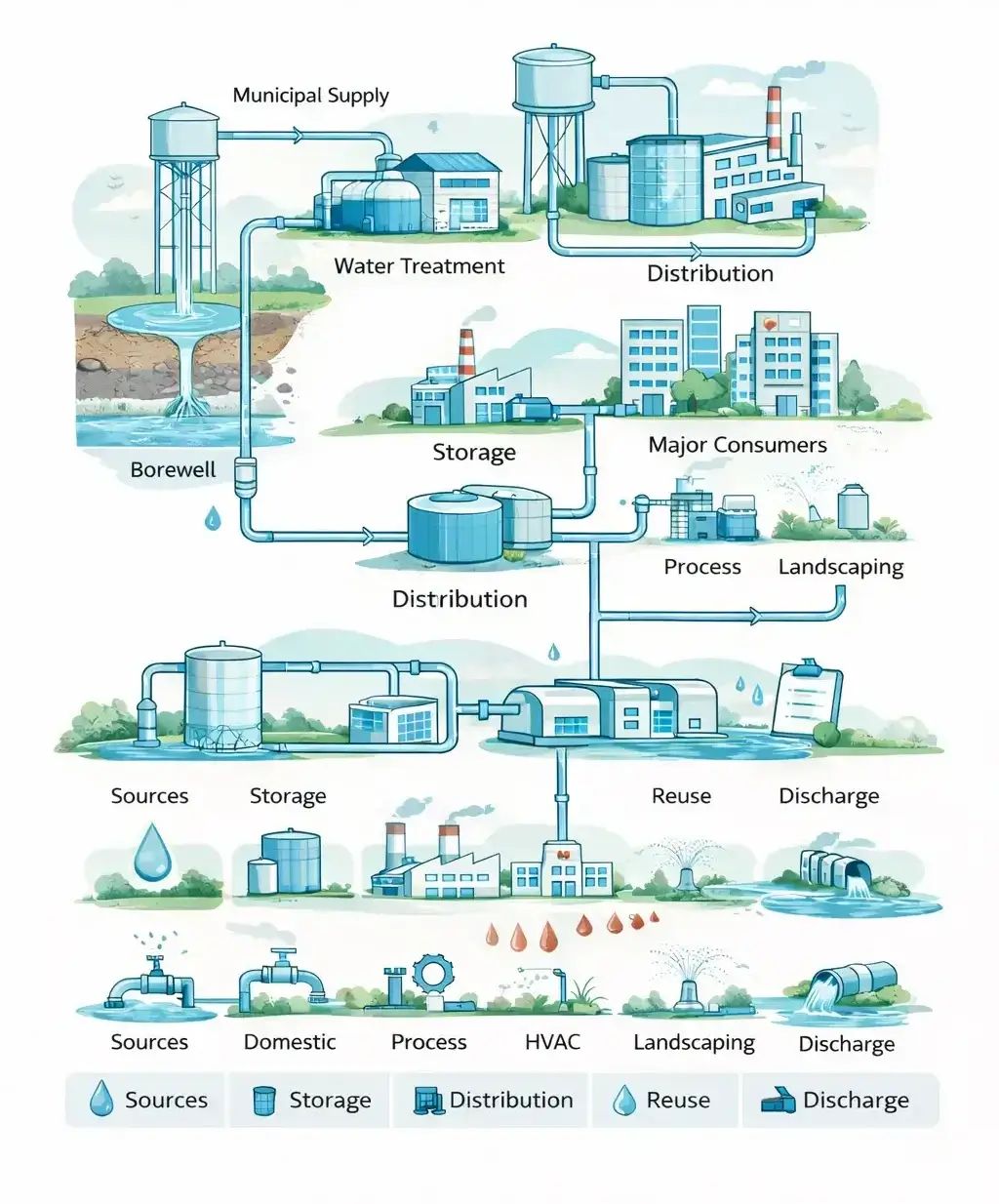
water-balancing-system-workflow-industrial-facility
Typical water balancing workflow illustrating source identification, system boundary definition, distribution mapping, storage assessment, reuse streams, discharge points, and reconciliation of inputs and outputs to identify unaccounted water and system losses.
Typical Water Audit Outcomes
  • Identification of 10–20% unaccounted water due to leakages, overflows, unmetered consumption, and data gaps
  • 8–15% improvement potential through system balancing, metering rationalisation, and operational control
  • Preparation of a site-specific water balance statement covering inputs, usage, reuse, storage variation, and losses
  • Clear segregation of real losses vs apparent losses for targeted corrective action
  • Implementation-ready recommendations with monitoring and balancing checkpoints
  • Audit-ready documentation supporting CGWA, SPCB, sustainability disclosures, and internal reviews
Client Sector Water Saved (L/Year) Cost Savings (₹) Verified Satisfaction ROI Achievement
Manufacturing Plant Auto Components | Gurugram
14,200,000
₹9,10,000
99% ✓
9 months
IT Park – Commercial Complex | Bengaluru
9,600,000
₹6,30,000
98% ✓
11 months
Hotel & Resort – 5 Star | Goa
18,400,000
₹12,80,000
100% ✓
7 months
Educational Institute | Pune
5,200,000
₹3,60,000
99% ✓
12 months
Hospital – 300 Bed Facility | Delhi
7,900,000
₹5,40,000
98% ✓
10 months
Residential Township – 600 Units | Noida
3,800,000
₹2,60,000
99% ✓
14 months

📊 Data Methodology: All measurements verified using calibrated flow meters and volume reconciliation methods. Water balance accuracy validated through input–output closure checks. Client satisfaction measured through structured post-implementation surveys.

Manufacturing Industry – Water System Balancing & Loss Control

Challenge:
High water procurement (19,500 litres/day) with mismatch between supplied water and recorded consumption. No clarity on losses across process, cooling, and utility systems. Rising tanker dependency and inconsistent water records.

Our Approach

  1. System Boundary Definition:
    Defined complete water system limits including borewell supply, municipal input, storage tanks, process usage, utilities, and discharge.
  2. Metering & Data Validation:
    Installed and verified zone-wise sub-meters and conducted 24-hour flow reconciliation.
  3. Water Balance Development:
    Prepared detailed input–output balance including storage variation and reuse streams.
  4. Loss Identification:
    Identified real losses from underground pipeline seepage and apparent losses from incorrect meter placement.
  5. Balancing Measures:
    Recommended pipeline repair, metering realignment, balancing valves, and monitoring protocol.
  6. Implementation Support:
    Assisted facility team with corrective actions and post-implementation verification.

Documented Results

  • ✓ Unaccounted water reduced from 6,800 to 1,900 L/day
  • ✓ Overall water procurement reduced by 41%
  • ✓ Annual cost reduction: ₹9,10,000
  • ✓ Improved system closure accuracy (>95%)
  • ✓ Stable water balance maintained for 12+ months
  • ✓ Client satisfaction rating: 99/100

Third-Party Verification:
Results validated through independent measurement review and internal audit verification records.

View Water Audit Case Studies

Fields marked with an asterisk (*) are required

Latest News

Our Impact at a Glance

98%

Client Satisfaction

45M+

Liters Water Saved

500+

Audits Completed

35%

Average Savings

8-Step Water Balancing Process (Implementation-Focused)

The following process is followed to ensure the water balance results are accurate, measurable, and suitable for operational control, compliance review, and management decision-making.

Step 1 — Data Collection

Collect source-wise water supply data including municipal supply, borewells, tankers, recycled water, historical water bills, STP/ETP records, storage capacities, drawings, and available consumption logs.

Step 2 — System Boundary & Mapping

Define water balance boundaries and map all water sources, storage tanks, distribution networks, reuse loops, and end-use points to establish a complete source-to-discharge system overview.

Step 3 — Site Walkthrough

Validate physical infrastructure, assess actual operating conditions, identify leakage and overflow risks, verify undocumented consumption points, and confirm real-world water movement across systems.

Step 4 — Measurement & Verification

Verify adequacy and accuracy of existing meters, perform spot flow measurements where required, validate volumes through reconciliation checks, and confirm reliability of recorded consumption data.

Step 5 — Water Balance

Prepare a detailed water balance equation covering inputs, usage, reuse, storage variation, and losses. Quantify unaccounted water and establish baseline water balance performance indicators.

Step 6 — Loss & Gap Identification

Identify and segregate real losses (leakages, overflows) and apparent losses (meter inaccuracies, data gaps). Assess system imbalances and prioritise corrective opportunities.

Step 7 — Controls & Monitoring Framework

Define balancing controls, metering improvements, routine monitoring practices, documentation requirements, and performance tracking mechanisms to maintain balance closure over time.

Step 8 — Reporting & Closure

Prepare a structured water balancing report with validated findings, balance diagrams, quantified gaps, and actionable recommendations. Present results for management review and implementation alignment.

Comprehensive Deliverables You Receive

Water System Mapping & Water Balance

Source-to-discharge water system mapping with a documented and reconciled water balance, clearly identifying major consumption points, reuse streams, storage variation, and losses.

Metering & Monitoring Recommendations

Recommendations to strengthen measurement points, improve data accuracy, rationalise meters, and establish routine tracking mechanisms for sustained water balance control.

Loss Reduction & Control Measures

Prioritised actions for leakage reduction, overflow control, and system balancing with clear feasibility and implementation guidance.

Water Balancing Report for Review & Compliance

A structured, audit-ready report suitable for management review, internal audits, sustainability reporting, and regulatory reference (as applicable to facility operations).

Industries We Serve

Manufacturing & Industrial

Commercial Buildings

Warehousing & Logistics

Hospitals & Healthcare

Related Water Audit Projects

Water Quality Audit

Elion Technologies and Consulting Private Limited completed water audit for Bengaluru hotel chain to improve efficiency.

Elion Technologies and Consulting mapped usage patterns, highlighted savings potential, and supported sustainable water efficiency improvements for hotel operations.

facility water balance audit

Elion Technologies and Consulting Private Limited showcases how water audits help industries reduce major operational costs.

Elion Technologies and Consulting improves industrial water efficiency, cutting waste and lowering operational expenses through data-driven audit insights and solutions.

water audit

Elion Technologies and Consulting Private Limited completed water audit for pharmaceutical unit in Haridwar Uttarakhand

Elion Technologies and Consulting improved water usage, identified saving opportunities, and supported sustainable operational efficiency for the pharmaceutical facility team.

Water Quantification Study

Elion Technologies and Consulting Private Limited showcases water audit expertise for automotive in Gurgaon Haryana

Elion Technologies and Consulting delivers actionable insights improving water efficiency, reducing costs, and supporting sustainable operations for Gurgaon automotive facilities.

Why Clients Trust Elion

Serving
Since
2010

10,000+ Satisfied Client

50,000+ facility
Audit

Pan-India
and International

Related Water Audit Projects

Who Should Mandatorily Undertake Water Balancing?

Water Balancing is mandatory or strongly recommended for the following facilities where accurate water accounting is required:

  • Industrial units with multiple water sources or high water consumption
  • Facilities with complex internal distribution networks and reuse loops
  • Sites applying for CGWA approval, renewal, or compliance verification
  • Commercial and institutional facilities with centralised water and utility systems
  • Organisations implementing water efficiency, sustainability, or ESG programs
  • Facilities experiencing unexplained high water procurement or tanker dependency

Elion Technologies & Consulting can review your facility profile and advise whether Water Balancing is mandatory, recommended, or critical for your operations.

Water Balancing Expertise & Competency

All Water Balancing studies are executed by Elion Technologies & Consulting Pvt. Ltd.’s in-house multidisciplinary audit team, comprising experienced water management professionals with extensive exposure across industrial, commercial, institutional, and infrastructure facilities.

Our team brings decades of hands-on experience in water audits, system reconciliation, loss analysis, and utility optimisation. Each Water Balancing engagement follows a standardised, peer-reviewed methodology, supported by calibrated instruments, verified data collection protocols, and internal technical validation.

The Water Balancing methodology focuses on:

  • Accurate reconciliation of water inputs and outputs
  • Quantification of real and apparent losses
  • Verification of system closure and data reliability
  • Development of implementation-ready control measures

This structured approach ensures consistency, confidentiality, technical accuracy, and uniform quality across projects, regardless of facility size or location. Where applicable, studies are aligned with IS 10430 principles, CGWA requirements, and SPCB expectations to ensure regulatory relevance and audit readiness.

Frequently Asked Question (FAQs)

Water Balancing is not universally mandated, but it is mandatory or strongly recommended for facilities with high water consumption, multiple water sources, CGWA compliance requirements, or sustainability reporting obligations.

Water Balancing is carried out using engineering best practices, aligned with IS 10430 principles, CGWA guidelines, CPCB/SPCB expectations, and accepted international water accounting methodologies.

Water Balancing is the process of quantitatively reconciling all water inputs with measured usage, reuse, storage variation, discharge, and losses to identify unaccounted water and system inefficiencies.

No. Water Balancing is typically conducted during normal operations. Temporary flow checks and validations are planned to avoid disruption to facility operations.

  • Water bills and abstraction records
  • Borewell, tanker, and municipal supply details
  • STP/ETP flow logs and reuse data
  • Storage tank capacities and layouts
  • Existing flow meter details and drawings

Yes. Water Balancing explicitly quantifies real losses (leakages, overflows) and apparent losses (meter inaccuracies, data gaps), enabling targeted corrective action.

No. Water Balancing forms the quantitative foundation of water management and complements a full Water Audit, which also covers efficiency improvement and optimisation opportunities.

Water balancing involves optimizing water distribution, flow rates, and quality within a system. It ensures efficient resource utilization, cost savings, and environmental  sustainability.

Elion technologies brings over a decade of industry experience, certified auditors, tailored solutions, and a proven track record of success, ensuring optimal water system performance.

Our certified auditors assess your water systems, analyze data, make precise adjustments, and implement strategies to achieve harmonious and efficient water distribution.

Yes, we have served various industries, including commercial, industrial, residential, healthcare, agriculture, and more. Our expertise spans diverse sectors.

Absolutely, our solutions are tailored to your specific needs, considering factors such as system size, water quality, and environmental requirements.

We utilize cutting-edge technologies for real time data analysis, precise adjustments, and monitoring, ensuring optimal and up-to-date water balance.

Yes, our strategies contribute to water conservation by minimizing wastage, enhancing distribution efficiency, and promoting responsible water use.

Clients often experience significant cost savings due to reduced energy consumption, optimized system performance, and lower maintenance expenses.

Contact us through our website or phone, and our team will guide you through the process, starting with a consultation or assessment.

Yes, we offer continuous monitoring, adjustments, and support to ensure your water systems maintain peak efficiency over time.

While our primary operations are local, we also provide services to a broader region, depending on the projects scale and requirements.

Yes, by optimizing water distribution and reducing stress on equipment, our services can extend the lifespan of your water systems and components.

Yes, we adhere to industry best practices and relevant standards to ensure our solutions are of the highest quality and effectiveness.

Our extensive experience, certified auditors, tailored strategies, technological integration, and commitment to sustainability make us a standout choice.

Timelines vary based on the complexity and scale of the project. We aim to complete assessments and adjustments efficiently while ensuring thoroughness.

You can reach us through our website’s contact form or by calling our customer service hotline. Our team is ready to address your inquiries and guide you through the process.

It ensures that water is distributed efficiently, reducing wastage and the need for excess water.