Training Coordinator, Industrial Paint Manufacturer
“The safety induction for new hires was handled smoothly. Elion brought their own AV equipment and kept the session engaging. We’re thinking of repeating this monthly.”

And Consulting Private Limited
And Consulting Private Limited
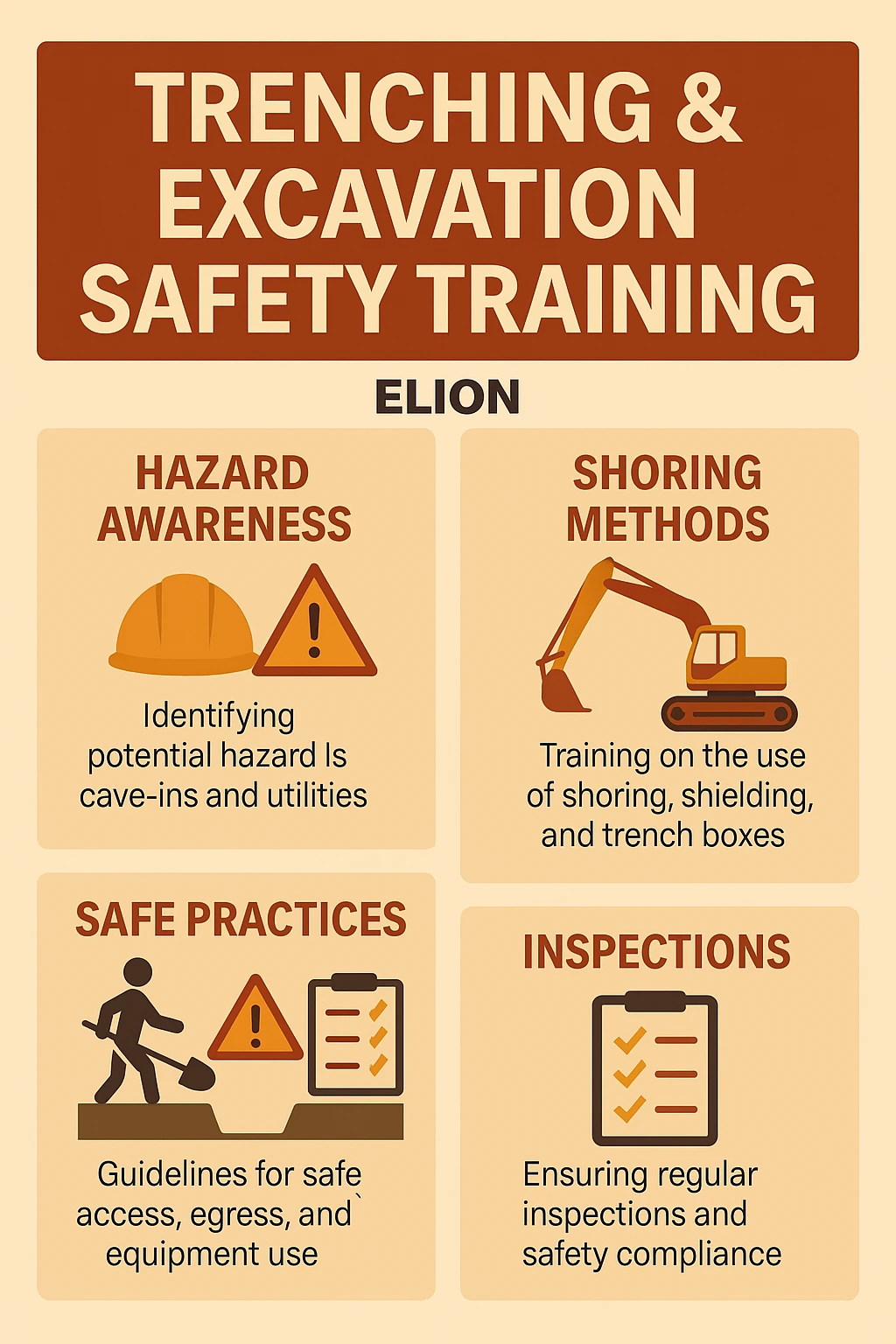
Trenching and excavation activities are among the most hazardous in construction and maintenance. Cave-ins, buried utility strikes, and collapse-related fatalities occur frequently due to poor planning or lack of safety protocols. This training helps workers understand protective systems, hazard identification, and emergency procedures specific to trench work.
Elion delivers trenching safety training tailored to your project site, depth of excavation, soil conditions, and utility presence. Whether for civil construction, pipeline installation, or electrical trenching, our content is aligned to your field risks and compliance requirements.
Participants receive a Certificate of Participation from Elion Technologies. The training is aligned with:
Planning excavation or trenching work?
Request a Quote or contact us at [email protected].
“The safety induction for new hires was handled smoothly. Elion brought their own AV equipment and kept the session engaging. We’re thinking of repeating this monthly.”
“Good response from our team for the chemical spill drill and awareness session. We had a minor leak last year and this training was timely. They even explained the MSDS sheet details clearly.”
“Elion conducted ergonomics training for our office support staff. They gave tips that don’t need any budget—just posture, breaks, and seating angles. Everyone found it useful.”
“Warehouse safety training was organized at our distribution center. The module covered stacking, material flow, and emergency handling. One or two team leads found the content basic, but the newcomers appreciated it.”
“The hot work and gas cutting safety training helped us address some recent near-misses. Our fabrication contractors said it was the first time anyone explained why permits matter, not just how to fill them.”
“We held a training on ergonomics and workstation safety. Elion’s speaker had a practical approach—suggested small furniture changes and posture tips that didn’t cost much but helped our office staff.”
“Elion covered cold storage safety and ammonia handling well. Some of our technicians said it was the first time they understood how to respond to leaks. We may request them for a follow-up drill.”
“Our garment unit required machine safety awareness for new joiners. Elion kept it interactive and used visuals from our own plant, which the workers related to.”
“The crane and material handling training helped reduce near misses in our yard. The trainer also gave tips that were not in the slides, based on their field experience. That made a difference.”
“We requested a training module on emergency evacuation procedures. Elion included site-specific examples which helped. The mock drill later was well-coordinated too. Our fire wardens felt more confident after the session.”
It’s a program that trains workers on safe excavation practices, focusing on soil hazards, protective systems, and preventing cave-ins.
Cave-ins, underground utilities, falls, atmospheric hazards, and equipment safety.
Construction workers, supervisors, safety officers, and contractors.
Usually 1 day.
Yes, participants receive certificates.
Yes, practical on-site sessions are preferred.
Yes, tailored to specific site conditions and regulations.
Fields marked with an asterisk (*) are required
Plant safety training is of utmost importance in any industrial setting. It is crucial for the safety and well-being of employees, as well as for the overall productivity and efficiency of the plant. Proper training ensures that employees are equipped with the knowledge and skills to identify and mitigate potential…
Hazard and Operability Studies (HAZOP) are a critical component of any workplace safety program. These studies are designed to identify potential hazards and operational issues that could pose a risk to employees, equipment, and the environment. By conducting a thorough HAZOP study, organizations can proactively identify and address potential risks…
Lab safety training is an essential component of any laboratory environment. It is crucial for ensuring the safety and well-being of all personnel working in the lab, as well as for protecting the integrity of the research being conducted. Proper training helps to minimize the risk of accidents, injuries, and…
Elion Technologies and consulting Mock Drill Training is a critical initiative designed to improve safety protocols and operational efficiency in warehouse environments. In warehouses, where accident risks are significant, mock drills serve as preventative measures to prepare staff for actual emergencies. The program simulates emergency scenarios, enabling employees to practice…
Employee safety awareness training is a crucial aspect of any organization’s operations. It is essential for employees to be aware of potential hazards in the workplace and to know how to prevent accidents and injuries. By providing comprehensive safety awareness training, employers can ensure that their employees are equipped with…
Cement factories are critical components of the construction industry, providing the essential material for building infrastructure, homes, and commercial properties. However, the production of cement involves complex processes that can pose significant risks to workers if not managed properly. Therefore, training in cement factories is not merely a regulatory requirement;…
The Occupational Safety and Health Administration (OSHA) has established regulations to protect workers from the harmful effects of noise exposure in the workplace. These regulations are designed to prevent hearing loss and other health issues that can result from prolonged exposure to high levels of noise. OSHA’s noise exposure regulations…
Safety training in the workplace is a critical component of organizational success and employee well-being. It serves as a proactive measure to prevent accidents, injuries, and fatalities, which can have devastating effects not only on individuals but also on the overall productivity and morale of a company. By equipping employees…
Elion’s Safety Training Program is a comprehensive initiative designed to enhance workplace safety and promote a culture of awareness among employees. In an era where industrial safety is paramount, Elion has taken significant strides to ensure that its workforce is not only aware of potential hazards but is also equipped…
Safety training for factory workers is of utmost importance as it ensures the well-being of employees and the smooth operation of the factory. Factory environments are often filled with potential hazards, from heavy machinery to chemical exposure, and it is crucial for workers to be equipped with the knowledge and…