
Training Coordinator, Industrial Paint Manufacturer
“The safety induction for new hires was handled smoothly. Elion brought their own AV equipment and kept the session engaging. We’re thinking of repeating this monthly.”
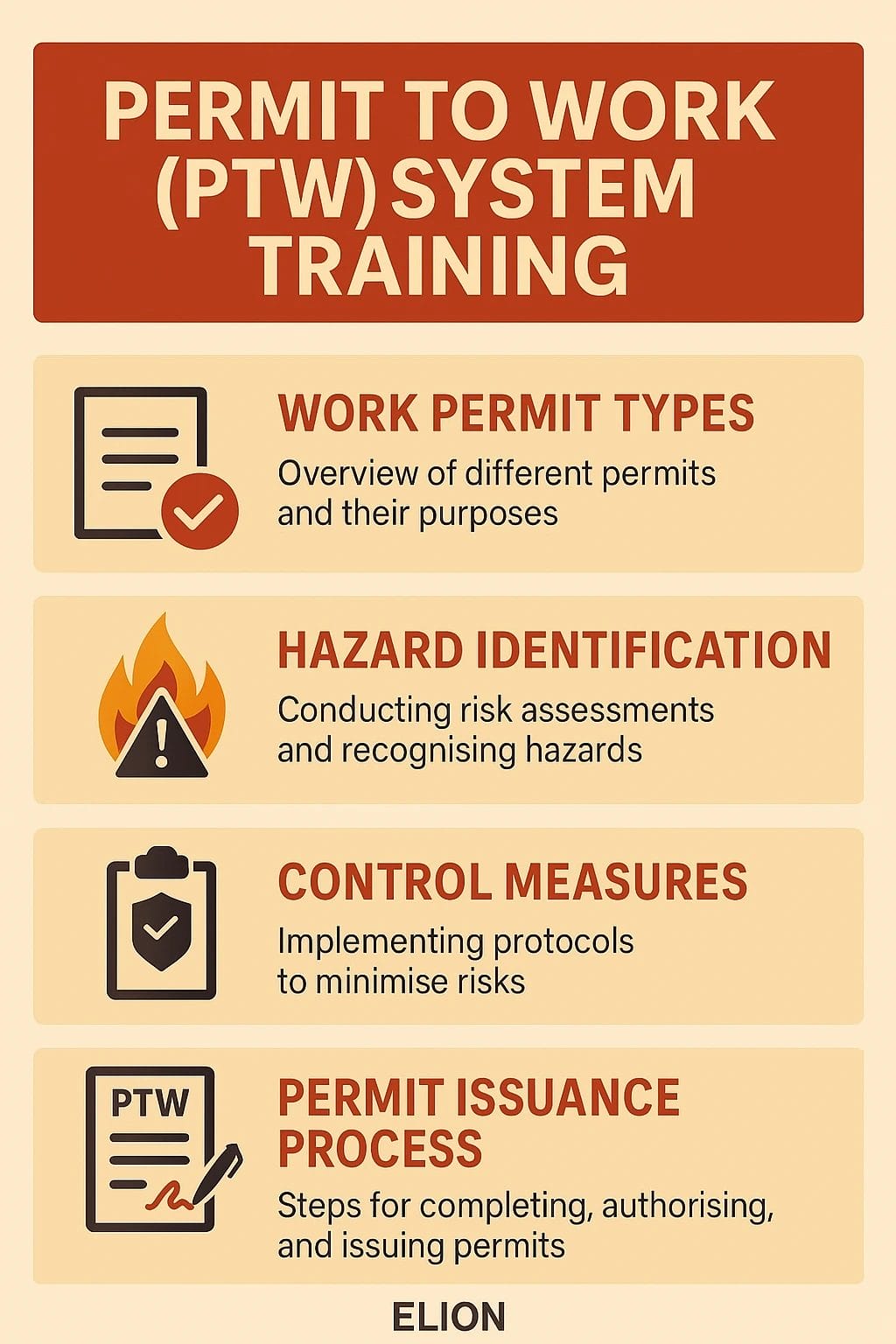
Unsafe work during maintenance, confined space entry, hot work, or electrical isolation often leads to serious incidents. A structured Permit to Work (PTW) system ensures high-risk jobs are carried out with proper controls and approvals. PTW Training enables your workforce to manage permits responsibly and prevent accidents caused by poor coordination or communication.
Elion delivers site-specific PTW system training based on the nature of your high-risk activities, permit formats, and departmental responsibilities. Whether you’re in a manufacturing unit, data center, warehouse, or construction site, the program is adapted to your processes and job types.
Participants receive a Certificate of Participation from Elion Technologies. The training complies with:
Need to improve your permit system or train new supervisors?
Request a Quote or contact us at [email protected].
“The safety induction for new hires was handled smoothly. Elion brought their own AV equipment and kept the session engaging. We’re thinking of repeating this monthly.”
“Good response from our team for the chemical spill drill and awareness session. We had a minor leak last year and this training was timely. They even explained the MSDS sheet details clearly.”
“Elion conducted ergonomics training for our office support staff. They gave tips that don’t need any budget—just posture, breaks, and seating angles. Everyone found it useful.”
“Warehouse safety training was organized at our distribution center. The module covered stacking, material flow, and emergency handling. One or two team leads found the content basic, but the newcomers appreciated it.”
“The hot work and gas cutting safety training helped us address some recent near-misses. Our fabrication contractors said it was the first time anyone explained why permits matter, not just how to fill them.”
“We held a training on ergonomics and workstation safety. Elion’s speaker had a practical approach—suggested small furniture changes and posture tips that didn’t cost much but helped our office staff.”
“Elion covered cold storage safety and ammonia handling well. Some of our technicians said it was the first time they understood how to respond to leaks. We may request them for a follow-up drill.”
“Our garment unit required machine safety awareness for new joiners. Elion kept it interactive and used visuals from our own plant, which the workers related to.”
“The crane and material handling training helped reduce near misses in our yard. The trainer also gave tips that were not in the slides, based on their field experience. That made a difference.”
“We requested a training module on emergency evacuation procedures. Elion included site-specific examples which helped. The mock drill later was well-coordinated too. Our fire wardens felt more confident after the session.”
A formal, documented system to control hazardous work activities by issuing permits before work begins.
Supervisors, safety officers, workers, and contractors involved in hazardous work.
Types of permits, roles and responsibilities, hazard identification, and permit approval processes.
Usually 1 day.
Yes, a certificate is awarded upon completion.
Yes, on-site delivery is preferred for practical relevance.
English, Hindi, and regional languages.
Yes, content is tailored to your permit system and operational procedures.
Fields marked with an asterisk (*) are required
In the realm of industrial safety, fire hazards pose a significant threat, particularly in high-risk environments such as coal mines. Recognizing this critical need, Elion has developed a comprehensive onsite fire safety training program tailored specifically for the unique challenges faced by coal mining operations. This initiative is not merely…
Occupational Safety and Health Administration (OSHA) training requirements in India are essential for ensuring the safety and well-being of employees in the workplace. OSHA is a regulatory body that sets and enforces standards to ensure safe and healthy working conditions for employees. In India, OSHA training requirements are governed by…
Elion Technologies and consulting Mock Drill Training is a critical initiative designed to improve safety protocols and operational efficiency in warehouse environments. In warehouses, where accident risks are significant, mock drills serve as preventative measures to prepare staff for actual emergencies. The program simulates emergency scenarios, enabling employees to practice…
Industrial safety training programs are essential for ensuring the well-being of employees and the success of a business. These programs provide employees with the knowledge and skills they need to identify and mitigate potential hazards in the workplace, ultimately reducing the risk of accidents and injuries. By investing in industrial…
Mock drill training is an essential element of organizational preparedness, especially in industries where safety and emergency response are critical. Mock drills replicate real-world emergency situations, enabling employees to practice their responses in a safe, controlled setting. This practical training improves individual competencies while strengthening team coordination and communication skills.…
Elion, a prominent player in the manufacturing sector, has long been committed to ensuring the safety and well-being of its employees. The company recognizes that a safe workplace is not only a legal obligation but also a moral imperative that fosters productivity and employee satisfaction. To this end, Elion has…
In today’s dynamic work environment, the significance of customized safety training cannot be overstated. Traditional, one-size-fits-all training programs often fail to address the specific risks and challenges faced by individual teams. Customized safety training is designed to meet the unique needs of a workforce, ensuring that employees are not only…
Employee safety awareness training is a crucial aspect of any organization’s operations. It is essential for employees to be aware of potential hazards in the workplace and to know how to prevent accidents and injuries. By providing comprehensive safety awareness training, employers can ensure that their employees are equipped with…
Process safety management (PSM) is a systematic approach to managing the hazards associated with processes involving highly hazardous chemicals. It is designed to prevent unwanted releases of hazardous chemicals, which can lead to fires, explosions, and toxic exposures. PSM is crucial for industries such as oil and gas, chemical manufacturing,…
Elion, a leader in chemical processing, prioritizes safety and preparedness throughout its operations. Recognizing the inherent risks in the industry, the company has implemented comprehensive mock drill training as a fundamental component of its safety protocols. These simulations recreate emergency scenarios under controlled conditions, enabling employees to practice appropriate response…