
Energy Audit Services in India by BEE Certified Energy Auditors
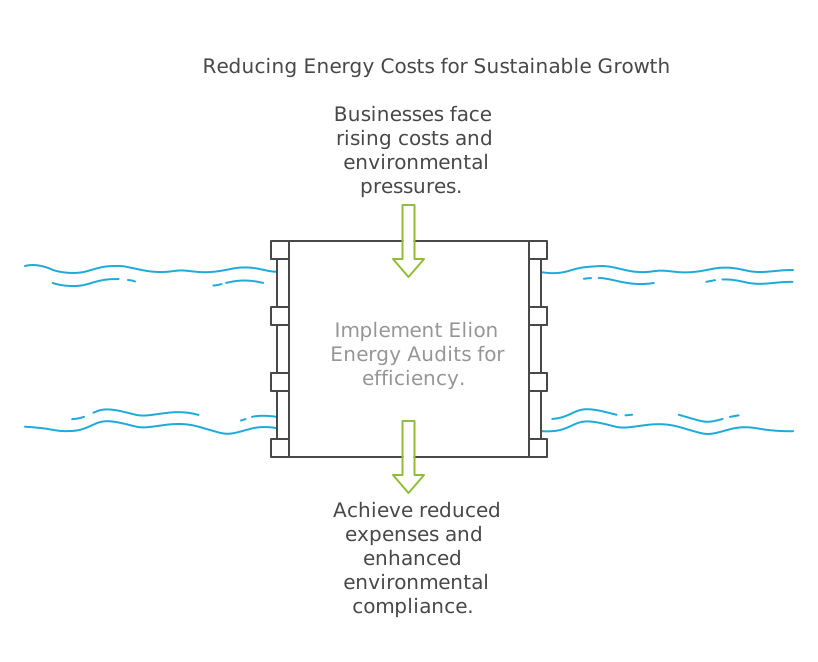
An energy audit is a systematic inspection of a facility’s electrical and thermal systems that identifies specific, costed opportunities to cut energy waste. Under India’s Energy Conservation Act 2001, the Bureau of Energy Efficiency (BEE) requires “Designated Consumers” in sectors like cement, steel, and textiles to conduct periodic energy audits and appoint certified Energy Managers under the PAT Scheme. Facilities that skip this step typically carry avoidable inefficiencies that compound every month.
For example, an auto component plant in Pune was spending ₹85 lakh a month on electricity with no historical benchmarking. An audit found 38 motors running below 40% load and a power factor of 0.87; fixing those issues cut the bill by ₹18.5 lakh a month, paying for the audit within six months. A Bengaluru IT park with a Power Usage Effectiveness of 2.4 (well above the 1.5 benchmark for modern data centres) brought it down to 1.8 and saved ₹42 lakh annually by correcting HVAC set points and UPS loading.
⚡ Quick Answer: What Does an Energy Audit Cost and Save?
A commercial or industrial energy audit in India typically identifies 2–35% in energy savings, depending on facility type and current efficiency. Most clients recover the audit cost within 6–18 months through implemented recommendations.
A commercial or industrial energy audit in India typically identifies 2–35% in energy savings, depending on facility type and current efficiency. Most clients recover the audit cost within 6–18 months through implemented recommendations.
Elion Technologies and Consulting Pvt. Ltd. has run this process across facilities from 10 kW to over 100 MW connected load, in all 28 states and 8 union territories of India, since 2010.
Our multidisciplinary team includes expert Bureau of Energy Efficiency (BEE) Certified Energy Auditors from Electrical, Mechanical, Thermal, Energy Management, Chemical, and Process Engineering disciplines. Their combined expertise enables a comprehensive evaluation of current energy consumption patterns, system performance, and equipment efficiency across industrial and commercial facilities.
Through detailed measurement, analysis, and engineering assessment, the team identifies practical and technically feasible energy conservation opportunities. Each recommendation is supported with technical calculations and financial evaluation, including the expected energy savings and payback period, enabling clients to make informed decisions for improving energy efficiency and reducing operational costs.
Elion Technologies and Consulting Private Limited conducts energy audits aligned with BEE guidelines, ISO 50001 Energy Management Systems, and ASHRAE Level 1, Level 2 and Level 3 Energy Audit methodologies
“Over the years, Elion has conducted energy audits for facilities with connected loads ranging from
10 kW to over 100 MW and voltage levels up to 132 kV across multiple industries.”
What is an Energy Audit ? Types, Process & Benefits?
Elion energy audit services provide a technical assessment of how electrical and thermal energy is used within a facility. It involves a systematic inspection and analysis of energy consumption in buildings, industrial plants, commercial establishments, and infrastructure facilities where electricity or fuel-based energy is used.
The audit is conducted in accordance with recognized guidelines such as ASHRAE energy audit levels, ISO 50001 energy management standards, and national regulations issued by authorities such as the Bureau of Energy Efficiency (BEE), Government of India or other country-specific regulatory bodies.
During the audit, engineers evaluate the performance and efficiency of electrical and thermal equipment, including motors, transformers, HVAC systems, lighting systems, boilers, compressors, and other utility systems.
The objective of an energy audit is to identify energy saving opportunities through equipment efficiency improvement, operational optimization, and process improvements, while maintaining required levels of production quality, safety, and occupant comfort.
Pair your energy audit with an electrical safety audit to address both efficiency and compliance in a single site visit.
Energy Audit Methodology : Step-by-Step Process
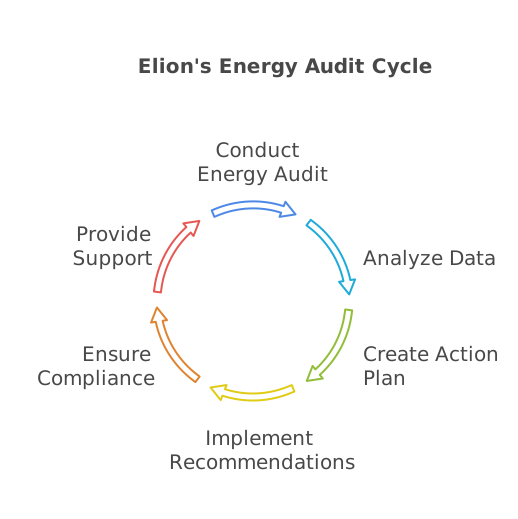
Through Elion’s structured energy audit methodology, clients can clearly understand what is done in an energy audit, including the following steps:
- Upon receiving a client enquiry, Elion shares a Pre-Assessment Energy Audit Data Collection Form.
- The client provides preliminary information regarding facility operations, energy consumption, equipment details and utility systems.
- Based on the provided information, Elion prepares a detailed techno-commercial proposal customized to the client’s requirement. The audit scope may include:
4. The commercial proposal is prepared considering the installed equipment at the facility including:
Electrical Equipment
- Motors
- Transformers
- DG Sets
- HVAC Systems
- Lighting Systems
- Pumps
- Fans and Blowers
Thermal Equipment
- Compressors
- Boilers
- Furnaces
- Heaters
5. After receipt of the confirmed work order, the Elion audit team visits the site and conducts the energy audit as per the approved scope.
6. The audit involves detailed measurements and system analysis using NABL-calibrated Energy Audit instruments owned by Elion, including:
- Power Quality Analyzers
- Ultrasonic Flow Meters
- Infrared Thermal Imaging Camera
- Lux Meters
- Anemometers
- Tachometers
- Hygrometers
- Flue Gas Analyzers
- Ultrasonic and Acoustic Compressed Air Leak Detectors
- Earth Resistance Tester
- Digital Multimeter
- Pressure Gauge / Pressure Transmitter
- Steam Trap Analyzer
- Temperature Meter / Thermometer
- Clamp Meters and other specialized instruments
7. During the site visit, the team evaluates operational practices to identify energy losses caused by process inefficiencies, idle equipment operation, and operational practices.
8. Detailed analysis of electricity bills and energy consumption patterns is conducted to identify abnormalities in billing, tariff optimization opportunities, demand management issues and power quality problems such as harmonics.
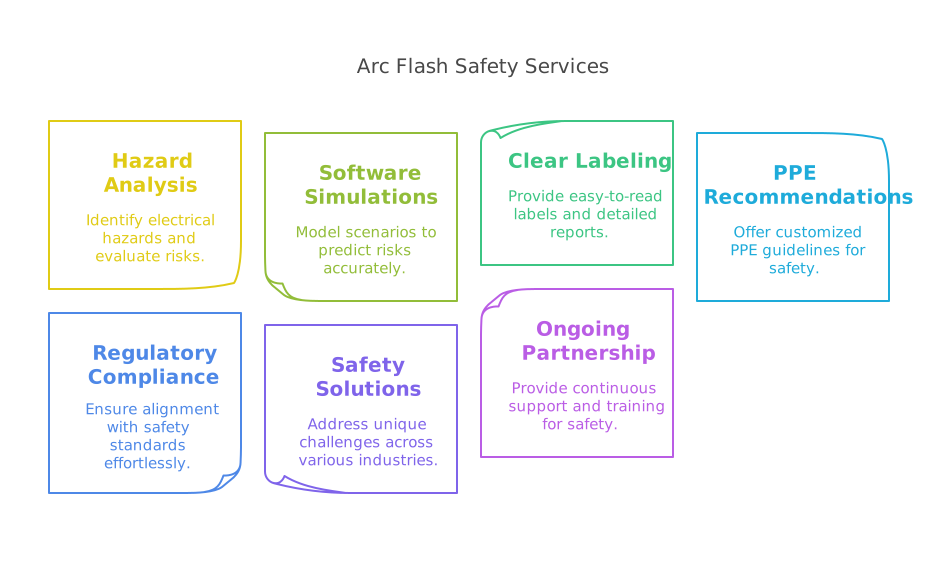
9. Where required by the client, Elion also conducts additional studies such as Arc Flash Studies, Relay Coordination Studies, Thermography and Power Quality Analysis.
10. Potential Energy Conservation Measures (ECMs) are identified during the site visit and discussed with the facility management team.
11. All collected data is analysed at Elion’s office by a team of engineers, including BEE Certified Energy Auditors, to develop technically feasible and economically viable recommendations.
12. The final Energy Audit Report is prepared in Elion’s proprietary reporting format aligned with national and international standards. The report typically includes:
- Executive Summary
- Historical Energy Consumption Analysis
- Equipment-wise Energy Performance Analysis
- Electrical and Thermal Energy Assessment
- Renewable Energy Opportunities
- Detailed Energy Saving Recommendations
- Technical Calculations and Assumptions
- Investment Requirements and Payback Period Analysis
13. Elion provides lifetime technical support through email and telephonic consultation for implementation of recommended energy conservation measures.
14. Post-audit follow-ups are conducted to track implementation progress and capture realized savings.
“Elion operates as an independent engineering consulting organization and does not supply equipment or execute energy efficiency projects.
This ensures that the recommendations provided in the energy audit report remain completely unbiased and technically justified.
We follow our Independent Energy Audit Methodology“
Energy Audit Clients: Industries & Organizations Served
Elion Technologies and Consulting Private Limited has successfully conducted energy audits for several leading organizations including:
- Indian Railways
- Indian Oil Corporation
- Western Coalfields Limited
- Adani Group
- Aditya Birla Group
- Reliance Industries
- PVR Cinemas
- Taj Hotels
- TATA Group
- WIPRO
- Vedanta
- Axis Bank
- ICICI Bank
- Larsen & Toubro
- NHPC
- Ultratech
- ONGC
- JSW
- India Government mint
along with many other industrial, commercial, residential and infrastructure clients across India
“Clients implementing the recommendations from Elion’s energy audits have achieved energy savings ranging from 2% to 35%,
depending on facility type, operational conditions and implementation level.”
Energy Audit Case Studies Across Industries in India
Elion has conducted numerous energy audits across different sectors. Selected case studies are available on our website for reference.
Due to client confidentiality and Non-Disclosure Agreements (NDA), detailed company information cannot be disclosed in some cases. However, representative case studies from various industries can be accessed below:
- Case Study: Energy Audit of Multiple Hotels in India
- Improving Energy Efficiency: Automotive Factory Case Study
- Case Study: Elion’s Energy Audit at a Cement Plant in Chhattisgarh Cut Power Costs by 18%
- Case Study: Elion’s Energy Audit Drove Energy Savings for a Large Hospital in New Delhi
- Case Study of Energy Audit for College in Palwal Haryana
- Case Study Energy Audit of Chemical Manufacturing Company
- Maximizing Energy Efficiency: IT Park Case Study
- Case Study Energy Audit of Residentials Building in India
- Case Study of Energy Audit for food good manufacturing in Gurgaon Haryana
- Case Study of Energy Audit of multiple hotels in India
- Case Study: Elion’s Water Audit Helped a Resort in Kerala Achieve Water Neutrality
- Case Study: Power Audit Performed by Elion at an IT Data Center in Bangalore
- Case Study of Electrical Safety Audit for logistic park in Ahmedabad Gujarat
- Case Study of Energy Audit for heavy manufacturing industry and its mainlining in Rajasthan
- Case Study of Comprehensive HAZOP Analysis in a Petrochemical Plant at Paradip, Odisha
“Additional case studies from industrial, commercial and infrastructure sectors are available on our Energy Audit Case Study page.”
Energy Audit Services Across All States in India
Elion provides Energy Audit Services across India through its offices in:
“Our team has conducted audits in all 28 States and 8 Union Territories of India, enabling us to support clients
with region-specific regulatory requirements, utility tariff structures and operational conditions.”
Energy Audit Instruments & Equipment Used
Elion performs energy audits using high-precision diagnostic instruments to ensure reliable data collection and accurate analysis. All instruments used during the audit are NABL calibrated and owned by Elion.
Typical energy audit instruments used during the audit include:
- Power Quality Analyzers for electrical load profiling and harmonic analysis
- Ultrasonic Flow Meters for water and process flow measurement
- Thermal Imaging Cameras for heat loss and electrical hotspot detection
- Flue Gas Analyzers for combustion efficiency evaluation
- Lux Meters for lighting assessment
- Anemometers for airflow measurement
- Tachometers for equipment speed verification
- Hygrometers for environmental measurement
- Acoustic detectors for compressed air leak identification
These measurements allow detailed analysis of system efficiency, losses, and operational performance.
“Our team has conducted audits in all 28 States and 8 Union Territories of India, enabling us to support clients
with region-specific regulatory requirements, utility tariff structures and operational conditions.”
What Does an Elion Energy Audit Include?
- Electricity bill analysis (12 months) & tariff optimisation review
- Maximum Demand (MD) analysis and demand management
- Power factor & APFC panel performance check
- Harmonic distortion measurement (THD)
- Motor efficiency audit (load factor, efficiency class, VFD suitability)
- Pump & fan efficiency testing (flow, head, BEP analysis)
- Compressed air leak detection (ultrasonic survey)
- Compressed air pressure drop & dryer efficiency check
- Steam system and steam trap audit (condensate recovery)
- Boiler efficiency testing (flue gas analysis, combustion efficiency)
- Heat exchanger and insulation survey (thermal imaging)
- HVAC system audit (chiller COP, cooling tower performance)
- Lighting audit (lux levels, LED retrofit savings calculation)
- DG set efficiency and fuel consumption analysis
- Specific Energy Consumption (SEC) benchmarking vs industry
- Energy flow diagram / Sankey diagram preparation
- Prioritised recommendations with investment & payback period
- Final audit report with executive summary and action plan
Is Energy Audit Mandatory in India?
Under the Energy Conservation Act, 2001 (EC Act), the Bureau of Energy Efficiency (BEE) has designated energy-intensive industries as ‘Designated Consumers’ (DCs). Under the Perform, Achieve and Trade (PAT) Scheme, these industries — including aluminium, cement, fertiliser, iron & steel, oil refineries, petrochemicals, pulp & paper, and textiles — are legally mandated to appoint BEE Certified Energy Managers and conduct periodic energy audits.
For non-designated facilities, the EC Act empowers State Designated Agencies (SDAs) to mandate energy audits for commercial buildings and industrial units exceeding defined connected load thresholds.
ISO 50001:2018 certification, while voluntary, is increasingly required by multinational buyers and ESG-driven supply chain compliance programmes.
Elion’s energy audits satisfy all BEE, PAT, and ISO 50001 compliance requirements.
Industries We Conduct Energy Audits For
• Manufacturing & Auto Components — Reduce motor, compressor & utility costs. SEC benchmarking against sector peers.
• Pharmaceutical & API Plants — FDA-compliant energy monitoring. HVAC energy optimisation for cleanrooms.
• Hospitals & Healthcare — Critical HVAC & medical equipment energy management. Uptime-critical audit approach.
• IT Parks & Data Centres — PUE (Power Usage Effectiveness) optimisation. UPS, cooling & lighting efficiency.
• Textile & Garment Units — Humidification, spinning & weaving energy benchmarking.
• Cement & Steel Plants — Kiln, VRM, compressor & lighting energy audit. PAT Scheme compliance.
• Commercial Buildings & Malls — ECBC compliance audit. HVAC, lighting, lift & escalator energy review.
• Educational Institutions — NAAC green audit with energy component. LED lighting & solar feasibility.
Case Studies
Case Study 1: Auto Component Manufacturer, Pune
Challenge: ₹85L/month electricity bill with no historical benchmarking.
Findings: 38 motors running below 40% load factor; 12 compressed air leaks; power factor 0.87 (below MSEDCL requirement).
Outcome: Post-implementation savings of ₹18.5L/month. ROI achieved in 6 months.
Case Study 2: Pharmaceutical Plant, Hyderabad
Challenge: High HVAC energy costs in classified manufacturing areas.
Findings: Chiller COP 2.8 vs benchmark 4.2; 15 faulty steam traps; over-lighting in production areas (>800 lux vs IS 3646 requirement of 500 lux).
Outcome: ₹12L annual savings via chiller optimisation, steam trap replacement, and LED retrofit.
Case Study 3: IT Park, Bengaluru
Challenge: PUE of 2.4 (industry benchmark: 1.5 for modern data centres).
Findings: Cooling set point 18°C vs recommended 24°C; UPS running at 25% load (inefficiency zone); bypass lighting always on.
Outcome: PUE improved to 1.8. Estimated annual saving: ₹42L in electricity costs.
Energy Audit Report Sample PDF' and 'Energy Audit Checklist PDF
- Sample Energy Audit Report (PDF) — See the exact format, depth, and recommendations our clients receive
- Energy Audit Checklist India 2025 (PDF) — 18-point audit scope checklist based on BEE Energy Audit Manual
Frequently Asked Questions – Energy Audit in India
1. What is an Energy Audit?
An energy audit is a systematic examination of a facility’s energy use to identify opportunities to reduce consumption and costs. It covers electricity, fuel, compressed air, steam, and cooling systems.
2. Who can conduct an Energy Audit in India?
Energy audits in India are typically conducted by Bureau of Energy Efficiency (BEE) Certified Energy Auditors or experienced engineering consulting firms specializing in energy management and efficiency assessment.
3. What are the different types of Energy Audits?
Energy audits are generally classified as:
- ASHRAE Level 1 – Walk-through Energy Audit
- ASHRAE Level 2 – Detailed Energy Survey and Analysis
- ASHRAE Level 3 – Investment Grade Energy Audit
The scope depends on the facility size, energy consumption, and client objectives.
4. What systems are covered in an Energy Audit?
Energy audits typically evaluate both electrical and thermal systems including:
- Motors and pumps
- Transformers and electrical distribution systems
- HVAC systems
- Lighting systems
- Boilers and steam systems
- Compressed air systems
- Furnaces and heaters
- Utility systems and process equipment
5. What instruments are used during an Energy Audit?
Professional energy audits involve measurements using specialized instruments such as:
- Power Quality Analyzers
- Ultrasonic Flow Meters
- Thermal Imaging Cameras
- Flue Gas Analyzers
- Lux Meters
- Anemometers
- Tachometers
- Hygrometers
- Compressed Air Leak Detectors
These instruments help engineers accurately evaluate system efficiency and identify energy losses.
6. What are the benefits of conducting an Energy Audit?
An energy audit helps organizations:
- Reduce electricity and fuel consumption
- Improve equipment efficiency
- Reduce operational costs
- Improve power quality and reliability
- Identify opportunities for renewable energy
- Support sustainability and ESG goals
7. How much can I save with an energy audit?
Elion’s clients typically achieve 10–30% reduction in energy bills. A mid-sized manufacturing plant with a ₹1 crore monthly electricity bill can save ₹10–30 lakh monthly after implementing audit recommendations. In one Pune auto-component plant audit, identifying 38 underloaded motors and 12 compressed air leaks cut a ₹85 lakh monthly bill by ₹18.5 lakh, with payback in under 6 months.
8. What does an Energy Audit report include?
A typical energy audit report includes:
- Executive summary
- Historical energy consumption analysis
- Equipment performance evaluation
- Electrical and thermal system analysis
- Energy conservation measures (ECMs)
- Investment cost and payback period analysis
- Technical calculations and assumptions
9. How long does an Energy Audit take?
A preliminary energy audit (Type 1) takes 1–2 days for a medium-sized facility. A detailed energy audit (Type 2) takes 3–7 days depending on plant size and the number of utility systems.
10. Is Energy Audit mandatory in India?
Certain industries classified as Designated Consumers under the Energy Conservation Act, 2001 are required to conduct periodic energy audits through BEE-certified energy auditors. Under BEE’s PAT Scheme, this currently covers energy-intensive sectors including aluminium, cement, fertiliser, iron & steel, oil refineries, petrochemicals, pulp & paper, and textiles. Non-designated commercial and industrial facilities above defined connected-load thresholds can also be mandated to audit by their State Designated Agency (SDA).
11. What industries require Energy Audit services?
Energy audits are commonly conducted in:
- Manufacturing industries
- Power plants
- Commercial buildings
- Hospitals
- Hotels
- Shopping malls
- Data centers
- Warehouses
- Infrastructure facilities
12. What is the difference between Energy Audit and Power Audit?
An energy audit evaluates both electrical and thermal energy usage, while a power audit primarily focuses on electrical systems, load distribution, and power quality analysis.
13. What methodology is followed during an Energy Audit?
Elion follows a structured methodology including pre-assessment, field measurements, engineering analysis and reporting.
You can read more about our Independent Energy Audit Methodology
14. Can thermography be included in an energy audit?
Yes. Electrical thermography can help identify overheating in electrical systems. Learn more about our Electrical Thermography Inspection Services here.
15. What is a BEE Certified Energy Auditor?
A BEE Certified Energy Auditor is a professional accredited by India’s Bureau of Energy Efficiency under the Energy Conservation Act, 2001. Elion holds EA-1192 and REA-51 accreditations.
16. What is the cost of an energy audit in India?
Energy audit costs range from ₹50,000 for a small commercial facility to ₹5,00,000+ for large industrial plants. Cost depends on facility size, number of utility systems, and audit type (preliminary vs detailed). Most clients recover this cost within 6–18 months through implemented energy-saving recommendations.
17. What is the PAT Scheme under BEE?
The Perform, Achieve and Trade (PAT) Scheme is a market-based mechanism under India’s Energy Conservation Act. Designated Consumers (DCs) must reduce their Specific Energy Consumption (SEC) by a BEE-mandated target. Elion helps DCs measure SEC, conduct mandatory energy audits, and trade Energy Saving Certificates (ESCerts).