
Introduction: When Estimations Are No Longer Enough
For most facility managers and plant operators, energy costs represent one of the largest and least-controlled operational expenses. High-level energy assessments may identify where energy is being wasted, but they rarely provide the level of technical certainty required to justify significant capital investment. This is the core problem that an ASHRAE Level 3 Energy Audit — also known as an Investment Grade Energy Audit — is specifically designed to solve. When an organisation plans to invest tens of millions of rupees in energy-saving measures such as high-efficiency HVAC systems, variable frequency drives, cogeneration plants, or renewable energy integration, decision-makers need bankable data — not estimations. They need precise engineering calculations, verified savings projections, and detailed financial models that financial institutions, boards of directors, and energy service companies (ESCOs) can rely upon. In India, where energy intensity across industrial and commercial sectors remains high, the ASHRAE Level 3 audit has gained increasing relevance as organisations align with Bureau of Energy Efficiency (BEE) mandates, Perform Achieve Trade (PAT) scheme requirements, and corporate sustainability targets. This article provides a comprehensive technical guide to understanding, planning, and executing an ASHRAE Level 3 Investment Grade Energy Audit.
What Is an ASHRAE Level 3 Energy Audit?
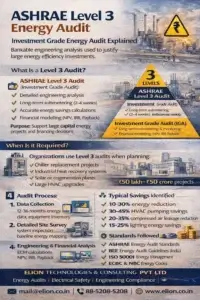
An ASHRAE Level 3 Energy Audit is the most rigorous and detailed tier in the three-level energy auditing framework established by the American Society of Heating, Refrigerating and Air-Conditioning Engineers (ASHRAE). It is specifically designed to support capital-intensive investment decisions in energy efficiency by providing a comprehensive, engineering-grade analysis of a facility’s energy systems. The three ASHRAE levels are defined as:
- Level 1 – Walk-Through Assessment: Identifies low-cost/no-cost energy saving opportunities through visual inspection and review of utility bills.
- Level 2 – Energy Survey and Analysis: Provides detailed analysis of facility systems and identifies ECMs with capital cost and savings estimates.
- Level 3 – Investment Grade Audit (IGA): Delivers precise engineering analysis with detailed financial modelling, supporting large capital investment decisions.
A Level 3 audit goes significantly beyond its predecessors. It involves long-term submetering, monitoring of systems over representative operational cycles, rigorous engineering calculations, and financial feasibility analysis including payback periods, NPV, and IRR — data that is typically required by lenders, ESCOs, and performance contracting entities before committing to large-scale energy projects.
| Key Definition | An ASHRAE Level 3 Investment Grade Energy Audit is a detailed, data-driven engineering assessment that provides the financial certainty required to justify and finance significant capital investment in energy efficiency improvements. |
Why the ASHRAE Level 3 Audit Is Critical for Your Organisation
1. Supports Major Capital Investment Decisions
Organisations looking to implement high-value Energy Conservation Measures (ECMs) — such as chiller replacements, industrial process heat recovery, or on-site solar power — require investment-grade financial analysis. An ASHRAE Level 3 audit provides the rigorous data foundation needed for board approvals, financing applications, and performance contracts.
2. Regulatory Compliance in India
India’s Energy Conservation Act and the BEE’s PAT (Perform Achieve and Trade) scheme require designated consumers in energy-intensive sectors to reduce their Specific Energy Consumption (SEC). An investment grade energy audit provides the technical documentation necessary to demonstrate compliance, claim energy savings certificates (ESCerts), and validate energy performance improvements to regulatory authorities.
3. Enables Performance Contracting and ESCO Financing
Energy Service Companies (ESCOs) structure their performance contracts around guaranteed savings. An ASHRAE Level 3 audit provides the verified baseline and projected savings data upon which these contracts are built. Without investment-grade data, ESCO financing is practically impossible to secure.
4. Enhances ESG and Sustainability Reporting
As corporate ESG disclosures become increasingly scrutinised by investors, lenders, and regulators, organisations need credible, third-party verified energy data. An ASHRAE Level 3 audit provides the technical foundation for BRSR (Business Responsibility and Sustainability Reporting), GRI, and CDP disclosures.
5. Risk Reduction in Infrastructure Planning
Large energy capital projects carry significant financial and operational risk. Proper investment-grade analysis reduces the risk of cost overruns, underperformance, and project failure by providing accurately engineered projections rather than rough estimates.
Applicable Standards and Regulatory Frameworks
A professionally conducted ASHRAE Level 3 audit in India aligns with the following standards and regulatory frameworks:
| Standard / Framework | Relevance to Level 3 Energy Audit |
| ASHRAE Procedures for Commercial Building Energy Audits | Primary methodology framework for Level 1, 2, and 3 energy audits |
| BEE Energy Audit Guidelines (India) | Mandatory framework for energy audits in BEE-designated consumers under EC Act 2001 |
| IS 14858 – Energy Auditing (BIS) | Indian Standard for conducting energy audits in industrial and commercial facilities |
| ISO 50001 – Energy Management Systems | International framework for systematic energy performance improvement, supported by investment-grade audit data |
| NBC 2016 – National Building Code | Sets energy performance requirements for commercial and institutional buildings |
| ECBC – Energy Conservation Building Code | Governs energy efficiency in new and retrofitted commercial buildings; Level 3 data supports ECBC compliance |
| CEA Regulations (Electrical Safety) | Central Electricity Authority regulations relevant to electrical system assessments during audits |
| IEC 60364 / IS 732 | Electrical installation standards referenced during assessment of distribution systems |
Common Energy Problems Found During Level 3 Audits
Field experience across industrial, commercial, and infrastructure facilities in India consistently reveals a predictable set of high-impact energy inefficiencies. The following are the most commonly identified issues during ASHRAE Level 3 assessments:
HVAC and Cooling Systems
- Oversized or undersized chillers operating at chronically poor part-load efficiency ratios
- Poorly maintained cooling towers with ineffective heat rejection, leading to elevated condensing pressures
- Absence of variable frequency drives (VFDs) on chiller pump and AHU fan motors, resulting in significant wastage during partial load operation
- Duct leakages in air distribution systems accounting for 15–25% of total conditioned air losses
- Inadequate thermal insulation on chilled water pipes, causing significant heat gain
Electrical Distribution and Power Quality
- Low power factor (often below 0.85) across motor-heavy industrial loads, resulting in increased kVA demand and penalty charges
- Harmonics generated by variable speed drives and UPS systems causing transformer overheating and neutral conductor overloading
- Unbalanced loading across phases, increasing losses and reducing equipment lifespan
- Transformer loading below optimal efficiency range (below 50% or above 90% of rated capacity)
- Energy theft and metering discrepancies identified through submetering reconciliation
Industrial Process Systems
- Compressed air systems with leakage rates often exceeding 30% of total compressed air generation
- Steam distribution networks operating with inadequate insulation and high condensate losses
- Process heating systems with poor combustion efficiency and excessive flue gas heat losses
- Inefficient lighting systems (outdated fluorescent or HPS fixtures) in warehouses, production floors, and parking areas
Building Envelope and Passive Systems
- Poorly specified glazing with high solar heat gain coefficient (SHGC) in office buildings, driving up cooling loads
- Inadequate roof insulation in industrial sheds and warehouses, contributing to significant thermal loads
How Professionals Conduct an ASHRAE Level 3 Energy Audit
Investment-grade energy audit services at ASHRAE Level 3 follow a structured, phased methodology to ensure engineering accuracy and financial reliability. The following describes the professional approach used by certified energy auditors:
Phase 1 – Project Scoping and Pre-Audit Data Collection
Before any site visit, the audit team conducts a comprehensive desk review:
- Collection and analysis of minimum 12–36 months of utility bills (electricity, diesel, gas, steam, water)
- Review of existing facility drawings, equipment specifications, and maintenance records
- Understanding of operational schedules, occupancy patterns, and production cycles
- Identification of the largest energy consuming systems (energy signature analysis)
- Definition of audit scope, system boundaries, and investment threshold for ECMs under consideration
Phase 2 – Detailed Site Survey and System Baseline Establishment
The site survey for a Level 3 audit is considerably more exhaustive than lower-level assessments:
- Complete walkthrough of all energy-consuming systems with detailed documentation
- Verification of nameplate data and actual operating conditions for all major equipment
- Identification of submetering requirements and installation of temporary monitoring equipment
- Review of building management system (BMS) and SCADA data where available
- Assessment of operational practices that influence energy consumption
Phase 3 – Long-Term Submetering and Monitoring
This phase distinguishes Level 3 from all other audit types. Temporary submeters and data loggers are installed at critical measurement points:
- Electrical submetering of individual systems (HVAC, lighting, process loads, utilities)
- Temperature, pressure, and flow monitoring on thermal systems
- Compressed air flow and pressure monitoring across generation and distribution
- Steam flow, condensate return, and heat recovery monitoring
- Data collection periods typically spanning 2–4 weeks to capture representative operational cycles
Phase 4 – Engineering Analysis and Energy Modelling
Collected data is subjected to rigorous engineering analysis:
- Development of baseline energy models using hourly simulation tools where applicable
- Regression analysis to correlate energy consumption with driving variables (production output, occupancy, weather)
- Engineering calculation of savings for each identified ECM using first-principles analysis
- Uncertainty analysis quantifying confidence intervals for projected savings
- Sensitivity analysis assessing impact of key variables on projected performance
Phase 5 – Financial Analysis and ECM Prioritisation
Each identified Energy Conservation Measure is subjected to a full financial analysis:
- Capital cost estimation with appropriate contingency factors
- Simple payback period, Net Present Value (NPV), Internal Rate of Return (IRR), and Life Cycle Cost Analysis (LCCA)
- Financing scenario modelling (capex, ESCO, green bonds, MSME scheme funding)
- Risk-adjusted savings projections accounting for operational variability
- Prioritised ECM implementation roadmap aligned with capital planning cycles
Phase 6 – Investment Grade Report Preparation
The final deliverable is a comprehensive investment grade technical report:
- Executive summary for non-technical decision-makers
- Detailed technical findings for each system assessed
- Engineering calculations and measurement data supporting all ECM projections
- Financial models with sensitivity analyses
- Implementation plan with timeline, resource requirements, and measurement and verification (M&V) protocols
- Baseline documentation suitable for ESCO performance contracting
Tools and Instruments Used in ASHRAE Level 3 Audits
The precision and reliability of an ASHRAE Level 3 audit depends heavily on the quality and calibration of measurement instruments deployed. NABL-calibrated instruments are the standard for professional investment grade assessments:
| Instrument | Application in Level 3 Audit |
| Power & Energy Analyzers | Measurement of kW, kVA, kVAr, power factor, harmonics (THD), and load profiles over extended monitoring periods |
| Clamp-on Power Meters / Data Loggers | Continuous submetering of individual circuits and equipment for long-term energy profiling |
| Thermal Imaging Cameras (Infrared) | Detection of thermal anomalies in electrical panels, insulation failures, refractory hot spots, and HVAC system losses |
| Ultrasonic Flow Meters | Non-invasive measurement of water, chilled water, hot water, and condenser water flow rates |
| Ultrasonic Leak Detectors | Identification and quantification of compressed air and steam system leakages |
| Combustion Gas Analyzers | Assessment of flue gas composition, excess air, combustion efficiency, and CO/NOx emissions in boilers and furnaces |
| Digital Pressure Gauges & Manometers | Measurement of compressed air pressure differentials, steam pressure, and duct static pressure |
| Pt-100 Temperature Probes / Data Loggers | Extended monitoring of process temperatures, HVAC supply/return temperatures, and heat recovery streams |
| Lux Meters | Measurement of illuminance levels for lighting system audit and energy saving calculation |
| Anemometers | Measurement of air velocity for duct flow calculations and ventilation assessments |
| Power Quality Analysers | Long-term recording of voltage sags, swells, transients, and harmonic distortion profiles |
| Portable Hygrometers | Dew point and humidity measurement for compressed air quality assessment and HVAC analysis |
Expert Insights from the Field
Elion Technologies & Consulting Pvt. Ltd. has been conducting engineering audits across India since 2010, with a portfolio exceeding 30,000 technical audits spanning industrial plants, commercial complexes, retail chains, warehouses, banks, hotels, and infrastructure facilities. Clients include leading organisations such as Adani Enterprises, Reliance, Vedanta, Havells, Tata Group, Indian Railways, IOCL, HPCL, PVR Cinema, and Aditya Birla Group, among others. Based on field experience gathered by Elion’s BEE-certified energy auditors across facilities operating at up to 132 kV electrical system levels, the following observations consistently emerge during ASHRAE Level 3 assessments:
| Field Observation 1 | In large industrial facilities, compressed air systems are almost universally one of the top three energy consumers — yet submetering of compressed air generation is absent in the vast majority of plants audited. Introducing proper flow metering during a Level 3 audit routinely reveals leakage losses of 25–35%, representing annual energy costs running into crores of rupees. |
| Field Observation 2 | In commercial and institutional buildings with central chilling plants, the absence of variable speed drives on primary and secondary chilled water pumps is one of the most consistently overlooked energy saving opportunities. Long-term submetering during Level 3 audits demonstrates that VSDs on pumping circuits typically deliver verified savings of 30–45% on pump energy, with payback periods of under three years. |
| Field Observation 3 | Power quality issues — particularly harmonic distortion generated by non-linear loads — are frequently identified during extended power monitoring campaigns. Undetected harmonic levels cause transformer derating, neutral conductor overheating, and premature motor failures, creating both energy waste and significant asset replacement costs. A Level 3 audit captures this data with certainty that shorter assessments cannot. |
The use of NABL-calibrated instruments and professionally certified engineers ensures that measurement data collected during Elion’s Level 3 assessments meets the accuracy and traceability standards required for investment-grade reporting and regulatory submissions.
Common Mistakes Organisations Make with Energy Audits
- Treating Level 1 or Level 2 audits as sufficient for large capital investment decisions: Low-level audits provide directional insights, not bankable data. Using Level 1 or 2 findings to justify crore-level investments significantly increases financial and technical risk.
- Conducting audits without adequate submetering: Many organisations commission audits that rely entirely on nameplate data and utility bills. Without actual measured load data, energy saving projections are estimates at best and misleading at worst.
- Selecting auditors without relevant certifications: Energy audits for designated consumers require BEE-certified energy auditors. Engagement of uncertified practitioners risks non-compliance and produces reports that cannot be submitted to regulatory authorities.
- Failing to account for interactive effects between ECMs: Implementing one energy conservation measure (e.g., LED lighting retrofit) changes the thermal load on HVAC systems. Level 3 methodology accounts for these interaction effects; simplistic assessments do not.
- Ignoring measurement and verification planning: The audit report should specify M&V protocols (per IPMVP) for verifying savings post-implementation. Without an M&V plan, claimed savings cannot be validated, which undermines performance contracting.
- Limiting scope to electrical systems only: A comprehensive Level 3 audit must assess all energy carriers — electricity, fuel gas, diesel, steam, compressed air, and water. Partial scope assessments miss significant cross-system optimisation opportunities.
- Not aligning audit scope with planned investments: Some organisations commission audits without clearly defining the investment threshold and scope of measures being evaluated, resulting in reports that do not provide actionable investment guidance.
ASHRAE Level 3 Energy Audit – Practical Checklist for Organisations
Use the following checklist to evaluate your organisation’s readiness for an ASHRAE Level 3 Investment Grade Energy Audit:
Pre-Audit Preparation
- Compile 24–36 months of utility bills (electricity, fuel, water) with meter-level data where available
- Gather equipment inventory with nameplate data for all major energy-consuming systems
- Prepare facility drawings including electrical single-line diagrams, HVAC schematics, and process flow diagrams
- Document current production volumes, occupancy profiles, and operational schedules for the audit period
- Identify capital projects under consideration and their investment scale to define audit scope
Audit Execution – Key Requirements
- Confirm auditor certifications (BEE Certified Energy Auditor credential mandatory in India)
- Verify that instruments are NABL-calibrated with valid calibration certificates
- Ensure submetering and data logging is planned for a minimum of 2–4 weeks at all critical measurement points
- Confirm that all energy carriers (electricity, steam, compressed air, fuel, water) are within scope
- Confirm that interactive effects between ECMs will be accounted for in analysis
Report Deliverables
- Engineering-grade baseline energy model with supporting measurement data
- Individual ECM analysis with capital cost estimates, verified savings projections, and financial metrics (SPP, NPV, IRR)
- Sensitivity and uncertainty analysis for each major ECM
- Prioritised implementation roadmap with M&V protocols (IPMVP Option B or C as appropriate)
- Compliance documentation suitable for BEE/regulatory submission
Why Independent Third-Party Energy Audits Deliver Superior Results
For organisations operating under regulatory scrutiny, preparing for ESCO financing, or reporting energy performance to external stakeholders, independent third-party audits offer critical advantages over internal assessments:
- Objectivity and absence of commercial bias: Independent auditors have no interest in selling equipment or services. Their recommendations are based solely on technical merit and financial viability.
- Regulatory credibility: BEE and other Indian regulatory authorities require audits to be conducted by certified third-party auditors. Internal assessments do not satisfy these requirements.
- Accepted by financial institutions: Lenders and green finance providers typically require independent investment-grade audits as a precondition for energy efficiency loans, green bonds, and performance contracts.
- Access to specialised instrumentation: Professional auditing firms maintain calibrated instrumentation that most organisations cannot cost-effectively own and maintain in-house.
- Benchmarking capability: Experienced auditors who have assessed hundreds of similar facilities can accurately benchmark a client’s performance against industry norms, providing context that internal teams lack.
- Legal defensibility: Third-party audit findings and recommendations carry greater weight in regulatory proceedings, insurance assessments, and contractual disputes.
About Elion Technologies & Consulting Pvt. Ltd.
Elion Technologies & Consulting Pvt. Ltd. is an independent engineering audit and safety compliance firm headquartered in India, operating since 2010. Over more than a decade of professional practice, Elion has completed over 30,000 engineering audits and technical assessments across the country. Elion’s energy audit practice is executed by qualified engineers holding BEE Certified Energy Auditor credentials, supported by NABL-calibrated professional instrumentation. The firm’s experience spans a comprehensive range of facility types including large industrial plants, pharmaceutical manufacturing, petrochemical and refining complexes, commercial office buildings, retail chains, warehouses, hotels, hospitals, banks, data centres, and public infrastructure — with electrical system assessments extending up to 132 kV. Elion’s client portfolio includes some of India’s most prominent organisations including Adani Enterprises, Reliance, Vedanta, Havells, Tata Group, Indian Railways, IOCL, HPCL, PVR Cinema, and Aditya Birla Group, providing evidence of the firm’s ability to operate across diverse industry verticals and complex energy environments. As a strictly independent consulting organisation, Elion does not sell, supply, or install energy equipment or systems. This independence ensures that audit findings and recommendations are free from commercial conflicts of interest — a critical requirement for investment grade energy assessment work.
Conclusion
An ASHRAE Level 3 Investment Grade Energy Audit is not simply a detailed energy assessment — it is a strategic financial tool. For organisations considering significant capital investment in energy efficiency, planning to enter performance contracting arrangements with ESCOs, or reporting energy performance under mandatory regulatory frameworks, an investment grade audit provides the engineering rigour and financial precision that decisions of this magnitude require. The distinction between a well-conducted Level 3 audit and lesser assessments is not academic. It determines whether energy savings projections are reliable enough to secure financing, whether regulatory submissions will be accepted, and whether capital investments will deliver their expected returns. Long-term submetering, rigorous engineering analysis, properly calibrated instrumentation, and certified professional execution are not optional elements — they are the defining characteristics of a genuinely investment-grade assessment. For organisations operating in India’s increasingly energy-regulated environment, commissioning a professionally conducted ASHRAE Level 3 Energy Audit is one of the highest-value technical investments available.
Frequently Asked Questions
What is the difference between ASHRAE Level 2 and Level 3 Energy Audit? An ASHRAE Level 2 audit provides detailed analysis of energy systems and identifies Energy Conservation Measures (ECMs) with capital cost and savings estimates. A Level 3 audit goes further by conducting long-term submetering and monitoring, developing detailed engineering models, performing rigorous financial analysis (NPV, IRR, LCCA), and producing investment-grade documentation suitable for securing financing and performance contracting. Level 3 is the appropriate choice when the investment under consideration exceeds several crore rupees or when ESCO financing is involved. Who mandates an Investment Grade Energy Audit in India? In India, the Bureau of Energy Efficiency (BEE) requires designated consumers under the Perform Achieve and Trade (PAT) scheme to conduct energy audits by BEE Certified Energy Auditors. For organisations pursuing ESCO financing, green loans, or performance contracts, lenders and ESCOs typically require an investment grade audit that meets ASHRAE Level 3 standards. Some state electricity regulatory commissions and large PSU procurement policies also specify investment grade energy assessments for energy efficiency capital projects. How long does an ASHRAE Level 3 Energy Audit take? An ASHRAE Level 3 Energy Audit for a medium to large industrial or commercial facility typically requires 6–12 weeks from project initiation to final report delivery. This includes 1–2 weeks of pre-audit data review, 1–2 weeks of intensive site survey, 2–4 weeks of continuous submetering and monitoring to capture representative operational data, followed by 2–4 weeks of engineering analysis, energy modelling, and financial analysis before the investment grade report is finalised. What qualifications should an energy auditor have for a Level 3 audit? For energy audits in India, auditors should hold the BEE Certified Energy Auditor (BEE CEA) credential issued by the Bureau of Energy Efficiency. Additionally, auditors conducting investment grade assessments should have relevant engineering qualifications, demonstrated experience with energy system modelling and financial analysis, and practical familiarity with the type of facility and systems being audited. The auditing firm should maintain NABL-calibrated instruments with current calibration certificates. What does an Investment Grade Energy Audit report contain? A professionally prepared Investment Grade Energy Audit report contains: a verified facility energy baseline with supporting measurement data; detailed technical findings for all assessed energy systems; individual Energy Conservation Measure analyses with engineering calculations, verified savings projections, capital cost estimates, and financial metrics; sensitivity and uncertainty analyses; an interactive effects analysis for the recommended ECM implementation sequence; a prioritised implementation roadmap; and Measurement and Verification protocols for post-implementation savings verification. Can an ASHRAE Level 3 audit help in obtaining green financing in India? Yes. An ASHRAE Level 3 Investment Grade Energy Audit is typically a prerequisite for green financing mechanisms in India. SIDBI’s energy efficiency lending programmes, the World Bank and ADB energy efficiency funds channelled through Indian financial institutions, and green bonds issued under SEBI’s green bond guidelines all require investment-grade technical justification. An audit conducted to Level 3 standards provides the engineering certainty that lenders need to assess loan viability and project risk. How is an Investment Grade Energy Audit different from a routine energy audit? A routine energy audit (Level 1 or Level 2) identifies energy saving opportunities and provides order-of-magnitude estimates of savings and costs. An Investment Grade (Level 3) audit goes fundamentally further: it establishes a rigorously measured and documented baseline, conducts long-term monitoring to capture system behaviour across representative operational cycles, applies first-principles engineering analysis to quantify savings with defined uncertainty margins, and produces financial models that can withstand scrutiny from lenders, ESCOs, and regulatory bodies. What sectors benefit most from ASHRAE Level 3 Energy Audits in India? In India, the following sectors derive the greatest value from ASHRAE Level 3 Investment Grade Energy Audits: energy-intensive industries (cement, steel, aluminium, textiles, chemicals, and petrochemicals) subject to BEE PAT scheme obligations; large commercial real estate portfolios where centralised HVAC systems represent major capital upgrade opportunities; healthcare facilities and hotels where energy costs are high and operational continuity requirements make investment rigour essential; data centres and IT facilities where energy is a direct operational cost driver; and public sector organisations and infrastructure utilities subject to increasing regulatory and ESG reporting requirements.