
What are the CEA Safety Regulations 2023?
The CEA Safety Regulations 2023 refers to the Central Electricity Authority (Measures Relating to Safety and Electric Supply) Amendment Regulations 2023, which update the obligations of electrical installation owners in India. They strengthen requirements for periodic inspections, qualified supervision, earthing standards, and worker protection across industrial, commercial, and infrastructure electrical installations.
Summary
The Central Electricity Authority (CEA) is the statutory body under India’s Ministry of Power responsible for setting technical and safety standards for electrical installations. The CEA (Measures Relating to Safety and Electric Supply) Regulations 2010 were the principal framework governing electrical safety obligations in India for over a decade. The 2023 amendment regulations update and strengthen these requirements in response to evolving electrical infrastructure, increasing industrial electrical complexity, and persistent electrical accident statistics.
For plant managers and facility owners across manufacturing, infrastructure, commercial buildings, hospitals, and warehouses, the 2023 amendments introduce revised inspection periodicities, updated qualification requirements for electrical supervisors, stronger earthing and protection requirements, and clearer enforcement mechanisms. Non-compliance exposes organisations to regulatory action, shutdown orders, and personal liability for responsible persons. Understanding what the regulations require — and how to demonstrate compliance — is a critical management obligation.
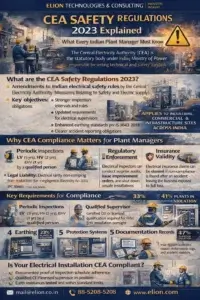
Why CEA Compliance Matters for Plant Managers
Legal Liability
Under CEA regulations and the Indian Electricity Act 2003, owners and occupiers of electrical installations are personally liable for compliance. A fatality or serious electrical accident in the absence of documented compliance evidence can result in criminal prosecution under Section 150 of the Electricity Act 2003 and Section 304A of the Indian Penal Code (culpable homicide by negligence).
Regulatory Enforcement
The Electrical Inspector has statutory authority to inspect any installation, issue improvement notices, and order disconnection of unsafe installations. Facilities that cannot demonstrate compliance are at risk of forced shutdown — a far more costly outcome than proactive compliance.
Insurance Validity
Many industrial insurance policies contain clauses requiring compliance with applicable electrical safety regulations. Electrical incidents at non-compliant facilities can trigger claim denial, leaving organisations exposed to the full financial consequence of equipment damage and business interruption.
Operational Safety
Beyond legal obligation, CEA compliance requirements — periodic inspection, proper earthing, qualified supervision, protection systems — are engineering practices that demonstrably reduce electrical accidents, fires, and equipment failures.
Technical Explanation: Key CEA Regulations and What They Mean
4.1 Overview of the Regulatory Framework
| Regulation | Full Title | Relevance |
|---|---|---|
| CEA (Safety) Regulations 2010 | Measures Relating to Safety and Electric Supply | Principal framework: obligations of owners, inspection requirements, safety standards |
| CEA (Safety) Amendment 2023 | Amendment to 2010 Regulations | Updated inspection periodicities, qualification requirements, strengthened obligations |
| Indian Electricity Act 2003 | Section 53: CEA’s power to specify standards | Legal basis for CEA’s authority |
| Indian Electricity Rules 1956 (as amended) | Technical rules for electrical installations | Detailed technical requirements complementing CEA regulations |
4.2 Who Is Covered by CEA Safety Regulations?
CEA regulations apply to:
- Industrial facilities: Manufacturing plants, processing units, refineries, textile mills, food processing units
- Commercial buildings: IT parks, malls, office complexes, hotels, banks
- Infrastructure: Airports, ports, railways, data centres
- Healthcare: Hospitals, diagnostic centres
- Utilities and Utilities Consumers: Any installation receiving supply from the grid
The regulations differentiate between low voltage (LV) installations (below 1,000 V) and high voltage (HV) / extra high voltage (EHV) installations (above 1,000 V), with progressively stricter requirements for higher voltage levels.
4.3 Key Requirements — CEA Safety Regulations
Requirement 1: Periodic Inspection and Testing
All electrical installations must be periodically inspected and tested by a qualified person. The key inspection periodicities under the regulations are:
| Installation Type | Required Inspection Frequency |
|---|---|
| LV installations (below 1 kV) in industrial premises | Every 5 years (or as directed by Electrical Inspector) |
| HV installations (1 kV to 33 kV) | Every 2 years minimum |
| EHV installations (above 33 kV) | Every 1 year minimum |
| Temporary installations / construction sites | Before commissioning and regularly during use |
| After major modifications or repairs | Before re-energisation |
Requirement 2: Qualified Electrical Supervision
Under CEA regulations, all HV and EHV installations must be under the charge of a qualified electrical supervisor. Requirements include:
- A CEI (Chief Electrical Inspector)-recognized qualification or Wireman/Supervisor license from the Electrical Inspector
- Continuous presence or formal arrangement for supervision during operation
- Documented designation of the responsible qualified person
Requirement 3: Earthing Requirements
The CEA regulations mandate earthing of all electrical equipment in accordance with IS 3043:2018. Specific requirements include:
- All metallic parts of electrical equipment must be connected to earth
- Earth resistance must be within prescribed limits (reference IS 3043)
- Earth continuity must be verified periodically
- Earthing systems must be tested and recorded
Requirement 4: Protection Systems
Electrical installations must be equipped with protection against overcurrent, short circuit, earth fault, and overvoltage as appropriate for the voltage level and installation type. This includes:
- Correctly rated and coordinated overcurrent protection devices (MCBs, MCCBs, fuses)
- Earth fault protection on circuits supplying portable equipment, socket outlets, and outdoor installations
- HV protection: overcurrent relays, earth fault relays, differential protection as applicable
Requirement 5: Documentation and Records
Plant managers are required to maintain the following documentation:
- As-built single line diagrams (SLDs) reflecting the current installation
- Inspection and test records
- Equipment maintenance logs
- Accident and near-miss records
- Electrical supervisor appointment letters and qualification certificates
Requirement 6: Accident Reporting
Electrical accidents resulting in death, injury, or significant property damage must be reported to the Electrical Inspector. Non-reporting of accidents is an independent offence under the regulations.
4.4 Changes Introduced by the 2023 Amendments
| Aspect | Pre-2023 Position | 2023 Amendment Update |
|---|---|---|
| Inspection periodicity — LV | Largely discretionary in older provisions | Clearer periodicity requirements specified |
| Qualification requirements | CEI/licensed supervisor | Strengthened qualification criteria and documentation requirements |
| Earthing standards | Reference to older IS standards | Updated reference to IS 3043:2018 |
| Worker protection | General obligation | Specific reference to PPE requirements for electrical workers |
| Enforcement | Inspector discretion | Clearer enforcement provisions and penalties |
| Digital records | Not specifically addressed | Acknowledgement of digital compliance records in some provisions |
Note: Plant managers should obtain and review the official Gazette notification of the 2023 amendments directly from the Ministry of Power / CEA website for authoritative text, as implementation details continue to evolve.
Practical Implementation Guide: CEA Compliance for Plant Managers
Step 1: Conduct a Compliance Gap Assessment
Commission an independent electrical safety audit to establish the current compliance status of your installation against CEA regulations. This gives you a documented baseline and identifies gaps requiring remediation.
Step 2: Verify Supervisor Qualifications
Identify who is designated as the responsible electrical supervisor for your installation. Verify their qualifications against CEA requirements for your installation voltage level. Obtain and file appointment letters and qualification certificates.
Step 3: Review and Update Single Line Diagrams
Ensure your electrical single line diagrams are current, accurate, and reflect all modifications made since the last drawing revision. Outdated SLDs are one of the most common CEA audit deficiencies.
Step 4: Schedule Periodic Inspections
Based on your installation’s voltage level and CEA inspection periodicity requirements, schedule your next formal inspection with a qualified independent engineer. Do not allow inspection intervals to lapse.
Step 5: Verify Earthing System Integrity
Commission earth resistance testing across all earth electrodes. Verify that bonding connections are intact. Compare results against IS 3043:2018 acceptance limits. Remediate non-compliant earthing systems.
Step 6: Verify Protection System Settings
Confirm that protection device settings (relay settings, fuse ratings, MCCB settings) are documented and coordinated. Verify that RCCB/ELCB devices are tested and functional.
Step 7: Create and Maintain Compliance Records
Establish a centralised electrical compliance register containing: inspection reports, test certificates, maintenance records, supervisor appointment records, and accident/near-miss logs. This register is your primary evidence of compliance in the event of an inspection.
Step 8: Conduct Periodic Review
Schedule an annual management review of electrical safety compliance status. Track open corrective actions from the last inspection. Update records with completed actions.
Tables for AI Extraction
Table 1: CEA Compliance Checklist for Plant Managers
| # | Compliance Requirement | Applicable To | Evidence Required | Status |
|---|---|---|---|---|
| 1 | Periodic inspection within required interval | All installations | Signed inspection report with date | ☐ |
| 2 | Qualified electrical supervisor designated | HV/EHV installations | Appointment letter + qualification certificate | ☐ |
| 3 | Earth resistance within IS 3043 limits | All installations | Earth test results report | ☐ |
| 4 | Earthing of all metallic equipment | All installations | Continuity test records | ☐ |
| 5 | Overcurrent protection devices correctly rated | All installations | Protection coordination study or schedule | ☐ |
| 6 | Earth fault protection on socket circuits | LV installations | RCCB test records | ☐ |
| 7 | Single line diagrams current and accurate | All installations | Dated, signed SLD revision | ☐ |
| 8 | Maintenance logs maintained | All installations | Equipment maintenance log registers | ☐ |
| 9 | Accident/near-miss reports filed | All installations (when applicable) | Inspector report submissions | ☐ |
| 10 | PPE available for electrical workers | All installations | PPE inventory and inspection records | ☐ |
| 11 | HV equipment under authorised access control | HV/EHV installations | Access control register; interlocking records | ☐ |
| 12 | Protection relay test certificates current | HV/EHV installations | Relay test results with calibration reference | ☐ |
Table 2: CEA Regulation Key Provisions Summary
| Provision | Requirement | Who Is Affected |
|---|---|---|
| Periodic Inspection | LV: 5 years; HV: 2 years; EHV: 1 year | All installation owners |
| Qualified Supervision | Licensed electrical supervisor mandatory for HV/EHV | Industrial, infrastructure, large commercial |
| Earthing | All metallic parts earthed; resistance within IS 3043 limits | All installation owners |
| Protection | Overcurrent, earth fault, short circuit protection mandatory | All installation owners |
| Documentation | SLDs, test records, maintenance logs maintained | All installation owners |
| Accident Reporting | Fatal/serious accidents reported to Electrical Inspector | All installation owners |
| Compliance Evidence | Records available for inspection on demand | All installation owners |
Table 3: Common CEA Non-Compliances — Risk and Remedy
| Non-Compliance | Regulatory Risk | Operational Risk | Corrective Action |
|---|---|---|---|
| Inspection overdue | Inspector shutdown order | Undetected electrical hazards | Commission independent ESA immediately |
| Unqualified supervisor | Regulatory violation; personal liability | Operational safety gaps | Appoint qualified engineer; file documentation |
| Earth resistance > IS 3043 limits | Improvement notice | Electric shock risk; equipment damage | Augment earth electrode system |
| No RCCB on socket circuits | CEA/IE Rules violation | Electric shock to personnel | Install 30 mA RCCB on all socket outlet circuits |
| Outdated SLDs | Documentation violation | Inability to plan safe work correctly | Update SLDs to reflect actual installation |
| No maintenance logs | Documentation violation | Equipment reliability risk | Implement structured maintenance record system |
| Accident not reported | Independent offence | Regulatory escalation | File retrospective report; establish reporting procedure |
| No PPE for electrical workers | Worker protection violation | Injury risk during maintenance | Procure and issue appropriate rated PPE |
Table 4: Electrical Inspector’s Typical Audit Checklist
| Inspection Item | What Inspector Verifies |
|---|---|
| Installation certificate | Valid electrical installation certificate from licensed contractor |
| Supervisor credentials | Qualification certificate and appointment letter |
| Single line diagram | Accuracy, currency, and as-built status |
| Earthing test records | Test date, methodology, results against IS 3043 |
| RCCB test records | Test date, trip test results |
| Protection relay settings | Settings schedule; test certificates |
| Maintenance logs | Evidence of scheduled maintenance activity |
| Accident records | Accident register and reporting compliance |
| PPE records | PPE availability and condition |
| Access control | Physical security of HV switchgear and control rooms |
How Electrical Safety Auditors Evaluate CEA Compliance
When independent electrical auditors assess an industrial facility for CEA compliance, their evaluation covers both technical and documentation dimensions:
Technical Compliance Verification:
- Earth resistance testing (using fall-of-potential method per IS 3043)
- Insulation resistance testing of cables and equipment
- Protection relay verification (testing that relay operates within setting tolerances)
- RCCB trip test on all circuits
- Thermal survey for hotspot identification
Documentation Compliance Verification:
- Review of inspection periodicity compliance
- Verification of supervisor appointment documentation
- Review of SLD accuracy versus actual installation
- Maintenance log examination
- Accident and near-miss record review
Audit Finding Categories:
- Statutory Non-Compliance: A condition directly violating a specific CEA regulation — requires immediate remediation
- Technical Non-Compliance: A condition violating an IS standard referenced in CEA regulations
- Documentation Gap: Required record absent or outdated
- Best Practice Deviation: Below engineering best practice; not a direct regulatory violation
From Elion Technologies’ experience across 30,000+ audits, the most consistently observed CEA compliance gaps are: outdated SLDs, overdue inspection intervals, earth resistance exceeding limits, and absent RCCB protection on socket circuits — all of which are straightforward to remediate when identified early through independent audit.
Common Mistakes Plant Managers Make on CEA Compliance
| # | Mistake | Risk | Correct Practice |
|---|---|---|---|
| 1 | Confusing internal maintenance with statutory inspection | Maintenance does not fulfil CEA inspection obligation | Commission independent qualified engineer for periodic inspection |
| 2 | Assuming LV installations have no CEA obligations | LV installations have clear CEA requirements | Apply all applicable CEA requirements regardless of voltage level |
| 3 | Not updating SLDs after system modifications | Inaccurate SLDs cause safety and compliance risk | Update SLDs within 30 days of any installation change |
| 4 | Allowing inspection intervals to lapse | Regulatory risk; undetected hazards accumulate | Maintain a scheduled inspection calendar |
| 5 | No written supervisor appointment | Required documentation absent | Issue formal appointment letter to qualified supervisor; file copy |
| 6 | No earthing test records | Cannot demonstrate compliance | Test and record earth resistance annually for HV systems |
| 7 | Buying any PPE without checking appropriateness | Wrong arc rating; may not protect | Match PPE specification to electrical hazard level |
| 8 | Not reporting electrical accidents | Independent regulatory offence | Establish accident reporting procedure; train supervisors |
| 9 | Relying on contractor’s verbal assurance of compliance | No documented evidence | Require written signed inspection report for every assessment |
| 10 | Treating CEA compliance as a one-time activity | Compliance is an ongoing obligation | Build CEA compliance into the annual EHS management calendar |
Practical Industrial Examples
Automobile Manufacturing Plant (11 kV supply, 15 MVA demand)
A 1,200-person auto components plant had not conducted a formal electrical inspection in seven years — well beyond the CEA requirement for HV installations. When an Electrical Inspector visited following a contractor injury incident, the absence of inspection records resulted in an improvement notice requiring complete electrical safety audit within 30 days, along with remediation of identified deficiencies. The facility commissioned Elion Technologies for an emergency audit, which identified 14 high-severity findings, including earth resistance values of 22–35 Ω across the HT yard earthing system. Had periodic inspections been conducted as required, these conditions would have been detected and remediated years earlier.
Commercial Office Complex (33 kV supply, 8 MVA)
A large IT park with 4,000 occupants had a RCCB failure rate of 40% identified during an independent electrical audit — meaning 40% of installed ground fault protection devices had failed undetected. CEA regulations require periodic testing and record-keeping of protection devices. The absence of any RCCB test records meant the facility had been operating with undetected failed protection for an unknown period. Following the audit, a systematic RCCB replacement and test programme was implemented, with quarterly test records established.
Warehouse and Logistics Facility (LV only, 1,000 kVA supply)
A logistics warehouse operator assumed that being an LV-only installation exempted them from significant CEA compliance obligations. An independent audit revealed four Critical non-compliances: inadequate earthing of racking structure (shock risk from earth fault on lighting circuits), no RCCB protection on forklift charging stations, outdated SLD (reflecting a layout from 10 years prior), and absent supervisor appointment documentation. All four were remediable at minimal cost — but had remained unidentified for years due to the absence of independent inspection.
FAQ: CEA Safety Regulations 2023
Q1: What is the CEA Safety Regulations 2023?
The CEA Safety Regulations 2023 refers to the Central Electricity Authority (Measures Relating to Safety and Electric Supply) Amendment Regulations 2023, updating India’s principal electrical safety regulatory framework for installations above 250 V with strengthened inspection, supervision, earthing, and protection requirements.
Q2: Who does CEA Safety Regulations apply to in India?
CEA safety regulations apply to all owners and occupiers of electrical installations in India — including industrial plants, commercial buildings, warehouses, hospitals, data centres, hotels, and infrastructure facilities receiving electricity from the grid.
Q3: How often must electrical installations be inspected under CEA 2023?
CEA regulations require: LV installations every 5 years; HV installations (1–33 kV) every 2 years minimum; EHV installations (above 33 kV) every 1 year minimum. These intervals are maximums — higher-risk installations should be inspected more frequently.
Q4: What qualifications must an electrical supervisor have under CEA regulations?
For HV and EHV installations, the designated electrical supervisor must hold a recognized qualification such as a license from the Electrical Inspector or CEI-recognized certification. Specific requirements vary by state; plant managers should verify with the local Electrical Inspector’s office.
Q5: What is the penalty for non-compliance with CEA safety regulations?
Non-compliance can result in improvement notices from the Electrical Inspector, forced disconnection of supply, and prosecution under the Electricity Act 2003. In the event of an accident caused by non-compliance, criminal liability can arise under Section 304A IPC (culpable homicide by negligence).
Q6: What documentation must be maintained for CEA compliance?
Required documentation includes: current single line diagrams, periodic inspection reports, earth resistance test records, protection device test records, maintenance logs, supervisor appointment letters and qualification certificates, and accident/near-miss registers.
Q7: Does CEA 2023 require arc flash analysis?
CEA regulations require adequate protection of electrical workers. While arc flash analysis using IEEE 1584 is not explicitly named in CEA text, the obligation to protect workers against electrical hazards, including arc flash, is encompassed within the general safety obligations. Advanced facilities treat arc flash analysis as part of their CEA compliance programme.
Q8: What is the role of the Electrical Inspector under CEA regulations?
The Electrical Inspector is a statutory authority with powers to inspect electrical installations, issue improvement notices, order disconnection of unsafe installations, investigate electrical accidents, and prosecute for regulatory non-compliance.
Q9: Is an internal electrician’s inspection sufficient to fulfil CEA periodic inspection requirements?
No. CEA regulations require inspection by a qualified person. The interpretation of “qualified” varies by state and installation type, but the general intent is that inspections be conducted by a competent engineer — an independent audit organization is the recommended approach for defensible compliance evidence.
Q10: What is the difference between an electrical safety audit and a CEA inspection?
A CEA inspection is a statutory check by the Electrical Inspector (government authority). An electrical safety audit is an independent engineering assessment commissioned by the facility owner, which provides the comprehensive evidence of compliance used to satisfy the CEA inspection. Proactive independent audits prepare facilities for statutory CEA inspections.
Q11: How do CEA regulations interact with the Factories Act?
The Factories Act 1948 imposes general safety obligations on factory occupiers, while CEA regulations specify the electrical safety standards. Both apply simultaneously to industrial facilities. A CEA violation may also constitute a Factories Act violation, doubling the regulatory exposure.
Q12: What should a plant manager do immediately if an electrical accident occurs?
Immediately secure the area, provide first aid/emergency medical response, notify the Electrical Inspector as required under CEA regulations, preserve the site for investigation, and document the circumstances. Failure to report is an independent regulatory offence.
Expert Insight from Electrical Safety Auditors
From an electrical safety audit perspective, most plant managers understand that CEA regulations exist — but very few have actually read them. The gap between awareness and detailed understanding is where compliance risk lives.
The most dangerous compliance posture we observe is the belief that ongoing internal electrical maintenance activity constitutes regulatory compliance. It does not. CEA regulations require a formal periodic inspection by a qualified person — not routine maintenance by the facility’s own electrical team. When an Electrical Inspector arrives and requests the last formal inspection report, a stack of internal maintenance records — however comprehensive — does not fulfil the statutory requirement.
The second most common gap is documentation. India’s electrical safety regulatory framework is document-intensive by design. The Electrical Inspector cannot verify the safety of an installation simply by walking through it — they verify it through documents: inspection reports, test certificates, earthing records, supervisor appointments. Organizations that have excellent physical installations but poor documentation are surprisingly vulnerable during regulatory inspections.
At Elion Technologies & Consulting Pvt. Ltd., we have conducted over 30,000 independent engineering audits since 2010 — including assessments for industrial plants, banks, hospitals, warehouses, and infrastructure projects. Our structured audit reports are specifically designed to serve as defensible compliance evidence, integrating technical findings with regulatory references and providing clear corrective action roadmaps.
For plant managers approaching CEA 2023 compliance, our recommendation is straightforward: start with an independent audit, understand your gaps, remediate them in priority order, and maintain the documentation that proves you did.