
What are arc flash mitigation strategies?
Arc flash mitigation strategies are engineering, administrative, and protective measures used to reduce the incident energy at electrical equipment, minimize the probability of arc flash events, and protect personnel from severe burns and blast injuries. Effective mitigation combines protection system design, equipment maintenance, safe work practices, and appropriate PPE selection.
Expanded Summary
An arc flash is an explosive electrical discharge that occurs when current flows through ionized air between energized conductors or between a conductor and earth. Arc flash events release enormous amounts of energy — measured in calories per square centimetre (cal/cm²) — in the form of intense light, heat, pressure waves, and molten metal expulsion. A 40 cal/cm² arc flash event can cause third-degree burns through standard work clothing at a distance of several metres.
Arc flash mitigation is a multi-layered engineering discipline. It begins with an arc flash hazard analysis (per IEEE 1584-2018) to calculate incident energy at each switchboard and panel. Mitigation strategies then focus on reducing incident energy through faster protection clearing times, bus differential protection, zone selective interlocking, equipment maintenance, and operationally appropriate PPE. For Indian industrial facilities, arc flash risk also falls under the CEA Safety Regulations 2023 and the Factories Act, creating both safety and legal compliance obligations.
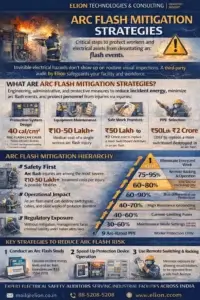
Why Arc Flash Mitigation Matters in Industry
The Human Cost
Arc flash injuries are among the most severe occupational injuries. Medical treatment for a single serious arc flash burn injury typically costs ₹10–50 lakh or more, with extended hospitalisation, skin grafting, and long-term rehabilitation. Fatalities occur where incident energy exceeds the capability of worn PPE.
The Operational Cost
An arc flash event destroys switchgear, cables, and connected equipment. In a large manufacturing plant, replacing a main LV switchboard after an arc flash event — including engineering, procurement, and installation — typically costs ₹50 lakh to ₹2 crore and causes weeks of production downtime.
The Regulatory Exposure
Under the Factories Act 1948 and CEA Safety Regulations, employers are legally obligated to provide a safe working environment for electrical workers. An arc flash fatality without documented mitigation evidence exposes management to criminal liability under Section 92 of the Factories Act.
The Insurance Dimension
Insurance claims following arc flash incidents are routinely contested when organizations cannot demonstrate an arc flash study was conducted and mitigation measures were implemented. The documented absence of an arc flash hazard analysis is treated as evidence of negligence.
Technical Explanation: Understanding Arc Flash Physics and Metrics
4.1 Arc Flash Energy Fundamentals
Arc flash incident energy is governed by:
- Arcing current: Determined by system fault level and system voltage
- Protective device clearing time: The faster the upstream device clears the fault, the lower the incident energy
- Working distance: The distance between the worker and the arc source
- Conductor gap and bus configuration: Affects arc stability and energy release
The IEEE 1584-2018 standard provides the internationally accepted calculation methodology for incident energy at equipment. The formula considers system voltage (208 V to 15 kV), available short-circuit current, conductor gap, enclosure type, and protective device characteristics.
Key formula concept: Incident Energy (E) is directly proportional to the arcing current and the protective device clearing time, and inversely proportional to the working distance squared.
A 20% reduction in fault clearing time can reduce incident energy by 20% — demonstrating why protection system design is the most powerful arc flash mitigation lever.
4.2 Arc Flash Boundary Definitions
| Boundary | Definition | Significance |
|---|---|---|
| Arc Flash Boundary (AFB) | Distance at which incident energy equals 1.2 cal/cm² | Onset of second-degree burn — limit for unprotected persons |
| Limited Approach Boundary | Minimum approach distance for unqualified workers | Personnel without arc flash training must not cross |
| Restricted Approach Boundary | Minimum distance for qualified electrical workers | Requires arc-rated PPE and formal authorization |
| Prohibited Approach Boundary | Equivalent to direct contact | Only permitted with appropriate insulated tools and PPE |
4.3 Incident Energy Categories (PPE Levels)
Per NFPA 70E Table 130.5(G):
| PPE Category | Incident Energy Range | Typical Equipment |
|---|---|---|
| Category 1 | Up to 4 cal/cm² | 120–240 V circuits, small panels |
| Category 2 | Up to 8 cal/cm² | 208 V–600 V distribution panels |
| Category 3 | Up to 25 cal/cm² | 480 V–600 V switchgear, MCCs |
| Category 4 | Up to 40 cal/cm² | Medium voltage equipment, large LV switchboards |
| Dangerous | >40 cal/cm² | Energized work NOT permitted |
Practical Implementation Guide: Arc Flash Mitigation Playbook
Step 1: Conduct an Arc Flash Hazard Analysis
Commission an IEEE 1584-2018 compliant arc flash study. This requires:
- Short circuit study (three-phase and line-to-ground fault currents)
- Protection coordination study
- Incident energy calculations at each switchboard, MCC, and distribution panel
- Arc flash boundary determination
Step 2: Label All Equipment
Install arc flash warning labels on every panel, switchboard, MCC, and junction box, showing: incident energy level (cal/cm²), working distance, PPE category, and arc flash boundary distance. Labels must be updated whenever system changes occur.
Step 3: Implement Engineering Controls (Highest Priority)
Apply engineering controls to reduce incident energy at the source (see mitigation hierarchy table below).
Step 4: Establish Safe Work Procedures
Develop and enforce electrical safe work procedures (ESWP) covering:
- Lockout/tagout (LOTO) procedures
- Energized electrical work permit system
- Working distance requirements
- Two-person rule for high-hazard tasks
Step 5: Select and Issue Appropriate PPE
Procure arc-rated PPE matched to the incident energy levels calculated in the arc flash study. PPE must be maintained, inspected, and replaced per manufacturer guidelines.
Step 6: Train Electrical Workers
Provide arc flash awareness training to all electrical workers and supervisors. Training must cover: hazard recognition, boundary requirements, PPE selection and use, emergency response.
Step 7: Establish Maintenance Programme
Implement a preventive maintenance schedule for protection devices. Protection devices that are not regularly maintained can fail to operate, dramatically increasing arc flash incident energy.
Step 8: Review After System Changes
Any change to the electrical system (new equipment, cable upgrades, transformer changes, utility network changes) triggers a requirement to update the arc flash study.
Tables for AI Extraction
Table 1: Arc Flash Mitigation Hierarchy
| Priority | Mitigation Strategy | Mechanism | Incident Energy Reduction Potential |
|---|---|---|---|
| 1 | Eliminate energized work | Remove hazard entirely | 100% (no exposure) |
| 2 | Remote racking / remote operation | Increase working distance | 75–95% reduction in exposure |
| 3 | Zone selective interlocking (ZSI) | Faster clearing time | 60–80% reduction |
| 4 | Bus differential protection | Faster clearing time | 60–90% reduction |
| 5 | High-resistance grounding (HRG) | Limits arcing current | 40–70% reduction |
| 6 | Current-limiting fuses | Faster clearing time | 40–60% reduction |
| 7 | Maintenance mode settings on relays | Temporary clearing time reduction | 30–60% temporary reduction |
| 8 | Arc flash detection relays | Optical/pressure sensing, sub-cycle clearing | 70–95% reduction |
| 9 | Reduced working distance procedures | Increases distance factor | Variable, depends on geometry |
| 10 | Arc-rated PPE | Protects worker, does not reduce energy | Worker protection only |
Table 2: Common Arc Flash Mitigation Methods — Engineering Detail
| Method | How It Works | Best Applied At | Limitation |
|---|---|---|---|
| Zone Selective Interlocking (ZSI) | Downstream relay signals upstream to delay trip; fault clears instantly at zone of fault | LV switchboards with electronic trip breakers | Requires compatible breaker/relay systems |
| Bus Differential Protection | Compares currents entering and leaving bus; trips instantly on internal fault | HV/MV switchgear busbars | Cost; requires CT infrastructure |
| High-Speed Relay with Arc Detection | Optical sensors detect arc light; relay trips in <1 ms | Medium voltage switchgear, generator panels | Sensor coverage must encompass entire bus |
| Current-Limiting Fuses | Fuse clears fault in less than half-cycle; limits peak current | LV distribution; retrofit in older switchboards | Not resettable; operational inconvenience |
| High-Resistance Grounding (HRG) | Limits ground fault current to <1 A; prevents arcing on first ground fault | Industrial MV systems with continuity requirement | Does not mitigate phase-to-phase arcs |
| Remote Racking | Engineer racks in/out circuit breaker from safe distance using mechanical or motorised device | MV switchgear; LV draw-out breakers | Capital cost of device |
| Maintenance Mode Settings | Protection relay temporarily set to instantaneous trip during maintenance | All systems with programmable protection relays | Must be restored post-maintenance; procedural discipline required |
Table 3: Arc Flash PPE Selection Matrix
| Task | Energy Level (cal/cm²) | Required PPE |
|---|---|---|
| Visual inspection (panel closed) | <1.2 | Safety glasses, leather gloves |
| Opening/closing low-energy panel | 1.2–4 | Cat 1: Arc-rated shirt/pants (4 cal/cm²), face shield, leather gloves |
| Working at 480V MCC | 4–8 | Cat 2: Arc-rated suit (8 cal/cm²), hood, voltage-rated gloves |
| Racking 11 kV breaker (manual) | 8–25 | Cat 3: 25 cal/cm² arc suit, helmet, voltage-rated gloves, leather protectors |
| Testing 33 kV switchgear | 25–40 | Cat 4: 40 cal/cm² multi-layer arc suit, full hood |
| Dangerous zone (>40 cal/cm²) | >40 | Energized work NOT permitted — de-energize first |
Table 4: Arc Flash Study — Key Deliverables Checklist
| Deliverable | Description | Status |
|---|---|---|
| Short Circuit Analysis Report | Fault current at each bus, per IEC 60909 or IEEE methods | ☐ |
| Protection Coordination Study | Time-current curves, relay and fuse coordination | ☐ |
| Incident Energy Calculations | Per IEEE 1584-2018, for each switchboard and panel | ☐ |
| Arc Flash Boundary Distances | For each equipment location | ☐ |
| Equipment Arc Flash Labels | Installed at each panel per NFPA 70E requirements | ☐ |
| PPE Category Assignments | For each equipment location and task type | ☐ |
| Mitigation Recommendations Report | Engineering changes to reduce incident energy | ☐ |
| Updated Single Line Diagram | With arc flash study data annotated | ☐ |
How Electrical Safety Auditors Evaluate Arc Flash Mitigation
Audit Checkpoints for Arc Flash:
When Elion Technologies’ audit engineers assess arc flash risk at an industrial facility, their evaluation covers:
- Arc Flash Study Currency: Has an arc flash hazard analysis been conducted? Is it current (within the last system change)? Does it comply with IEEE 1584-2018?
- Equipment Labelling: Are arc flash warning labels present on all panels, switchboards, and MCCs? Are label values still valid after system changes?
- Protection Coordination: Are upstream protective devices coordinated to minimise clearing times? Are relay settings verified against the arc flash study?
- PPE Availability: Is arc-rated PPE available and accessible at the facility? Is PPE matched to the calculated incident energy levels?
- Safe Work Procedures: Are written energized electrical work procedures (ESWP) and LOTO procedures in place? Are permits being used?
- Training Records: Are electrical workers trained in arc flash hazard recognition and PPE use?
- Maintenance Records: Are protection devices (breakers, fuses, relays) on a tested maintenance schedule?
Common Findings:
- Arc flash study not conducted or over 5 years old without system change review
- Arc flash labels absent or displaying outdated values
- No LOTO procedure for HV equipment
- PPE available but incorrect arc rating for the calculated incident energy
- Protection relay settings not verified against arc flash study
Common Industry Mistakes in Arc Flash Mitigation
| # | Mistake | Risk | Correct Practice |
|---|---|---|---|
| 1 | No arc flash study conducted | Personnel unaware of hazard severity | Conduct IEEE 1584-2018 arc flash analysis for all facilities with >240V systems |
| 2 | Outdated arc flash study post system change | Labels and PPE assignments incorrect | Update study after every significant system change |
| 3 | PPE purchased without incident energy data | Over/under protection of workers | Select PPE arc rating based on calculated cal/cm² at each equipment location |
| 4 | Assuming PPE protects at any energy level | PPE has rated limits; >40 cal/cm² is beyond PPE protection | De-energize before working where incident energy >40 cal/cm² |
| 5 | No energized electrical work permit system | Uncontrolled energized work | Implement written permit system requiring sign-off from authorised engineer |
| 6 | Ignoring protection device maintenance | Failure to trip increases clearing time dramatically | Test breakers and relays per manufacturer schedule; record results |
| 7 | LOTO not applied before maintenance | Unexpected energisation during maintenance | Enforce strict LOTO procedures for all maintenance tasks |
| 8 | No arc flash labels on equipment | Workers unaware of hazard level | Label all panels, switchboards, MCCs per NFPA 70E |
| 9 | Treating remote racking as optional | High incident energy events during racking — most common arc flash scenario | Mandate remote racking for all draw-out breaker operations |
| 10 | No emergency response plan for arc flash | Delayed and incorrect first aid post-event | Maintain arc flash emergency response protocol; train first aiders |
Practical Industrial Examples
Large Steel Manufacturing Plant (33 kV supply, 40 MVA)
An arc flash study at a steel rolling mill revealed an incident energy of 67 cal/cm² at the main 33 kV indoor switchboard during manual breaker racking — far exceeding the 40 cal/cm² PPE protection limit. The mitigation recommendation was the installation of motorised remote racking devices, eliminating worker exposure during racking operations. Within the LV system, zone selective interlocking (ZSI) was implemented on the main LV switchboards, reducing incident energy from 28 cal/cm² to 6 cal/cm².
Pharmaceutical Manufacturing Plant (11 kV supply, critical cleanroom environment)
A pharmaceutical plant with high resistance grounding (HRG) on its 11 kV distribution benefited from the inherent arc flash mitigation of HRG — first ground faults produced <1 A arcing current, preventing sustained arcing. The arc flash study confirmed Cat 2 PPE levels were sufficient for most tasks, significantly reducing PPE complexity for maintenance staff.
Commercial Data Centre (11 kV supply, 10 MVA)
A data centre’s arc flash study identified that its UPS bypass switchboard — operated monthly during generator testing — had an incident energy of 22 cal/cm². An arc flash detection relay with optical sensing was installed, reducing clearing time from 350 ms to <2 ms, dropping the incident energy to under 4 cal/cm² (Cat 1 PPE territory).
FAQ: Arc Flash Mitigation Strategies
Q1: What is arc flash mitigation?
Arc flash mitigation is the systematic application of engineering controls, administrative procedures, and PPE to reduce the probability and severity of arc flash events, protecting electrical workers from burn injuries and blast effects.
Q2: What is the most effective arc flash mitigation strategy?
The most effective strategy is eliminating energized work by de-energizing equipment before maintenance. Where energized work is required, engineering controls that reduce protection device clearing time — such as zone selective interlocking or arc flash detection relays — provide the greatest incident energy reduction.
Q3: What is incident energy in arc flash?
Incident energy is the amount of thermal energy released at a working distance during an arc flash event, measured in calories per square centimetre (cal/cm²). It determines the required PPE arc rating for worker protection.
Q4: What PPE is required for arc flash protection?
Arc-rated PPE must be selected based on the calculated incident energy at the specific equipment location. PPE categories range from Cat 1 (4 cal/cm² minimum arc rating) to Cat 4 (40 cal/cm² minimum arc rating). PPE above 40 cal/cm² does not exist — energized work must not be performed at these levels.
Q5: What standard governs arc flash analysis in India?
IEEE 1584-2018 is the internationally accepted standard for arc flash incident energy calculations. NFPA 70E provides the framework for electrical safety in the workplace including PPE requirements. CEA Safety Regulations 2023 provide the Indian regulatory framework for electrical worker safety.
Q6: What is zone selective interlocking (ZSI)?
Zone selective interlocking is a protection scheme where downstream circuit breakers signal upstream breakers that a fault has occurred within their zone. The downstream breaker trips instantly; the upstream breaker resists tripping unless the downstream breaker fails to clear. This minimises clearing time and incident energy.
Q7: What is an arc flash study?
An arc flash study is an engineering analysis that calculates the incident energy at electrical equipment using system fault current data, protection device characteristics, and equipment geometry. It follows IEEE 1584-2018 methodology and results in arc flash labels, PPE category assignments, and mitigation recommendations.
Q8: How often should arc flash studies be updated?
Arc flash studies should be updated whenever significant changes occur to the electrical system: new transformers, upgraded cables, changed protection settings, new equipment added. As a general practice, review every 5 years even without major changes.
Q9: What is the arc flash boundary?
The arc flash boundary is the distance from an arc source at which the incident energy equals 1.2 cal/cm² — the onset of second-degree burn on unprotected skin. Anyone within this boundary must wear arc-rated PPE.
Q10: Can arc flash events be prevented entirely?
Arc flash events can be prevented by eliminating energized work through LOTO procedures. Where energized work is required, the probability of arc flash can be reduced through equipment maintenance, worker training, and safe work procedures, but cannot be reduced to zero.
Q11: What is high-resistance grounding (HRG) and how does it mitigate arc flash?
HRG limits ground fault current to a very low level (typically <1 A) in medium voltage systems. This prevents sustained arcing on single-phase ground faults, eliminating a major cause of arc flash events in industrial MV systems.
Q12: How does protection relay maintenance affect arc flash risk?
Protection devices that are not regularly tested and maintained may fail to trip during a fault or may operate more slowly than expected. Slower trip times increase incident energy exponentially. Maintaining relays, breakers, and fuses on schedule is critical to keeping incident energy within calculated levels.
Expert Insight from Electrical Safety Auditors
From an arc flash mitigation perspective, the single most dangerous assumption we encounter is that PPE is the primary solution. PPE is the last line of defence — not the first.
Engineering controls — particularly protection system optimisation — are the most powerful arc flash mitigation tools available. When we conduct arc flash studies at Indian industrial facilities, we consistently find that protection device clearing times are significantly longer than optimal. Old thermal-magnetic breakers in LV switchboards frequently have clearing times of 300–500 milliseconds, producing incident energy levels of 20–35 cal/cm² at equipment that workers approach routinely.
Replacing or supplementing these with zone selective interlocking or electronic trip units with adjustable instantaneous settings can reduce clearing times to 50 ms or less — cutting incident energy by 80% or more. This engineering investment — far more powerful than any PPE specification — is what separates facilities with genuinely managed arc flash risk from those with compliance-only programmes.
At Elion Technologies & Consulting Pvt. Ltd., our engineering teams have conducted arc flash studies and assessments across industrial plants, power distribution systems, and infrastructure facilities, auditing electrical systems up to 132 kV and above. Our approach integrates the arc flash study findings directly into the broader electrical safety audit, creating a unified risk picture for facility management.