
1. Why Choosing the Right Audit Provider Matters
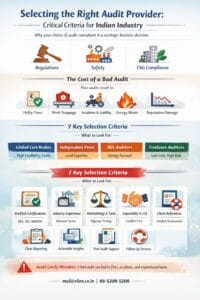
In India’s evolving regulatory landscape — shaped by the Factories Act 1948, the Environment Protection Act 1986, the Energy Conservation Act 2001, and increasingly stringent ESG disclosure requirements — the quality of your safety and energy audit is not an administrative checkbox. It is a strategic business decision. Choosing an unqualified or conflicted consultant can expose your organisation to compliance failures, regulatory penalties, reputational damage, and — most critically — preventable accidents. Conversely, the right provider translates audit findings into actionable, prioritised improvements that save lives and reduce operating costs.
| A 2023 analysis by Elion— one of India’s leading ESG and safety audit firms — found that organisations conducting independent, third-party safety audits using internationally recognised protocols reported a measurable positive trend of improvement in OHS performance in subsequent years, compared to those using internal-only assessments. |
An independent safety auditor conducting an instrumented on-site assessment — the standard that any credible audit provider should meet.
1.1 The Financial Stakes
| Risk of a Poor Audit Choice | Typical Cost or Consequence |
| Regulatory non-compliance fine (Factories Act) | ₹50,000–₹10 lakh per violation (and rising) |
| Work stoppage after inspector visit | ₹5–50 lakh per day (sector-dependent) |
| Industrial accident (liability + compensation) | ₹25 lakh–₹5 crore+ |
| Energy waste undetected over 3 years | ₹20–200 lakh for a mid-size plant |
| ESG rating downgrade affecting credit | Higher cost of capital; lender scrutiny |
| Reputational harm post-incident | Loss of key customers, delayed tenders |
These figures are not hypothetical. The Bureau of Energy Efficiency (BEE) estimates that India’s Designated Consumers — large energy users — could save ₹1.5 lakh crore annually through better energy management. A professional energy audit consultant surfaces these savings; a weak one misses them.
2. Understanding India’s Audit Market Landscape
The Indian safety and energy audit market includes a wide range of providers — from global certification bodies with decades of experience to local consultants operating without verifiable credentials. Understanding the landscape helps you set realistic expectations and ask better questions.
2.1 Categories of Providers
| Provider Type | Strengths | Limitations |
| Global Certification Bodies (e.g., TÜV SÜD, TÜV NORD India, Bureau Veritas) | Internationally recognised credentials; standardised methodology; accreditation assurance | Higher cost; may lack deep local regulatory knowledge; less flexible scope |
| National Independent Consultancies (e.g., Consultivo) | India-specific legal knowledge; sector diversity; IFC/World Bank approved in select cases | Brand varies widely; verify each engagement team’s credentials |
| BEE-Empanelled Energy Auditors | Statutory recognition for Energy Conservation Act compliance | May lack breadth beyond energy; check scope of ISO/safety coverage |
| Academic Institutions / R&D Labs | Cost-effective for pilot studies or research-linked audits | Not suitable for statutory compliance; limited accountability |
| Solo Freelance Consultants | Low cost, flexible | High risk: verify credentials individually; no institutional backup |
2.2 Regulatory Framework Governing Audit Providers in India
- Bureau of Energy Efficiency (BEE): Accredits and empanels Certified Energy Auditors (CEA) for statutory compliance under the Energy Conservation Act, 2001.
- Bureau of Indian Standards (BIS): IS 14489:2018 is the Code of Practice for Occupational Health and Safety (OHS) audit in India — the basis for most statutory safety evaluations.
- ISO Accreditation Bodies (NABCB in India): Accredits certification bodies issuing ISO 45001, ISO 14001, ISO 50001 certificates.
- NFPA (National Fire Protection Association, USA): An internationally recognised body whose codes (NFPA 72, NFPA 101, NFPA 704) are widely referenced in Indian fire safety audits, particularly for MNCs and export-oriented facilities.
- IFC Performance Standards: Increasingly required for projects with international financing or supply-chain ESG due diligence.
3. Seven Criteria for Selecting the Right Audit Consultant
Criterion 1: Certifications and Accreditations
Credentials are the minimum proof of competence. Do not accept claimed affiliations without verification. Relevant certifications to look for:
| Certification / Standard | What It Signals |
| BEE Certified Energy Auditor (CEA) | Government-accredited competence for energy audits under India’s Energy Conservation Act |
| ISO 45001:2018 Lead Auditor (IRCA/CQI) | Formal training and assessment in occupational health & safety management systems audit |
| ISO 50001:2018 Lead Auditor | Energy management systems audit competence |
| ISO 14001:2015 Lead Auditor | Environmental management systems — relevant for combined EHS audits |
| NEBOSH IGC / NEBOSH Diploma | Internationally recognised occupational safety qualification from the UK |
| NFPA Certification (CFI, CFPS) | Fire investigation or fire protection specialist — particularly relevant for fire safety audits |
| IFC / World Bank Approved Status | Independent assurance aligned to international financing standards |
| IS 14489:2018 Competency | Familiarity with India’s national OHS audit code — essential for statutory audits |
Criterion 2: Sector-Specific Industry Experience
A safety auditor with expertise in pharmaceutical cleanrooms may struggle in a petrochemical refinery. Energy auditors familiar with textile mills may miss key opportunities in data centres. Relevant sector experience is non-negotiable.
- Ask for a list of at least 5 audits conducted in your specific industry sector in the last 3 years.
- Request anonymised case studies or audit outcome summaries — not just client name-drops.
- Verify that the audit team (not just the firm) has sector credentials — the person who visits your plant matters more than the brand on the letterhead.
- For process industries (petrochemicals, chemicals, pharmaceuticals): look for additional qualifications in Process Safety Management (PSM), HAZOP, or ATEX/HAC (Hazardous Area Classification).
- For commercial buildings: confirm familiarity with National Building Code Part 4 (NBC Fire Safety Norms) and local fire department requirements.
Criterion 3: Service Scope and Deliverable Quality
The scope of service must match your compliance obligations, risk profile, and improvement goals. A vague ‘safety check’ is not an audit.
| What Good Scope Looks Like | Warning Sign in Scope Description |
| Defined audit criteria (IS 14489, ISO 45001, NFPA codes, etc.) | Generic reference to ‘applicable laws’ without specifics |
| Instrumented / diagnostic energy measurements, not just walkthroughs | Report based on desktop review only |
| Quantified, scored findings with risk ratings (Immediate / Short / Long-term) | Narrative-only findings with no prioritisation |
| Graphical summary and management dashboard | Lengthy text report with no visual summary |
| Corrective action plan with timelines and ownership | List of findings with no follow-up mechanism |
| Statutory report format compliant with BEE / IS 14489 | Report format incompatible with regulatory submission |
Criterion 4: Methodological Rigour and Independence
The audit methodology should be systematic, evidence-based, and documented — not ad hoc. Ask specifically:
- Does the consultant use a structured, scored audit protocol, or is it an informal walkthrough?
- Is the firm or individual operationally independent from any product supplier, contractor, or vendor whose services they might recommend?
- Does the firm offer both audit and implementation services? If so, how do they manage the conflict of interest?
- For energy audits: do they use calibrated instruments (power analysers, thermal cameras, flue gas analysers), or do they rely on facility data alone?
Independence is particularly important. A consultant who earns referral fees from equipment suppliers is structurally incentivised to recommend expensive upgrades rather than low-cost operational improvements.
Criterion 5: Impartiality and Conflict-of-Interest Declarations
Require a written conflict-of-interest (COI) declaration before engagement. This is standard practice among reputable global bodies and should be expected from any credible consultant. Elements a good COI declaration should cover:
- No current or recent commercial relationship with your competitors, equipment vendors, or contractors.
- No financial interest in the products or services they might recommend.
- A named internal review mechanism to escalate COI concerns.
- A commitment that the audit report will not be shared with third parties without your written consent.
Criterion 6: Client Testimonials and Reference Verifiability
Marketing brochures can claim anything. Verifiable references are the only trustworthy signal of past performance.
- Request 2–3 references from clients in the same industry and similar scale of operation.
- Call the reference — do not accept written testimonials alone.
- Ask references: ‘Did the findings lead to measurable improvement?’ and ‘Would you engage this firm again?’
- Check whether the firm has published case studies with sufficient detail to be meaningful — vague case studies are a warning sign.
- Look for publicly verifiable engagements: IFC-approved consultants maintain a public registry; ISO 45001 certified auditors can be verified through NABCB.
Criterion 7: Reporting Transparency and Post-Audit Support
A report delivered and never followed up is a wasted investment. Evaluate:
- Does the consultant offer a report walkthrough session with your management team?
- Is follow-up verification (re-audit or close-out review) included or available as an add-on?
- Are findings presented in a format compatible with your statutory reporting obligations (BEE, Factories Inspectorate, local fire authority)?
- Does the report clearly distinguish between regulatory non-compliance (must fix) and best-practice gaps (should fix)?
4. Questions to Ask Potential Audit Consultants
Use these questions in your initial briefing call and during written proposal evaluation. A confident, specific answer signals capability; a vague or defensive answer signals risk.
4.1 On Credentials and Qualifications
- Which specific certifications do your lead auditors hold for this engagement — and can you provide certificate numbers for verification?
- Is your firm empanelled with BEE as an energy auditor? Can you share your empanelment number?
- Which accreditation body approved your ISO audit training (e.g., IRCA/CQI, Exemplar Global)?
- Have your auditors undergone refresher training in the last 24 months on IS 14489, ISO 45001, or relevant NFPA codes?
4.2 On Methodology and Deliverables
- Walk me through your audit methodology from pre-audit planning to report delivery. How many days would an on-site assessment take for our facility size?
- Do you use a scored, weighted audit protocol? Can I see a sample report from a comparable engagement (anonymised)?
- What instruments do you use for energy measurement — power analysers, thermal imagers, ultrasonic leak detectors? Are they calibrated and certified?
- How do you prioritise findings — what risk classification system do you apply?
- What does your deliverable package include — executive summary, detailed findings, action plan, legal register gap analysis?
- In what format is the report — PDF, Word, editable action tracker? Is it compatible with statutory submission formats?
4.3 On Industry Experience and Past Results
- How many audits have you conducted in our specific industry (e.g., textiles, pharmaceuticals, steel, commercial buildings) in the past 3 years?
- Can you share 2–3 client references in our sector whom I can contact directly?
- What was the most significant compliance gap you have identified in an audit, and how did the client address it?
- Have your audit recommendations led to measurable improvements in safety performance or energy cost reduction? Can you quantify any examples?
4.4 On Independence and Impartiality
- Do you have any current or recent commercial relationships with equipment suppliers, contractors, or vendors whose products or services you might recommend in your report?
- Will you provide a written conflict-of-interest declaration before we sign the engagement?
- If you identify a major compliance gap that would require significant capital expenditure to remediate, how do you handle that in the report?
- Does your firm also offer implementation or contracting services? If so, how do you firewall the audit function?
4.5 On Post-Audit Support
- Do you offer a management presentation of findings included in the engagement, or is that a separate fee?
- Is a follow-up close-out audit or verification visit included, or available? At what cost?
- What happens if we dispute a finding — do you have a formal review or appeals process?
5. Common Red Flags to Watch Out For
In a market where credentials can be fabricated and scope descriptions can be vague, knowing what to avoid is as important as knowing what to seek.
| 🚩 | Unverifiable Credentials: The consultant claims certifications but cannot provide certificate numbers, issuing body names, or expiry dates. Always verify independently. |
| 🚩 | No Written Conflict-of-Interest Declaration: A reputable provider has no reason to refuse a COI declaration. Refusal or hesitation is a direct red flag. |
| 🚩 | Unusually Low Fees with Vague Scope: If a proposal costs 40–60% less than competitors for the same stated scope, the methodology, report quality, or auditor seniority is likely compromised. |
| 🚩 | Desktop-Only or Virtual-Only Audits for Physical Safety: A fire safety or electrical hazard audit conducted entirely without on-site physical inspection is categorically inadequate and potentially fraudulent. |
| 🚩 | Generic Reports with No Site-Specific Data: If you receive a sample report that reads like a template with few plant-specific observations, expect the same after your audit. |
| 🚩 | Guarantee of a ‘Clean’ Audit: No credible auditor can or should guarantee your facility will pass. This signals either incompetence or willingness to issue a misleading report. |
| 🚩 | Pressure to Bundle with Equipment Supply or Contracting: An auditor who insists on also supplying remediation services has a financial interest in finding more problems — and in recommending expensive solutions. |
| 🚩 | No Reference to IS 14489 or Relevant Standards: India’s statutory safety audit standard is IS 14489:2018. An auditor who does not reference it in their proposal likely lacks familiarity with statutory requirements. |
| 🚩 | Resistance to Sharing Sample Reports: Legitimate consultants share anonymised samples routinely. Refusal suggests reports are either low quality or templated. |
| 🚩 | Junior Staff Conducting All On-Site Work: A common practice is to send senior auditors for the sales pitch and deploy junior field staff for the actual assessment. Ask specifically who will be on-site. |
6. Case Study: When a Poor Consultant Choice Cost ₹1.4 Crore
| Note: This case study is based on a composite of real incidents documented in regulatory inspection records and industry insurance claim data. Identifying details have been changed to protect confidentiality. The financial figures reflect actual costs documented in post-incident assessments for similar cases. |
Background
A mid-size auto-components manufacturer in Pune (annual turnover ~₹120 crore) was required under its ESG supplier disclosure obligations to a European OEM customer to conduct an annual safety and fire risk audit. Procurement selected a local consultant offering a ‘comprehensive safety audit’ for ₹85,000 — significantly below the ₹1.8–2.4 lakh quoted by two other firms.
What Went Wrong
- The selected consultant held no verifiable ISO 45001 or IS 14489 qualifications. His firm’s certificate was from an unaccredited body not recognised by NABCB.
- The on-site visit lasted four hours (industry standard for a facility of that size: 2–3 days minimum). No instrumented measurement was conducted.
- The report, delivered 10 days later, contained no plant-specific photographs, used generic boilerplate findings, and declared the facility ‘substantially compliant’ with a single page of recommendations.
- Critical gaps were missed: overloaded electrical distribution boards, unserviced sprinkler heads in the paint shop, missing MSDS documentation for solvent storage, and inadequate signage in the evacuation routes.
The Consequences
| Cost Category | Amount (₹) |
| Electrical fire damage (paint shop, partial) | ₹38 lakh |
| Business interruption (11 days) | ₹52 lakh |
| Regulatory penalty (Factories Inspectorate) | ₹4.2 lakh |
| Emergency remediation and re-audit costs | ₹18 lakh |
| Legal and insurance administration | ₹9 lakh |
| OEM customer penalty for delayed supply | ₹19 lakh |
| Total documented cost | ₹140.2 lakh (~₹1.4 crore) |
The Lesson
The initial cost saving of ₹95,000–₹1.55 lakh (compared to competent providers) resulted in a loss exceeding 14 times the cost of the most expensive alternative. More importantly, three workers sustained burn injuries — a harm no financial figure can adequately represent. A competent auditor would have flagged the electrical load imbalance and the sprinkler maintenance deficit as immediate-priority findings requiring action within 30 days. The finding would have cost approximately ₹1.8 lakh to remediate properly — compared to ₹1.4 crore in actual consequences.
| Key Takeaway: The audit fee is not the cost of an audit. The cost of a bad audit is borne later — in accidents, downtime, penalties, and liability. |
7. Consultant Evaluation Scorecard
Use this scorecard when comparing proposals from multiple providers. Score each criterion 1–5 and weight by priority for your organisation.
| Evaluation Criterion | Weight (1–3) | Score (1–5) | Weighted Score |
| Certifications verified (BEE, ISO, NEBOSH, NFPA) | 3 | __ / 5 | __ / 15 |
| Sector-specific experience (relevant industry) | 3 | __ / 5 | __ / 15 |
| Methodology rigour and instrumentation | 3 | __ / 5 | __ / 15 |
| Impartiality / COI declaration provided | 3 | __ / 5 | __ / 15 |
| Sample report quality | 2 | __ / 5 | __ / 10 |
| Verifiable client references | 2 | __ / 5 | __ / 10 |
| Deliverable scope and format | 2 | __ / 5 | __ / 10 |
| Post-audit support offered | 1 | __ / 5 | __ / 5 |
| Value for fee (not lowest cost, but proportionality) | 1 | __ / 5 | __ / 5 |
| TOTAL | __ / 100 |
8. Further Resources and References
Regulatory & Statutory Bodies
- Bureau of Energy Efficiency (BEE) — beeindia.gov.in — Empanelled energy auditor registry, energy audit guidelines
- Bureau of Indian Standards (BIS) — bis.gov.in — IS 14489:2018 OHS Audit Code
- National Accreditation Board for Certification Bodies (NABCB) — nabcb.qci.org.in — Verify ISO certification bodies operating in India
- Petroleum and Explosives Safety Organisation (PESO) — peso.gov.in — For process industry and explosive storage audits