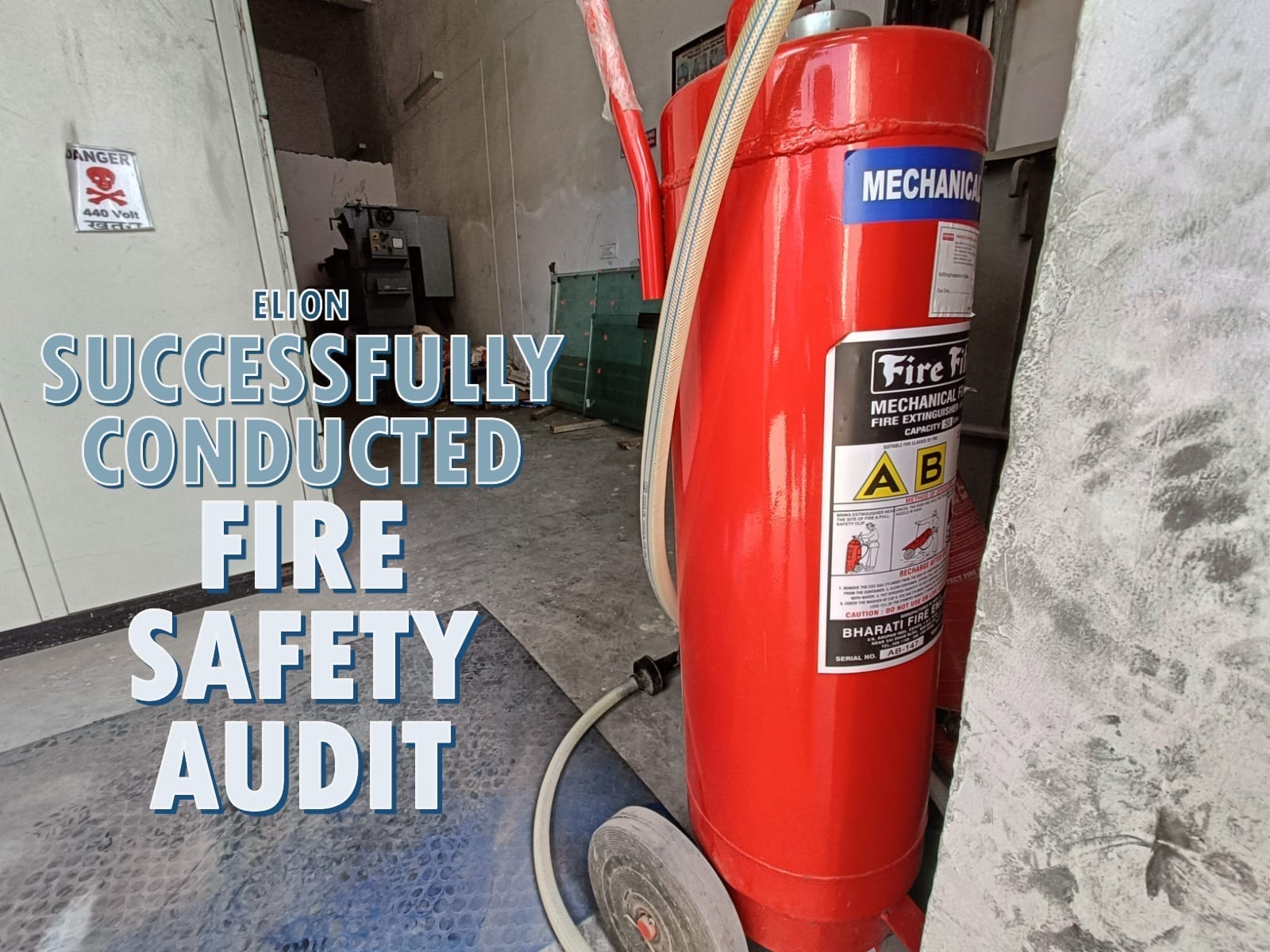
Fire Audit
A fire audit is a comprehensive, independent engineering assessment of a facility’s fire safety provisions — evaluating fire detection and alarm systems, automatic suppression infrastructure, passive fire protection measures, emergency lighting, escape routes and exit provisions, fire fighting equipment, hazardous material storage, housekeeping practices, fire safety management systems, and compliance with applicable fire safety legislation and building regulations. It provides facility operators, safety managers, and building owners with an objective, technically authoritative assessment of their fire safety status — identifying deficiencies, quantifying risk levels, and producing a prioritised corrective action programme that reduces the probability and consequence severity of fire events.
Fire remains one of the most catastrophic and frequently occurring hazards in Indian industrial and commercial facilities. Industrial fires cause fatalities, destroy assets built over decades, disrupt operations for months or years, and generate legal, regulatory, and reputational consequences that compound the direct physical damage. In commercial buildings — hotels, hospitals, shopping complexes, office towers, and educational institutions — fire events involving occupants unfamiliar with the building layout and escape provisions have historically produced mass casualty outcomes that subsequent investigations consistently attribute to identifiable, preventable fire safety deficiencies.
The critical characteristic of fire risk is that it accumulates invisibly. A fire suppression system with corroded pipework and blocked sprinkler heads may appear operational until the moment it is demanded to perform. An emergency exit that has been blocked by stored materials represents a zero-performance escape route that will only be tested when workers need it most. A fire detection system with failed detector heads and silenced fault indicators provides no warning of a developing fire. These conditions — each individually identifiable through systematic fire audit — collectively define the gap between a facility’s perceived fire safety status and its actual fire protection capability.
Why Fire Audits Are Essential for Life Safety and Regulatory Compliance
Fire safety is a life safety discipline — its ultimate purpose is the preservation of human life. This fundamental characteristic places fire audit in a category of engineering assessment where the consequences of inadequacy are not financial or operational but potentially fatal. The moral and legal obligation on facility operators to maintain effective fire safety provisions is absolute and non-negotiable — and independent fire audit is the mechanism by which compliance with that obligation is systematically verified.
From a regulatory standpoint, fire safety in Indian buildings and facilities is subject to comprehensive statutory requirements enforced by fire departments, building control authorities, factory inspectorates, and licensing bodies. Fire safety clearances and no-objection certificates are required for facility operation, occupancy, and licence renewal across a wide range of facility categories — with documented evidence of periodic fire safety inspection and audit increasingly required as a condition of clearance issuance and renewal.
Beyond statutory compliance, the insurance implications of inadequate fire safety documentation are significant. Insurers underwriting industrial and commercial property increasingly require evidence of periodic independent fire safety assessment as a condition of coverage and premium determination — with inadequate fire safety provisions representing grounds for coverage denial or significant premium loading.
Applicable Standards and Regulatory Framework
Fire safety audit in Indian facilities is governed by a comprehensive and multi-layered framework of statutory regulations, building codes, and technical standards, including:
- National Building Code (NBC) 2016, Part 4 — Fire and Life Safety section, the primary technical reference for fire safety provisions in Indian buildings covering detection, suppression, escape routes, compartmentation, and fire fighting access
- Fire Services Act and State Fire Prevention Acts — State-level statutory instruments governing fire safety requirements, inspection obligations, and no-objection certificate requirements for buildings and facilities
- Factories Act, 1948 and State Factories Rules — Mandating fire safety provisions, escape route adequacy, fire fighting equipment availability, and fire emergency preparedness in manufacturing facilities
- IS 2189 — Indian Standard for selection, installation, and maintenance of automatic fire detection and alarm systems
- IS 15105 — Indian Standard for design and installation of fixed automatic sprinkler fire extinguishing systems
- IS 3016 — Indian Standard for fire precautions in welding and cutting operations
- IS 13039 — Indian Standard for automatic fire suppression systems
- IS 10987 — Indian Standard for code of practice for fire protection of electronic data processing installations
- IS 2190 — Indian Standard for selection, installation, and maintenance of first-aid fire extinguishers
- IS 11457 — Indian Standard for automatic high expansion foam fire extinguishing systems
- IS 9668 — Indian Standard for provision and maintenance of water supplies for fire fighting
- NFPA 1 — Fire Code, internationally referenced for comprehensive fire safety programme assessment
- NFPA 13 — Standard for Installation of Sprinkler Systems, referenced for suppression system design and audit
- NFPA 72 — National Fire Alarm and Signalling Code, referenced for detection and alarm system assessment
- NFPA 101 — Life Safety Code, internationally referenced for means of egress, emergency lighting, and occupant notification assessment
- NFPA 10 — Standard for Portable Fire Extinguishers, referenced for extinguisher selection, placement, and maintenance requirements
- OISD (Oil Industry Safety Directorate) Standards — Governing fire safety requirements for petroleum storage, refinery, and hydrocarbon processing facilities
- Petroleum Act, 1934 and Petroleum Rules, 2002 — Establishing fire safety requirements for petroleum storage and handling facilities
- AERB Safety Codes — Governing fire safety requirements in nuclear and radiation facility environments
- ISO 45001 — Occupational Health and Safety Management System standard within which fire safety audit findings are integrated as a core hazard control assessment
- MSIHC Rules, 1989 — Requiring fire safety provisions and emergency planning for major hazard chemical installations
For facilities operating in multiple regulatory jurisdictions simultaneously — such as refineries subject to both OISD standards and Petroleum Rules, or hospitals subject to both NBC provisions and clinical facility licensing requirements — a fire audit must systematically address the most demanding applicable requirement across every relevant framework.
Industries Where Fire Audits Are Relevant
Fire hazards are present in every facility — but the severity, complexity, and regulatory intensity of fire safety requirements vary substantially across sectors. Manufacturing plants with significant combustible material inventories, flammable liquid usage, and hot work operations present complex fire risk profiles requiring comprehensive fire safety system assessment. Refineries and petrochemical facilities combine massive hydrocarbon inventories with high-energy ignition sources in a fire risk environment where a single failure of fire safety provisions can produce catastrophic consequences. Hotels, hospitals, shopping centres, and educational institutions present fire safety challenges centred on occupant evacuation — managing large numbers of people, including those who are mobility-impaired, asleep, or unfamiliar with the building, through escape systems that must perform reliably under fire conditions. Warehouses and logistics facilities with high rack storage of combustible goods require fire suppression systems designed for storage application and audited for continued adequacy as storage configurations change. Data centres combine high electrical energy density with irreplaceable data assets and business continuity criticality — making fire suppression system integrity and detection sensitivity primary fire audit concerns.
The Role of Independent Engineering Assessment
An independent fire audit provides the technical objectivity, cross-facility benchmarking context, and regulatory expertise that internal fire safety reviews and fire equipment maintenance contractors cannot credibly deliver. Elion’s fire safety engineers conduct fire audits using structured assessment frameworks aligned with NBC 2016, IS standards, NFPA references, and applicable statutory requirements — evaluating every element of a facility’s fire safety provisions against current standards, documenting deficiencies with technical precision, and producing recommendations that are engineering-grounded, practically implementable, and prioritised by life safety significance.
Articles, Case Studies, and Technical Resources on Fire Audit
This category is a dedicated knowledge hub for fire safety engineers, HSE professionals, facility managers, building owners, compliance officers, and plant managers seeking technically authoritative information on fire safety assessment, fire protection system evaluation, and statutory fire safety compliance management.
Resources published here include:
- Real project case studies from fire audit engagements conducted at Indian industrial, commercial, healthcare, and infrastructure facilities — documenting fire safety deficiencies identified, suppression and detection system failures found, escape provision inadequacies discovered, and corrective action programmes recommended and implemented
- Technical articles on fire audit methodology, fire detection and suppression system assessment techniques, passive fire protection evaluation, and means of egress adequacy analysis
- Industry best practices for fire safety management programme development, periodic fire safety inspection scheduling, fire drill programme management, and fire safety training adequacy assessment
- Regulatory compliance guides covering NBC 2016 fire and life safety requirements, State Fire Services Act obligations, Factories Act fire safety provisions, OISD fire safety standards, and fire no-objection certificate compliance requirements
- Engineering methodology explainers covering specific audit components — sprinkler system hydraulic adequacy assessment, fire detection system coverage analysis, emergency lighting performance testing, escape route width and travel distance assessment, fire compartmentation integrity evaluation, and passive fire protection condition review
- Risk assessment insights covering the life safety, operational, regulatory, and insurance consequences of fire safety system deficiencies across different facility categories and occupancy types
- Post-incident analysis content drawing lessons from fire incidents at Indian and international facilities to identify systemic fire safety failures and prevention implications
Whether you are conducting a comprehensive fire safety audit of a new facility, reviewing fire safety provisions following building modifications, preparing for a fire department inspection or no-objection certificate renewal, responding to insurance underwriter requirements, or investigating the fire safety factors contributing to a near-miss incident, the technical resources in this category provide the engineering and regulatory depth needed to manage fire safety with the rigour that life safety obligations demand.
Professional Fire Audit Services by Elion
Elion Technologies & Consulting Pvt. Ltd. delivers independent fire audit services for industrial, commercial, healthcare, hospitality, and infrastructure facilities across India. Our qualified fire safety engineers conduct comprehensive fire safety assessments covering automatic detection and alarm system adequacy, sprinkler and suppression system condition, portable fire fighting equipment inspection, passive fire protection integrity, emergency lighting performance, escape route and exit provision adequacy, fire safety signage, hazardous material storage compliance, housekeeping and ignition source management, fire safety management system evaluation, and statutory compliance review against NBC 2016, IS standards, applicable State Fire Acts, Factories Act provisions, and sector-specific regulatory requirements — producing detailed audit reports with findings classified by life safety significance and accompanied by prioritised corrective action recommendations.
To understand our fire audit methodology, scope of assessment, and how an independent fire audit can support your facility’s life safety management, regulatory compliance, and fire risk reduction objectives, visit our dedicated service page:
👉 Fire Audit Services by Elion
Industries Where Fire Audits Are Critical
- Manufacturing plants — automotive, engineering, textile, chemical, and process industries
- Oil, gas, and petrochemical refineries, terminals, and storage facilities
- Chemical and specialty chemical manufacturing plants
- Pharmaceutical and biotech manufacturing facilities
- Hotels, resorts, convention centres, and large hospitality establishments
- Hospitals, healthcare institutions, and large medical facility networks
- Shopping malls, retail complexes, and large commercial establishments
- Data centres and mission-critical IT infrastructure facilities
- Warehouses, cold storage facilities, and logistics and distribution centres
- Educational institutions, universities, and large campus facilities
- Banks, financial institutions, and currency handling facilities
- Steel, cement, aluminium, and primary metals processing industries
- Airports, metro rail systems, and large transport infrastructure
- Commercial high-rise buildings and large corporate campuses
- Power generation plants and electrical substation installations
Technical Topics Covered in This Knowledge Hub
Articles and case studies in this category address the complete technical and regulatory landscape of fire audit, fire protection system assessment, and fire safety compliance management, including:
- Fire audit methodology — scope definition, regulatory framework mapping, inspection sequencing, and findings classification
- Automatic fire detection system assessment — detector coverage analysis, detector type adequacy, panel condition review, and IS 2189 compliance verification
- Sprinkler system audit — hydraulic adequacy assessment, head condition inspection, water supply verification, obstruction analysis, and IS 15105 compliance review
- Gaseous suppression system assessment — agent quantity verification, nozzle condition, detection interface review, and discharge integrity testing
- Foam suppression system audit — foam concentrate quality, application rate adequacy, and OISD compliance review for petroleum facilities
- Portable fire extinguisher audit — type selection adequacy, placement compliance, service record verification, and IS 2190 compliance assessment
- Hydrant and hose reel system assessment — water supply pressure and flow verification, hydrant spacing adequacy, and hose condition inspection
- Passive fire protection audit — fire compartmentation integrity assessment, fire door condition and certification review, penetration seal adequacy, and structural fire protection inspection
- Emergency lighting assessment — coverage adequacy, battery performance testing, maintained and non-maintained fitting verification, and escape route illumination measurement
- Fire safety signage audit — exit sign placement, pictogram compliance, and directional signage adequacy assessment
- Means of egress assessment — escape route width measurement, travel distance calculation, exit door hardware compliance, and assembly point adequacy review
- Fire hazard identification — ignition source survey, fuel load assessment, and hot work control system review
- Housekeeping and material storage compliance — combustible material management, flammable liquid storage adequacy, and waste accumulation control
- Fire safety management system review — fire safety policy adequacy, responsible person designation, training records, and drill frequency compliance
- Fire risk assessment methodology — hazard identification, likelihood assessment, consequence evaluation, and risk rating framework
- Fire safety in hazardous areas — ATEX zone compliance, explosion-protected equipment integrity, and flammable atmosphere ignition source control
- Fire safety for high-rise buildings — smoke control system assessment, fire fighting lift adequacy, and fire brigade access review
- Fire safety in healthcare facilities — compartmentation adequacy for mobility-impaired occupant evacuation and medical gas fire risk management
- Fire safety in data centres — clean agent suppression system adequacy, sub-floor and above-ceiling detection coverage, and power system fire risk assessment
- Warehouse fire safety audit — rack storage sprinkler adequacy, commodity classification compliance, and in-rack sprinkler assessment
- Fire drill evaluation — drill scenario adequacy, evacuation time measurement, assembly point management, and post-drill debrief methodology
- NBC 2016 Part 4 compliance gap assessment — building-by-building deficiency identification and remediation roadmap development
- Fire no-objection certificate compliance — State fire department requirement mapping and documentary evidence preparation
- Common fire safety deficiencies identified during Indian facility fire audits — patterns, root causes, and prevention implications
- Post-fire incident investigation — fire spread analysis, suppression system performance review, and systemic fire safety failure identification
Elion’s Engineering Authority in Fire Audits
Since 2010, Elion Technologies & Consulting Pvt. Ltd. has established itself as one of India’s most experienced independent engineering audit and fire safety compliance consultancies. With over 30,000 audits completed across manufacturing, banking, hospitality, refinery, pharmaceutical, healthcare, and infrastructure sectors — spanning every category of industrial and commercial facility across every region of India — Elion has conducted fire safety assessments on some of the country’s most complex, highest-occupancy, and highest-consequence facilities. This depth and breadth of fire audit experience provides the cross-industry benchmarking context, regulatory knowledge, and engineering judgement that distinguishes Elion’s fire safety practice from equipment maintenance inspections and routine fire department compliance checks.
Our fire audit engagements are conducted by qualified fire safety engineers with specialist expertise in NBC 2016 Part 4 provisions, IS fire safety standards, NFPA codes, State Fire Services Act requirements, Factories Act fire safety obligations, and sector-specific frameworks including OISD petroleum facility fire standards and healthcare facility fire safety requirements. Using structured assessment methodologies, calibrated testing instruments — including fire alarm panel test equipment, emergency lighting test devices, water pressure measurement instruments, and thermal imaging cameras — and systematic site inspection protocols, Elion’s engineers evaluate every element of a facility’s fire safety infrastructure against current regulatory requirements and engineering best practice.
As a fully independent consultancy with no affiliation to fire detection equipment manufacturers, suppression system installers, fire extinguisher service contractors, or building management companies, Elion delivers fire audits that are technically objective, commercially unbiased, and focused entirely on identifying the genuine fire safety deficiencies that place lives, assets, and operational continuity at risk in the client facility. Every fire audit report produced by Elion is structured to serve as a technically defensible document for fire department inspections, no-objection certificate applications, factory inspectorate reviews, insurance underwriting assessments, legal due diligence, and management safety governance — giving fire safety engineers, facility managers, building owners, and safety professionals the independently verified, engineering-grounded fire safety assessment required to protect occupants and assets from one of the most serious and consequential hazards present in every built environment.