
India's Independent Engineering Audit Authority | Since 2010
Fire Pump Performance Testing at an Electronics Manufacturing Facility in Noida – Case Study
Annual fire pump testing measures actual flow and discharge pressure under load, so a plant knows its pumps will perform when a fire starts.
NFPA 25 Fire Pump Testing calls for a yearly flow test at churn, rated flow and 150% of rated flow. NFPA 20 expects a pump to deliver that 150% flow at no less than 65% of rated pressure.
On 4 July 2025, Elion tested four fire pumps at an electronics manufacturing plant in Sector 81, Noida: two electric and two diesel, rated 165 and 285 m³/hr. Using an ultrasonic flow meter and a 10-minute run at each point, maximum flows reached 112% to 122% of rated capacity. A full annual test covering electric, diesel and jockey pumps typically costs ₹18,000–₹40,000 (Elion price guide), while replacing a diesel-driven fire pump set can cost ₹15–25 lakh (indicative).
Electronics plants hold high-value machinery, clean production areas and dense electrical load, so fire-water reliability carries a high cost of failure. Pressure matters as much as flow, because a pump that moves water at too low a head cannot feed sprinklers. Below are the test method, the flow and pressure readings for each pump, and the checks that show whether a pump is truly ready.
Client Info
- Samsung Display Noida Private Limited
- Sector 81, Noida, Uttar Pradesh
- Electronics Manufacturing
- Fire Pump Performance Testing / Annual Fire Pump Flow Testing
🔥 Quick Answer: Annual Fire Pump Testing
Annual fire pump testing runs each pump at churn (no flow), rated flow and maximum flow, recording flow, discharge pressure, current and run time. NFPA 25 calls for it yearly, with readings compared against the pump curve. At a Noida electronics plant, four pumps reached 112–122% of rated flow in 10-minute runs.
30,000+
Audits Completed
Since 2010
Independent Practice
Pan-India
National Coverage
10+ Disciplines
Multi-disciplinary Audits
NABL-Calibrated
Precision Instruments
Scope
Scope of Fire Pump Testing
The assessment covered both the hydrant and sprinkler fire-pump systems, including electric and diesel-driven pumps. Testing included evaluation of:
No-flow/churn operating condition
Rated-flow performance
Maximum achievable flow
Discharge pressure
Electrical current and power for electric pumps
Continuous pump operation
General pump performance
Abnormal operating conditions, if any
Testing Methodology
Elion used an ultrasonic flow meter to measure the actual water flow through the fire-pump system. The tests were performed using the recirculation method, with the flow controlled through the discharge arrangement. Where applicable, the following parameters were recorded:
Parameter | Evaluation |
Flow | Ultrasonic flow measurement |
Discharge pressure | Recorded at different flow conditions |
Electrical current | Recorded for electric pumps |
Power | Recorded for electric pumps |
Running duration | 10-minute performance run |
Pump performance | Evaluated at different flow conditions |
Hydrant Main Electric Fire Pump
The hydrant main electric pump had a rated capacity of:
285 m³/hr with a 132 kW electric motor. The measured performance included:
Test Condition | Flow Achieved | Discharge Pressure |
Churn / 0% | 0–1.23 m³/hr | 11.0 kg/cm² |
Around 100% rated flow | 281.5–286.7 m³/hr | 7.0 kg/cm² |
Maximum achievable flow | 312.5–320.1 m³/hr | 1.0 kg/cm² |
The pump operated continuously for 10 minutes at the tested conditions.
A maximum flow of 320.1 m³/hr, equivalent to approximately 112.32% of rated capacity, was achieved and the pump passed the annual test.
Sprinkler Main Electric Fire Pump
The sprinkler main pump had a rated capacity of:
165 m³/hr with a 90 kW electric motor.
Measured performance included:
Test Condition | Flow Achieved | Discharge Pressure |
Churn / 0% | 0–1.76 m³/hr | 10.0 kg/cm² |
Around 100% rated flow | 163.4–165.8 m³/hr | 5.5 kg/cm² |
Maximum achievable flow | 193.6–195.1 m³/hr | 1.0 kg/cm² |
The sprinkler main pump achieved a maximum flow of 195.1 m³/hr, approximately 118.24% of rated capacity, and operated continuously for 10 minutes without disruption.
The pump passed the annual performance test.
Hydrant Diesel Fire Pump
The hydrant diesel pump was rated at:
285 m³/hr with a total rated head of 100 metres. Test results included:
Test Condition | Flow Achieved | Discharge Pressure |
Churn / 0% | 0–1.89 m³/hr | 10.0 kg/cm² |
Around 100% rated flow | 279.1–283.6 m³/hr | 5.0 kg/cm² |
Maximum achievable flow | 339.1–346.7 m³/hr | 1.5 kg/cm² |
The diesel pump achieved a maximum flow of approximately 346.7 m³/hr, corresponding to 121.82% of rated capacity.
It operated continuously for the required 10 minutes and passed the annual test.
Key Risk Metrics Defined
Sprinkler Diesel Fire Pump
The sprinkler diesel fire pump had a rated capacity of:
165 m³/hr with a rated head of 100 metres. The pump achieved:
Test Condition | Flow Achieved | Discharge Pressure |
Churn / 0% | 0–2.14 m³/hr | 10.0 kg/cm² |
Around 100% rated flow | 160.12–168.40 m³/hr | 7.5 kg/cm² |
Maximum achievable flow | 189.10–191.58 m³/hr | 1.8 kg/cm² |
The maximum recorded flow was 191.58 m³/hr, equivalent to approximately 116.11% of rated capacity.
The pump ran continuously for 10 minutes and passed the annual performance test.
Overall Test Results
The testing demonstrated satisfactory operating performance of the evaluated fire pumps.
The report concluded that:
- Fire pumps were operating within the required performance parameters
- Adequate water flow and pressure were available
- No excessive noise or vibration was identified
- Hydrant line pressure was within the acceptable range
- No significant operational issues were identified
- The fire-pump system was considered ready to provide fire protection during an emergency
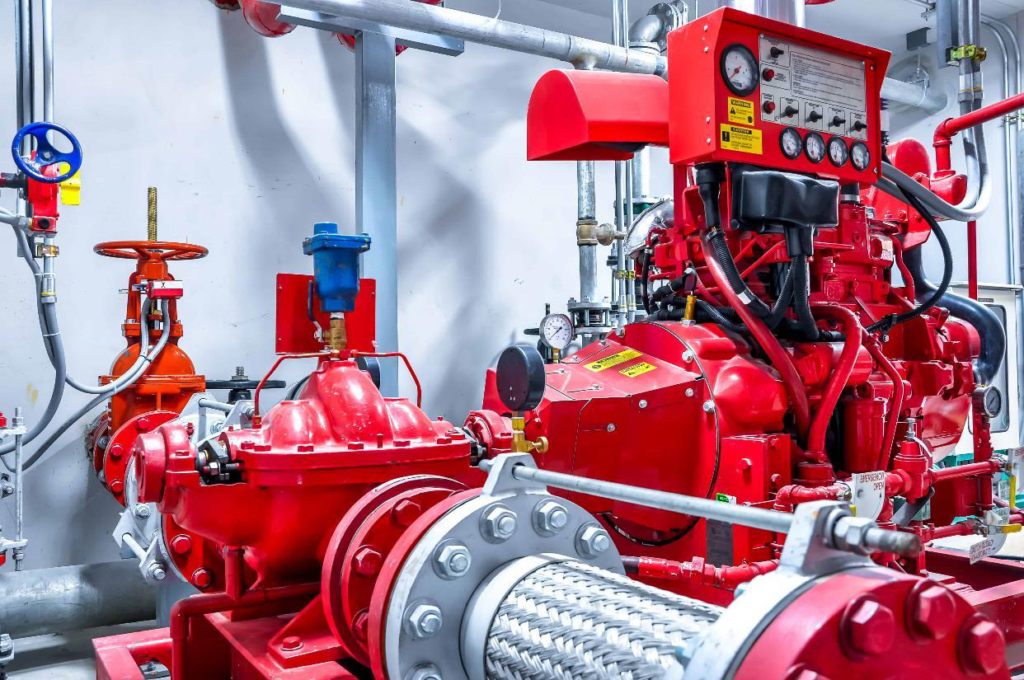
Why Fire Pump Testing Is Important in Electronics Manufacturing Facilities
Electronics manufacturing plants contain high-value production machinery, electrical installations, clean production areas and critical infrastructure. Fire-pump reliability is therefore an important part of the facility’s overall fire-protection strategy. Periodic performance testing helps determine whether the pumps can actually deliver the required flow and pressure under operating conditions, rather than merely confirming that the pump motor can start.
Fire pump performance testing can help identify:
- Reduced pump flow
- Pressure deterioration
- Mechanical wear
- Abnormal current or power consumption
- Diesel-engine problems
- Valve or piping restrictions
- Leakage
- Changes in pump performance over time
Key Outcome of the Assignment
The assessment provided quantified performance data for both electric and diesel-driven hydrant and sprinkler pumps.
All evaluated pumps were able to operate continuously during the prescribed test periods and were recorded as passing the annual fire-pump performance test.
The exercise provided documented evidence of the actual operating condition of the fire-pump system.
About Us
About Elion Technologies & Consulting
Elion Technologies & Consulting Pvt. Ltd. provides independent Fire Pump Testing Service and fire-safety engineering services for industrial, manufacturing, commercial and infrastructure facilities across India.
Annual fire pump testing
Fire pump performance testing
Fire pump flow testing
Hydrant pump testing
Sprinkler pump testing
Diesel fire pump testing
Electric fire pump testing
Jockey pump testing
Fire-water network assessment
Fire safety audit
Need Fire Pump Testing in Noida or NCR?
Elion undertakes third-party fire pump performance testing in Noida, Greater Noida, Delhi NCR and across India. Testing can include actual flow measurement, discharge pressure measurement, electrical parameters, operating-condition assessment and documented technical reporting. Contact Elion Technologies & Consulting Pvt. Ltd. for fire pump testing requirements.
FAQ
Q1. What is checked during fire pump performance testing?
The team records flow, discharge pressure, running duration, and current and power for electric pumps. For diesel pumps they also check engine operating condition. They also note noise, vibration, leakage and the general mechanical condition of each pump.
Q2. How much does fire pump testing cost in India?
For one or two pumps at an accessible metro site, an annual performance test typically costs ₹8,000–₹18,000. A full annual inspection, testing and maintenance visit covering electric, diesel and jockey pumps is commonly ₹18,000–₹40,000. Large multi-pump industrial sites are quoted individually, depending on pump count, flow-measurement method and report scope.
Q3. Why is an ultrasonic flow meter used to test fire pumps?
A clamp-on ultrasonic flow meter measures actual flow through the pipe without cutting into the line or adding a permanent flow meter. It suits sites that have no test header or in-line meter, subject to suitable pipe condition and straight-run length. The meter must be calibrated, and the pipe material and wall thickness entered correctly.
Q4. How often should fire pumps be tested in India?
NFPA 25 calls for periodic no-flow churn runs (weekly or monthly, depending on pump type and programme) and a full flow test every year. NBC 2016 Part 4 and IS 15301 require fire pumps to be kept in working order, and fire NOC renewals and insurance surveys commonly ask for current test records.
Q5. How does testing a diesel fire pump differ from an electric one?
Electric pumps are checked for motor current and power at each flow point. Diesel pumps need an engine run, battery and starting checks, and observation of engine temperature, oil pressure and speed. Both are tested for flow, discharge pressure and a continuous run, usually 10 minutes per test point.
Q6. Why does discharge pressure drop as flow increases in a fire pump test?
A centrifugal pump delivers lower pressure as flow rises, which is normal. NFPA 20 expects at least 65% of rated pressure at 150% of rated flow. Pressure that is lower than the manufacturer’s curve at the same flow can point to impeller wear, suction problems or a throttled line, so the readings should be compared with the pump curve.
Q7. What problems can a fire pump performance test find?
Typical findings are reduced flow, falling discharge pressure, mechanical wear, abnormal current or power, diesel-engine faults, valve or pipe restrictions and leakage. Finding these in a planned test means they can be corrected before a fire.