Training Coordinator, Industrial Paint Manufacturer
“The safety induction for new hires was handled smoothly. Elion brought their own AV equipment and kept the session engaging. We’re thinking of repeating this monthly.”

And Consulting Private Limited
And Consulting Private Limited
Unsafe work during maintenance, confined space entry, hot work, or electrical isolation often leads to serious incidents. A structured Permit to Work (PTW) system ensures high-risk jobs are carried out with proper controls and approvals. PTW Training enables your workforce to manage permits responsibly and prevent accidents caused by poor coordination or communication.
Elion delivers site-specific PTW system training based on the nature of your high-risk activities, permit formats, and departmental responsibilities. Whether you’re in a manufacturing unit, data center, warehouse, or construction site, the program is adapted to your processes and job types.
Participants receive a Certificate of Participation from Elion Technologies. The training complies with:
Need to improve your permit system or train new supervisors?
Request a Quote or contact us at [email protected].
“The safety induction for new hires was handled smoothly. Elion brought their own AV equipment and kept the session engaging. We’re thinking of repeating this monthly.”
“Good response from our team for the chemical spill drill and awareness session. We had a minor leak last year and this training was timely. They even explained the MSDS sheet details clearly.”
“Elion conducted ergonomics training for our office support staff. They gave tips that don’t need any budget—just posture, breaks, and seating angles. Everyone found it useful.”
“Warehouse safety training was organized at our distribution center. The module covered stacking, material flow, and emergency handling. One or two team leads found the content basic, but the newcomers appreciated it.”
“The hot work and gas cutting safety training helped us address some recent near-misses. Our fabrication contractors said it was the first time anyone explained why permits matter, not just how to fill them.”
“We held a training on ergonomics and workstation safety. Elion’s speaker had a practical approach—suggested small furniture changes and posture tips that didn’t cost much but helped our office staff.”
“Elion covered cold storage safety and ammonia handling well. Some of our technicians said it was the first time they understood how to respond to leaks. We may request them for a follow-up drill.”
“Our garment unit required machine safety awareness for new joiners. Elion kept it interactive and used visuals from our own plant, which the workers related to.”
“The crane and material handling training helped reduce near misses in our yard. The trainer also gave tips that were not in the slides, based on their field experience. That made a difference.”
“We requested a training module on emergency evacuation procedures. Elion included site-specific examples which helped. The mock drill later was well-coordinated too. Our fire wardens felt more confident after the session.”
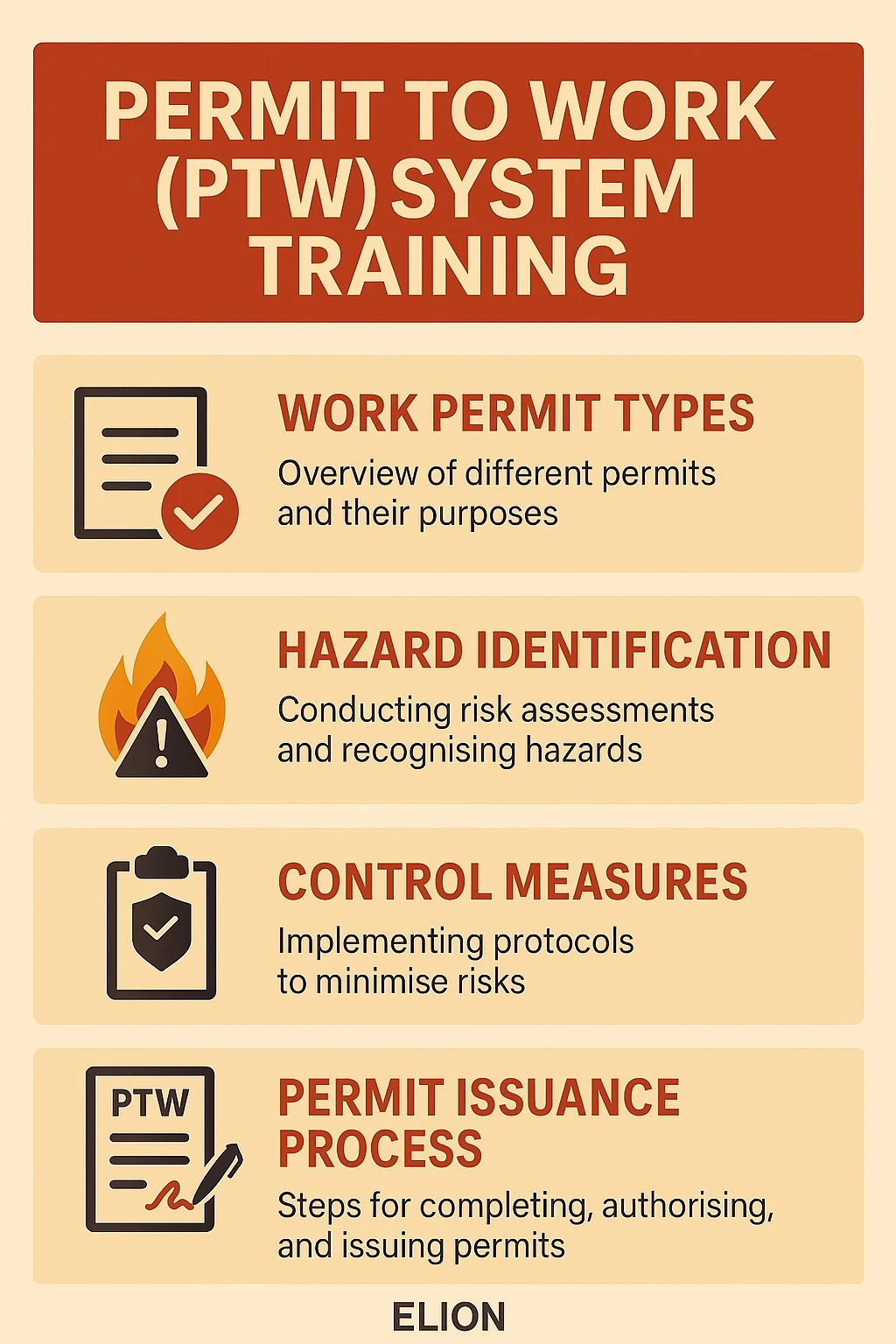
A Permit to Work (PTW) system is a formal documented procedure under which hazardous activities — hot work, electrical isolation, confined space entry, work at height, and chemical handling — are authorised and controlled before they begin. PTW systems are mandated in India under the Factories Act 1948 (Section 87), Petroleum Rules 2002, OISD Standard 105, IS 10291 (confined spaces), and IS 13818 (LOTO). A valid permit specifies the work scope, identified hazards, isolation measures applied (LOTO), PPE required, emergency procedures, authorised personnel, and time validity. Elion’s PTW training covers all permit types: Hot Work, Cold Work, Confined Space Entry, Electrical Isolation, Radiography, and Work at Height.
PTW training is mandatory for five categories: (1) Permit Issuers / Authorising Authority — managers or engineers who review and sign off permits; (2) Permit Receivers / Acceptors — supervisors and workers who accept the permit at the worksite; (3) Safety Officers — required under the Factories Act to verify hazard controls before permit issue; (4) Contractors and sub-contractor supervisors — especially in oil & gas, power, pharma, and heavy industry where contractor fatality rates are disproportionately high; (5) LOTO / Isolation personnel — those who apply physical locks, tags, and blinding. Under OISD-105 and Petroleum Rules 2002, all permit participants in petroleum installations must hold current PTW competency certification. Minimum batch size is 10; maximum is 200 in a single mobilisation.
Elion’s PTW programme covers ten topic areas: (1) Regulatory framework — Factories Act Section 87, OISD-105, OISD-117 (hot work), IS 5216 (electrical safety), Petroleum Rules 2002; (2) Permit types and their applicability — Hot Work, Cold Work, Confined Space Entry (IS 10291), Electrical Work / LOTO (IS 13818), Radiography, Work at Height (IS 3696); (3) Hazard Identification and Risk Assessment (HIRA / JSA) before permit issue; (4) Roles and responsibilities — Authorising Authority, Area Authority, Performing Authority, Safety Watch; (5) Isolation procedures — LOTO, blinding/blanking, de-energisation verification; (6) Gas testing protocols and gas-free certification; (7) Simultaneous Operations (SIMOPS) management; (8) Permit closure and post-job auditing; (9) Incident case studies from Indian industrial accidents; (10) Practical exercises — permit drafting, approval walkthrough, and scenario drills at your actual worksite.
Elion offers three formats: Foundation (Half-Day, 4 hours) — for workers who receive permits; covers permit types, responsibilities, and refusal rights. Standard (Full Day, 8 hours) — for supervisors, safety officers, and permit issuers; full curriculum including HIRA, LOTO, and permit drafting with written assessment. Advanced / Train-the-Trainer (2 Days) — for EHS managers and internal trainers; covers SIMOPS, PTW system audit, and trainer methodology with practical exercises. All programmes include a post-training assessment; certificates are valid for 3 years. Annual refresher training is recommended and required after any significant incident or PTW-related near-miss.
Yes. Participants who pass the post-training assessment (minimum 70%) receive Elion’s PTW Competency Certificate referencing OISD Standard 105. The certificate is accepted by OISD auditors, Factory Inspectors under the Factories Act, and petroleum installation HSE audits. For petroleum sector clients, certification aligns with OISD-105 Clause 7 (Training and Competency). Certificates carry the participant name, topics covered, assessment score, trainer credentials, Elion’s quality mark, and a 3-year validity date. Digital certificates with QR-code verification are provided for contractor management systems. Certificates are issued within 5 working days of training completion.
Yes — on-site delivery accounts for over 80% of Elion’s PTW training engagements and is the preferred mode. Benefits include: (1) Trainers review your existing PTW forms, permit registers, and SOPs before training and align all content to them; (2) Practical exercises are held at actual worksites — hot work areas, confined spaces, electrical substations — not in classrooms; (3) Scenario drills use your own machinery, isolation points, and gas-testing equipment; (4) Post-training debrief identifies gaps in your current PTW system against OISD-105 / Factories Act requirements; (5) Flexible group sizes — 10 to 200 participants per mobilisation. Elion has delivered on-site PTW training at refineries, power plants, pharmaceutical facilities, cement plants, and heavy engineering units across India.
Training is delivered in English, Hindi, Marathi, Tamil, Telugu, Kannada, and Gujarati. All training materials — permit templates, case study booklets, and assessment papers — are localised into the chosen language. Trainers are native speakers and industry-experienced for each region. Bilingual delivery (e.g., English instruction with Hindi materials) is available for multilingual workforces, which is common in pan-India plant operations. Language selection is confirmed at booking; custom translations for specialised terminology can be arranged with 2 weeks’ notice at no extra charge.
Yes — Elion customises every PTW programme to your industry, hazard profile, and existing permit system. Customisation includes: (1) Incorporating your current PTW forms, approval hierarchy, and permit numbering system; (2) Adding industry-specific permit types (Excavation Permit for construction, Diving Permit for offshore, Vehicle Entry Permit for explosive storage zones); (3) Case studies drawn from incidents in your sector — oil & gas, power, pharma, chemicals, or steel; (4) Role-play exercises mapped to your organisational structure; (5) A PTW system gap-analysis report benchmarked against OISD-105 / Factories Act, delivered post-training; (6) Assessment difficulty calibrated to your site risk level and regulatory obligation. Scope is agreed in a pre-training consultation call at no extra cost.
Fields marked with an asterisk (*) are required
Power transmission systems serve as the backbone of modern electrical infrastructure, enabling the efficient transfer of electricity from generation sources to end-users. These systems encompass a vast network of components, including transmission lines, substations, transformers, and distribution networks. As we delve into the intricacies of power transmission, we recognize that…
Industrial safety training is a crucial aspect of any workplace, as it helps to ensure the safety and well-being of employees. It is essential for employers to understand the importance of providing comprehensive safety training to their workers in order to prevent accidents, injuries, and even fatalities. By investing in…
Elion’s Safety Training Program is a comprehensive initiative designed to enhance workplace safety and compliance across various sectors, particularly in high-risk environments such as IT parks. The program is rooted in the belief that a proactive approach to safety not only protects employees but also fosters a culture of responsibility…
Safety training for factory workers is of utmost importance as it ensures the well-being of employees and the smooth operation of the factory. Factory environments are often filled with potential hazards, from heavy machinery to chemical exposure, and it is crucial for workers to be equipped with the knowledge and…
Hazard and Operability Studies (HAZOP) are a critical component of any workplace safety program. These studies are designed to identify potential hazards and operational issues that could pose a risk to employees, equipment, and the environment. By conducting a thorough HAZOP study, organizations can proactively identify and address potential risks…
Employee safety awareness training is a crucial aspect of any organization’s operations. It is essential for employees to be aware of potential hazards in the workplace and to know how to prevent accidents and injuries. By providing comprehensive safety awareness training, employers can ensure that their employees are equipped with…
Elion Technologies and consulting Mock Drill Training is a critical initiative designed to improve safety protocols and operational efficiency in warehouse environments. In warehouses, where accident risks are significant, mock drills serve as preventative measures to prepare staff for actual emergencies. The program simulates emergency scenarios, enabling employees to practice…
Vadodara, a prominent city in the Indian state of Gujarat, is known for its industrial prowess, particularly in the chemical sector. The chemical factory located in this region plays a pivotal role in the local economy, contributing significantly to employment and technological advancement. This facility specializes in the production of…
Behavioral safety training is a proactive approach to workplace safety that focuses on changing employee behaviors to reduce the risk of accidents and injuries. This type of training is based on the idea that most workplace accidents are caused by unsafe behaviors rather than unsafe conditions, and that by addressing…
Construction sites are inherently hazardous environments, where the risk of accidents and injuries is significantly higher than in many other industries. The importance of safety training in this context cannot be overstated. Effective safety training equips workers with the knowledge and skills necessary to identify potential hazards, understand safety protocols,…