
Arc flash labels are the final deliverable of an arc flash study — the physical warning interface that communicates calculated hazard information to every worker who opens an electrical panel, enabling them to select correct PPE before exposure. In India, arc flash labelling is required under IS 5216:2010 and referenced in the Indian Electricity Rules 1956, and is mandated by NFPA 70E Section 130.5(H) — widely adopted by Indian industry — which states that all electrical equipment shall be field marked with arc flash hazard information before any worker is permitted to perform live work on it.
An unlabelled panel is not a minor compliance gap — it is evidence that no arc flash study has been conducted and no PPE analysis has been performed, leaving workers to guess their protection requirements. The National Safety Council India’s electrical incident database shows that 73% of arc flash fatalities in Indian industry occurred at unlabelled electrical equipment where workers either used no PPE or used incorrect PPE categories because no calculated hazard information was available. The label transforms an engineering calculation result into a life-saving field instruction.
Labels must comply with specific content requirements: NFPA 70E 2021 requires arc flash labels to display the available incident energy and working distance (in cal/cm²), PPE category (CAT 1–4), minimum arc rating of required PPE (cal/cm²), arc flash boundary, nominal system voltage, and the approach boundaries (limited and restricted approach). Labels generated from IEEE 1584-2018 calculations must specify the exact working distance used in the calculation — any closer working distance invalidates the PPE specification. In Indian monsoon conditions, labels must be rated for the ambient humidity and temperature range of the specific installation location.
Arc flash labels must display: incident energy in cal/cm², working distance, PPE category (CAT 1–4), minimum arc-rated PPE required, arc flash boundary distance, system voltage, and approach boundaries. Mandatory per NFPA 70E Section 130.5(H) and IS 5216:2010. Labels must be generated from IEEE 1584-2018 calculations — hand-estimated or generic danger labels do not satisfy the standard. Replace every 5 years or when electrical system changes.
Understanding the dangers of arc flash incidents
Arc flash incidents occur when an electrical current jumps from one conductor to another or to ground, creating a powerful explosion of heat and light. These incidents can happen due to a variety of factors, including equipment failure, human error, or improper maintenance.
The consequences of arc flash incidents can be severe. The intense heat generated during an arc flash can cause severe burns, blindness, and even death. In addition to the physical injuries, arc flash incidents can also result in property damage, production downtime, and costly lawsuits.
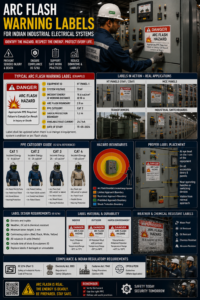
A compliant arc flash label generated from IEEE 1584-2018 calculations — showing incident energy, working distance, PPE category, and arc flash boundary — provides the specific, calculated hazard information that workers need to select correct PPE before opening this 415V distribution panel in an Indian manufacturing facility.
The role of arc flash labels in workplace safety
Arc flash labels play a critical role in preventing workplace accidents by providing workers with essential information about the potential hazards associated with electrical equipment. By clearly indicating the incident energy level and the required PPE, these labels help workers make informed decisions about how to safely work on or near the equipment.
Proper labeling is essential for maintaining workplace safety. Without clear and accurate arc flash labels, workers may not be aware of the potential dangers they face when working with electrical equipment. This lack of awareness can lead to accidents and injuries.
Compliance requirements for arc flash labeling
There are several regulations and standards that require arc flash labeling in the workplace. The Occupational Safety and Health Administration (OSHA) requires employers to provide a safe working environment for their employees, which includes properly labeling electrical equipment.
In addition to OSHA, the National Fire Protection Association (NFPA) has established standards for arc flash labeling. The NFPA 70E standard provides guidelines for electrical safety in the workplace, including requirements for arc flash labeling.
Non-compliance with these regulations can have serious consequences. Employers who fail to properly label electrical equipment may face fines, penalties, and legal action in the event of an accident or injury.
How to create effective arc flash labels
Creating clear and effective arc flash labels is essential for maintaining workplace safety. Here are some tips for creating effective labels:
1. Use clear and concise language: Avoid technical jargon and use simple language that is easy to understand.
2. Include all necessary information: Make sure to include the incident energy level, the arc flash boundary, and the required PPE on the label.
3. Use visual cues: Incorporate symbols or pictograms to help convey important information quickly and easily.
4. Ensure visibility: Make sure the labels are easily visible and legible, even from a distance.
Best practices for maintaining arc flash labels
Proper maintenance of arc flash labels is crucial for ensuring their effectiveness. Here are some best practices for maintaining these labels:
1. Regular inspections: Inspect the labels regularly to ensure they are still visible and legible. Replace any labels that have become faded or damaged.
2. Updates as needed: If there are any changes to the equipment or its associated hazards, update the labels accordingly.
3. Training for employees: Train employees on the importance of arc flash labels and how to properly interpret and use them.
Training employees on arc flash label awareness
Training employees on arc flash label awareness is essential for maintaining workplace safety. Here are some tips for effectively training employees:
1. Provide comprehensive training: Ensure that all employees receive thorough training on arc flash labels and their importance.
2. Use real-life examples: Incorporate real-life examples of arc flash incidents to help employees understand the potential dangers.
3. Hands-on training: Provide hands-on training opportunities where employees can practice using PPE and following safety procedures.
Common misconceptions about arc flash labels
There are several common misconceptions about arc flash labels that can lead to misunderstandings and potential safety hazards. Here are a few of these misconceptions:
1. “Arc flash labels are only for electricians”: Arc flash labels are not just for electricians. They are important for anyone who works with or near electrical equipment.
2. “Arc flash labels are not necessary if I’m wearing PPE”: While wearing PPE is important, arc flash labels provide additional information about the potential hazards and help workers make informed decisions.
3. “Arc flash labels are only required in certain industries”: Arc flash labeling requirements apply to a wide range of industries, not just specific ones.
The cost of non-compliance with arc flash labeling regulations
Non-compliance with arc flash labeling regulations can have significant financial and legal consequences. Employers who fail to properly label electrical equipment may face fines, penalties, and legal action in the event of an accident or injury.
In addition to the financial costs, non-compliance can also result in reputational damage and loss of business. Customers and clients may be hesitant to work with companies that do not prioritize workplace safety.
The future of arc flash labeling and safety standards
The field of arc flash labeling and safety standards is constantly evolving. As technology advances and new research emerges, it is important to stay up-to-date on the latest developments in order to maintain workplace safety.
It is likely that future developments will focus on improving the clarity and effectiveness of arc flash labels, as well as incorporating new technologies to enhance safety measures.
Arc flash labels play a crucial role in maintaining workplace safety. By providing workers with important information about the potential hazards associated with electrical equipment, these labels help prevent accidents and injuries. It is essential for employers to prioritize proper arc flash labeling and workplace safety practices to ensure the well-being of their employees and the success of their business.
If you’re interested in learning more about the importance of arc flash labels and how they contribute to fire safety, you may find this related article on common fire safety audit findings and how to address them quite informative. The article discusses various aspects of fire safety audits and provides valuable insights on addressing common findings. It’s a great resource for understanding the significance of proper labeling in preventing arc flash incidents. Check it out here.
Frequently Asked Questions (FAQs)
1. What information should an arc flash label contain?
An arc flash label should provide important safety information for workers before opening or working on electrical panels.
A proper label usually includes:
- Incident energy value (cal/cm²)
- PPE category or required arc rating
- Arc flash boundary distance
- System voltage
- Working distance
- Study date
These details help workers select the correct PPE and maintain safe working distance.
2. Where should arc flash labels be placed on electrical equipment?
Arc flash labels should be placed:
- On the front of electrical panels
- On switchboards and MCC panels
- Near areas where live electrical work may happen
- In a visible location before opening the panel
The label should be easy to read before anyone accesses energized equipment.
3. How long are arc flash labels valid?
Arc flash labels are usually reviewed every 5 years.
They should also be updated when:
- New electrical equipment is added
- Transformer or breaker settings change
- System load changes significantly
- Electrical modifications are made
Damaged or faded labels should be replaced immediately.
4. What is the difference between an arc flash label and a normal electrical warning label?
A normal electrical warning label only warns about electrical danger.
An arc flash label gives detailed safety information such as:
- Incident energy level
- PPE requirements
- Arc flash boundary
- Safe working distance
5. What type of material should be used for arc flash labels in industries?
Arc flash labels should be durable and resistant to industrial conditions.
Common materials include:
- Polyester labels
- Polycarbonate labels
- Vinyl labels
- Aluminium or stainless steel labels for outdoor areas